You know when you're trying to talk to someone at a gig, or somewhere very loud? You can't quite hear what they're saying, but you're too polite to say "I can't hear you" for the third time. That's how your playing sounds if your string muting isn't sorted.
Here's how to fix it: a job for each hand, an exercise based on the way Nile Rodgers learned it, and two technical points that make it easier.
String muting is a multiplier ▶ 0:37
String muting is a multiplier. It doesn't change how you play, but it does change how you sound: everything you can already do sounds clearer. It will expose your mistakes too, but you need to hear those in order to fix them.
Think of the dishwasher. You put it on in the other room and forget it's running. Then it switches off, the room is suddenly very quiet, and your head clears. That's what good muting does for your playing. Dishwashers are rather dull, I know, but I think the comparison holds.
How Nile Rodgers learned to mute ▶ 1:17
When Nile Rodgers started out, he was playing pop songs on a jazz guitar. The guitarist in the band opening for his wasn't the most remarkable player, yet he sounded far better than Nile, even through Nile's own amp. He was playing a Fender Stratocaster, so Nile bought one, then realised he wasn't really a Strat player. That's what started him learning to mute the strings, and it's where his distinctive sound came from. (He tells the story himself in his foreword to Fender's book Stratocaster: 70 Years.)
Where the extra noise comes from ▶ 1:48
Whenever you play one string, the others start to vibrate and ring. This is called sympathetic resonance, and some of it is simply the instrument itself vibrating.
Try this: play the 5th fret on the low E, then stop it with your thumb. You'll still hear some noise, mostly from the A string. The 5th fret on the low E is an A, so the open A string rings along with it.
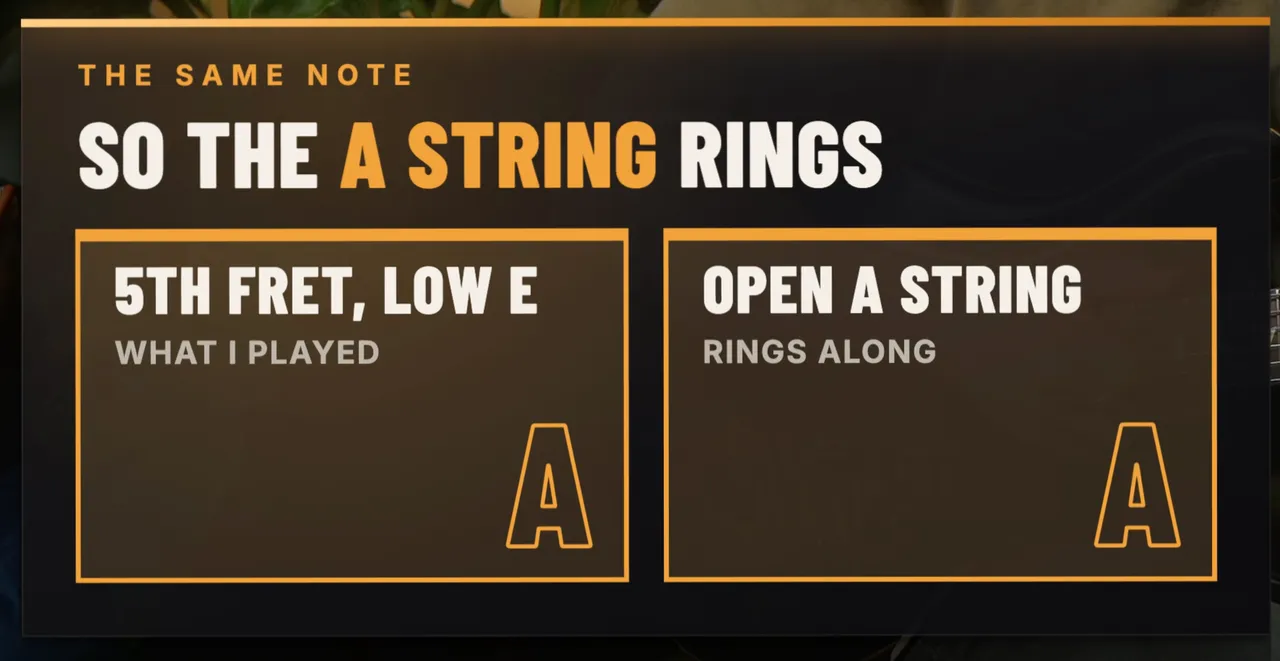
On top of that, lifting your fretting hand off can set a few of the open strings ringing. Those are the things to fix, and each hand takes care of its own side.
Right hand: the palm follows you down the strings ▶ 2:41
I'll use a C sharp minor pentatonic from the 9th fret for all of this. Play it all the way through, and at the end nothing should be ringing.
As you play each string and move on to the next, your picking hand covers the ones you've just left:
- Play the low E. As you move onto the A string, your palm comes to rest on the low E.
- On the D string, it's covering the A and the low E.
- By the B string, it's covering the low E, A, D and G.
- On the high e, the base of your palm is muting all the others.

Press gently. You needn't be meticulous about where the palm lands, because you aren't picking those strings; they only need covering. Use the base of the palm rather than the outer, karate-chop edge you'd use for chugging metal palm muting, which produces a different sound.
Left hand: the inside of the first finger ▶ 3:36
The first note of the scale is the 9th fret on the low E, and the other five strings mustn't ring. That's the left hand's job: I mute all of them with the inside of my first finger. In theory, then, you can strike all six strings with no right-hand muting at all, and the only thing that comes through is that C sharp.
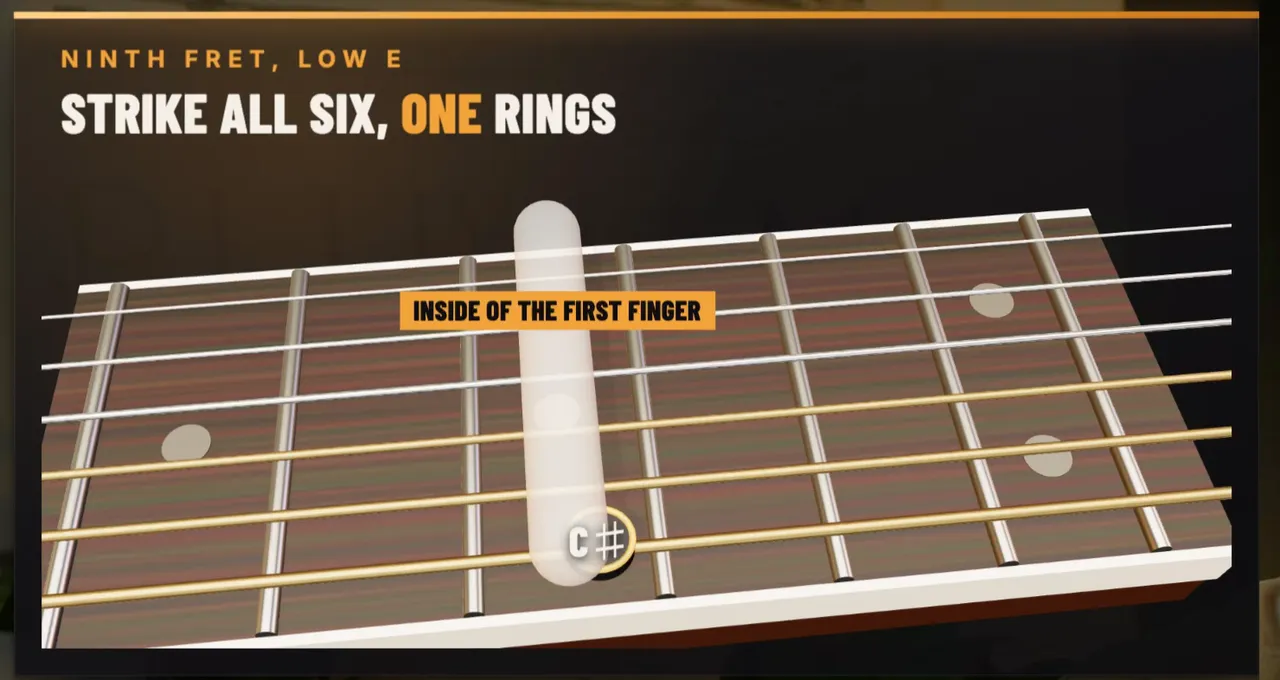
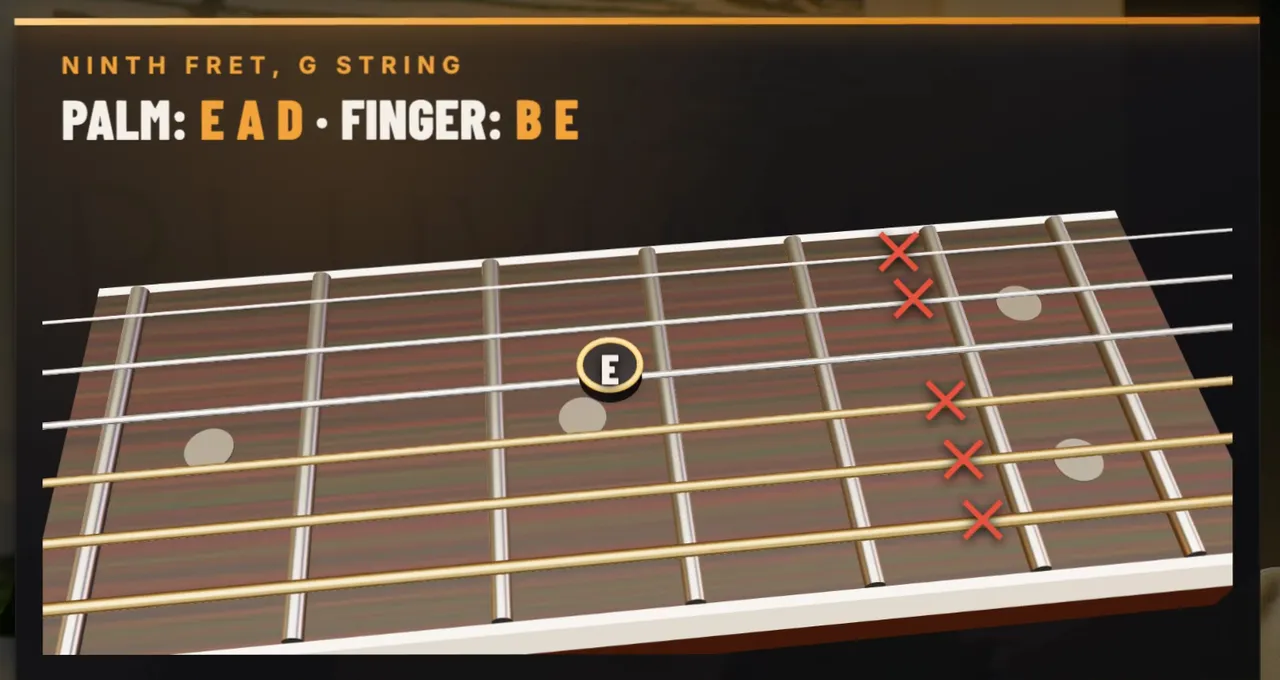
Through the rest of the scale, the hands share the work. On the 9th fret of the G string, the first finger is muting only the B and high e, while the palm covers the low E, A and D. The G string is the only one that can ring.
The chucking exercise: groups of four and three ▶ 5:05
Back to Nile Rodgers. He worked on a technique called chucking: constant 16th notes, "one e and a two e and a", with his left hand deciding which notes came through. It's all string muting, and it's the source of that iconic sound. Here it is as a simple exercise:
- Take any scale you know and play it in order. I used the same C sharp minor pentatonic.
- Downstrokes only, hitting as many strings either side of the target note as you can.
- Make sure they're all muted, so that only the target note sounds. Do it slowly.
I let the low E ring a little when I did it, so I'm not perfect. You'd probably guessed that already.
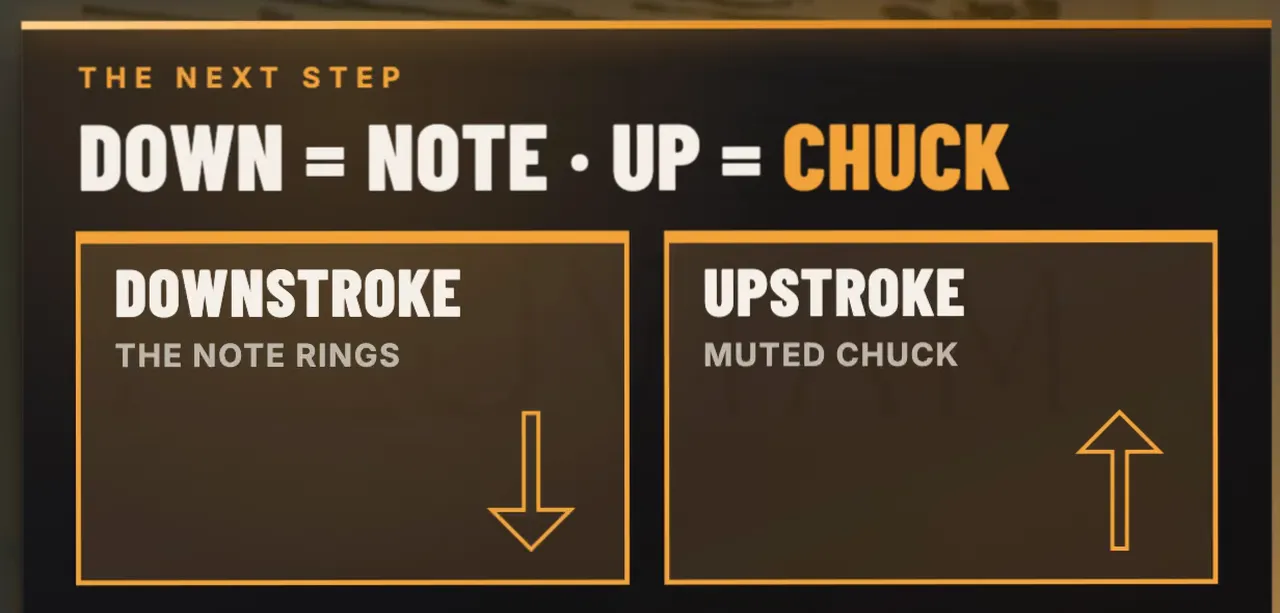
Next, add a chuck: down on the note, up with a muted chuck. Then reverse it to work on your upstroke: down with the chuck, up on the note.
One more thing. From the A string onwards, I also use the tip of my first finger, sometimes the second or third, to mute the next thicker string, because the palm doesn't always quite cover it, particularly when you're moving fast. On the 9th fret of the G string, the tip of my first finger touches the D string. On the 11th fret of the G, the tip of my second finger does.
For more funk and more of a test, try groups of four: the note, then three chucks, "one, chuck, chuck, chuck, two, chuck, chuck, chuck", up the scale and back. Then try groups of three. Your right hand keeps moving down and up through the 16ths, so the melody note alternates between a downstroke and an upstroke.
Two technical points: drop the elbow, angle the fingers ▶ 7:45
Right hand: drop from the elbow. As you move across towards the high e, don't simply turn the wrist to get there. Drop the elbow, so that the pick stays at a consistent angle to the strings and your palm covers them evenly. Turning the wrist leaves you at an awkward angle, with a lot of tension. You may need to tilt the picking hand ever so slightly away so that you don't mute the string you're playing.
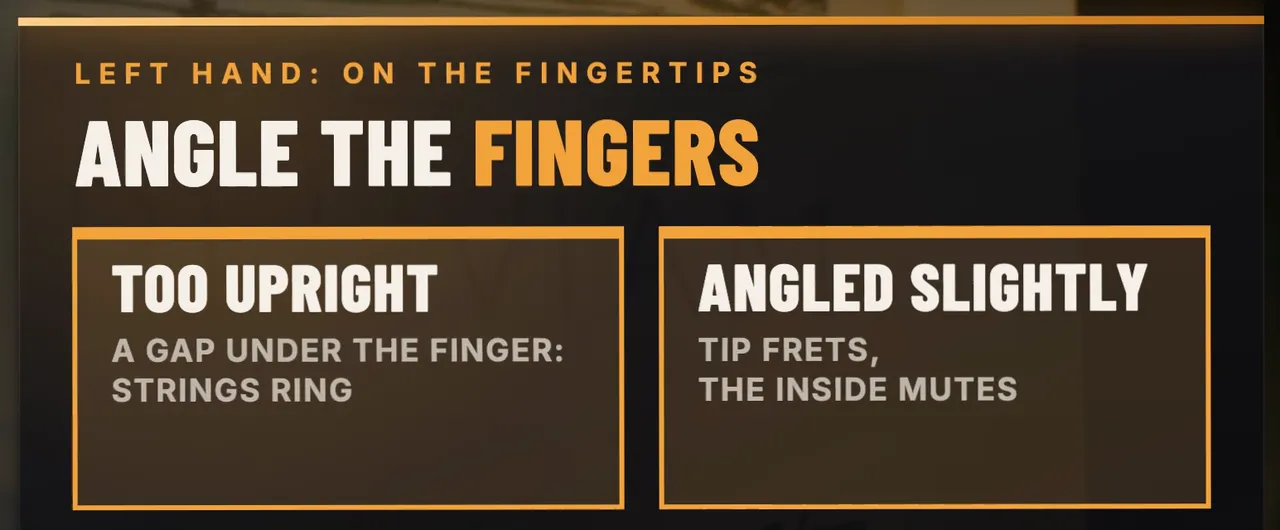
Left hand: angle the fingers slightly. You need to be on your fingertips. But if your fingers are too upright against the fretboard, you have to curl them to get there, and that leaves space underneath for the strings to ring. Play the 9th fret on the A string with a curled, upright finger and the other strings all ring out. Angle the fingers slightly and it becomes easier, and you can relax more, which helps with tension too.
Riffs to practise, and why gain makes it matter more ▶ 9:10
Once your muting is sorted, you can play riffs such as Le Freak by Chic and Can't Stop by Red Hot Chili Peppers. Nile spent a few weeks working on his chucking and, lo and behold, became the Nile Rodgers we know today. You won't become Nile Rodgers overnight, but work through the exercises properly, choose a few riffs like those two, and you'll be well on your way to much cleaner playing.
This applies whether you like funk or not. If you love rock or metal, it matters even more, because you have that much more overdrive to tame. Eddie Van Halen and Dimebag Darrell were phenomenally good at muting: so much gain, and yet it sounds so clean.
There's another story, about Billy Corgan, I think, struggling to play through Van Halen's rig because there was too much gain and Corgan's muting wasn't at Van Halen's level. Fair enough. If you're beaten by him, you've been beaten by the best, so there's no shame in it.
Our dishwasher is turned off and we're sounding nice and clean.
You'll make plenty of mistakes when you start on this, and that's fine. Take one scale, slowly, downstrokes only, hitting the strings either side of each note until only that note comes through. Then add the chuck, reverse it, and try groups of four and three. A slow metronome keeps the 16ths steady, and a funky track from the Backing Track Creator gives you something to chuck along to. Give it a few weeks, then take it into Le Freak or Can't Stop.
Make it easier: use only the low E, A and D strings of the scale, downstrokes only, and check after every note that nothing but the target note is ringing.
Make it harder: play the whole scale in groups of three, so the melody note alternates between downstroke and upstroke, and keep every other string silent throughout.


