Barre chords getting you down? For this one I went through everything from my own teaching and a load of other people's lessons, so you're getting a lot of people's ideas, plus where I think they're right and wrong. You won't be able to do it all at once. Take two or three points that really help and work on them one at a time.
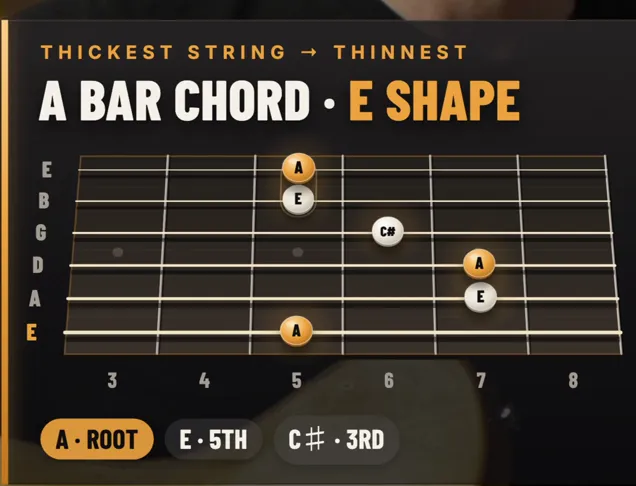
All the way through, we're using the E-shape barre chord at the 5th fret, which is an A chord. From the low E string to the high e, that's frets 5, 7, 7, 6, 5, 5.
Tension and progress you can't hear yet ▶ 1:00
The main complaint I see is thumb pain, tension or getting tired quickly. But a bit of fatigue or very mild aching at the base of the thumb doesn't necessarily mean you're doing anything wrong. Your muscles might just not be used to it yet.
For perspective, I mainly play electric, and if I play an acoustic for a few days in a row I get a bit tired playing barre chords, even though I can play them pretty consistently. So don't beat yourself up thinking you're missing a technique. It might just be repetition you need.
Whether you're pressing 0% enough or 60% enough, it sounds the same: dead. Only the last 90 to 100% of pressure makes the note ring. So you might be improving without hearing it yet. I'll never forget one of my students getting his first barre chord, with a lot of expletives and a lot of surprise. It just came out of nowhere.
Don't wrestle with the chord ▶ 3:09
Place the chord down, make a quick adjustment if you have to, then test it one string at a time. If something's wrong, give it one attempt to fix it. If that doesn't work, take the chord off and start again.
Holding a chord is one thing. Getting to it at speed in a song is another, so practise placing it. If it takes you more than 10 seconds to fix, let go and have another go.
You're not barring every string ▶ 4:07
A lot of people don't realise that most of the time you're not really barring all six strings. On that A barre chord, the only notes the barre actually has to hold are on the two highest strings, the B and high e. Get rid of those and play the first four strings, and there's not really any barring at all.
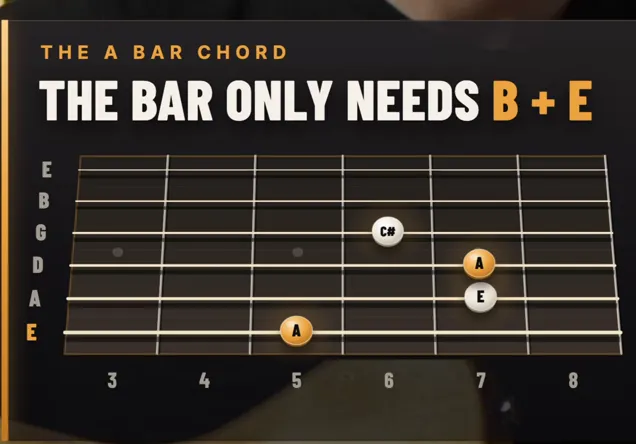
So the pressure only needs to go through the bottom crease of your first finger. With the minor shape (5, 7, 7, 5, 5, 5) the barre covers the three highest strings, but you still don't need to press through the A, D and G.
Move the minor shape over to the A string and you've got D minor, where the barre only plays the high e. Drop that string and there's no barre at all.
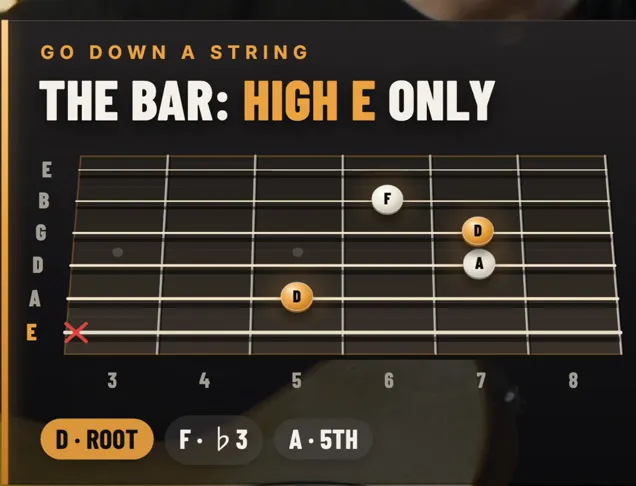
So, being realistic: if one barre chord is holding you up in a song, play those four strings and mute the B and high e with your first finger just touching them. Loads of songs do this on purpose, and an open D chord is only four strings anyway. Work on the full chord for sure, but play it like this for now.
Where the pressure comes from: thumb, first finger and elbow ▶ 6:14
A couple of things help get pressure onto those higher strings:
- Flex the first finger backwards slightly.
- Press the tip of your thumb towards the base of your first finger, not towards the fingertip like you would for a single note. That's the sensation you're after.
- Get the first finger right next to the fret wire. Going further back, or at an angle, makes it harder. One way is to place the finger almost on the fret wire, then roll it slightly onto the bony edge and move back just enough to come off the wire. You're on a bit of a knife edge, and the other three fingers should go on more easily after that.
There's one tip I've seen that I have a bit of a problem with: pushing the first finger higher up so the fattier pad at its base presses the B and high e instead of the crease. It might help. But it doesn't work for barre chords on the A string, because you'd be holding down the low E, which you'd normally mute with the tip of the first finger. That's why I prefer the place-and-roll idea, which works across different shapes.
You don't need as much thumb tension as you might think. I can hold a barre chord without my thumb at all, using my body as a fulcrum: pushing in with the elbow and pulling back with the arm.
I can also take the elbow off and play it with just the thumb. You should be able to do both, and if you're struggling, a little pull with the elbow on top of the thumb pressure you're already using might be all it takes.
Wrist angle, thumb and palm position ▶ 8:44
The curvature of your wrist makes a massive difference. If your wrist is bent right over, it's much harder to put pressure through. A few ways to fix it:
- Play higher up the neck. An F at the 1st fret makes the wrist angle a bit. Up around the 7th fret, which I think might be the easiest, my wrist is almost straight in line with the chord.
- Sit with the guitar a bit flatter against you and pull your elbow back, or use classical position. People say you should always play in classical position. You probably should, but I'm not going to bother.
- Don't just push your elbow out. Try it and you'll find it's really hard to press through the first finger.
My thumb is usually around the middle of the back of the neck, between the first and second fingers. Too high and the fingers curve in. Too low, with the wrist pushed forward, and the base of the first finger comes away from the strings.
Keep your palm close to the neck too. Start with your palm touching the underside, curl the fingers into the shape without pressing, then move away only as much as you need. For me that's about half a centimetre, just enough not to block the high e.
Make the guitar easier: detune and get a setup ▶ 11:08
You can start easier by detuning, to E flat standard, D standard or even lower. That lowers the string tension. To play along with songs, put a capo one fret higher for every semitone down: 1st fret for E flat standard, 2nd for D standard. As you get comfortable, move it down or take it off. The guitar tuner and the half-step down tuning page will help with this.
Also make sure the guitar is set up nicely: action not too high, not too much neck relief, no fret buzz, and maybe thinner strings. If you're not sure, ask a guitar shop or a good player you trust how it feels. If they say it's hard to play, a setup from a luthier is not normally too expensive and helps with loads of other things too.
Building the chord, and a thumb-over alternative ▶ 13:22
I almost always advise putting fingers 3, 4 and then 2 down first, then the first finger. It feels counterintuitive, but once those three are down, the first finger just drops on, so you're speeding up the weakest link.
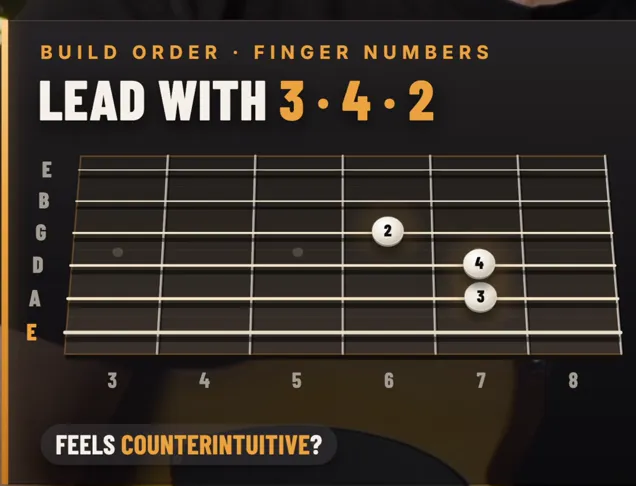
Those three fingers also need to be really arched, especially the top joint, which most of my students underestimate. Keeping your palm close to the neck helps. Let it drift away and the little finger especially straightens out.
For an alternative, take the open F shape and move it up to the frets of your barre chord, so for the A chord that's frets 5, 6 and 7. Then put your thumb over the top of the neck to hold the low E note that would have been your barre. The A string gets muted by the inside of your thumb.
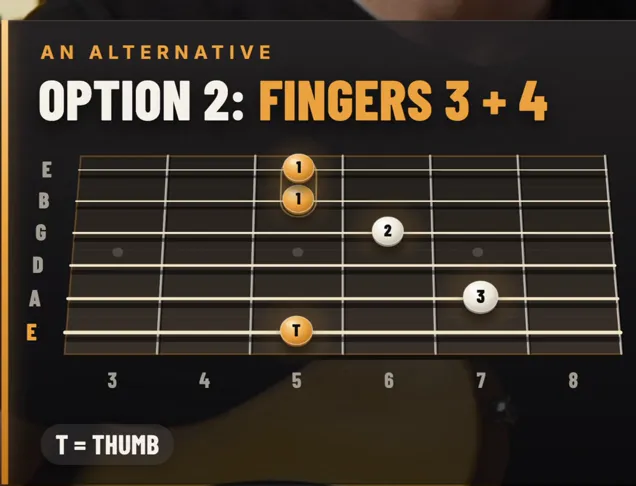
Or move the third finger up to the A string and put the little finger where the third finger was, for the full chord. The thumb-over version is quite cool because it frees you up to add extra notes.
Changing chords, and songs to practise with ▶ 15:39
When you're changing to a barre chord, look for a finger the two chords share. A common one is E major to C sharp minor, as in Where Is My Mind by the Pixies. Your third finger can stay on the D string.
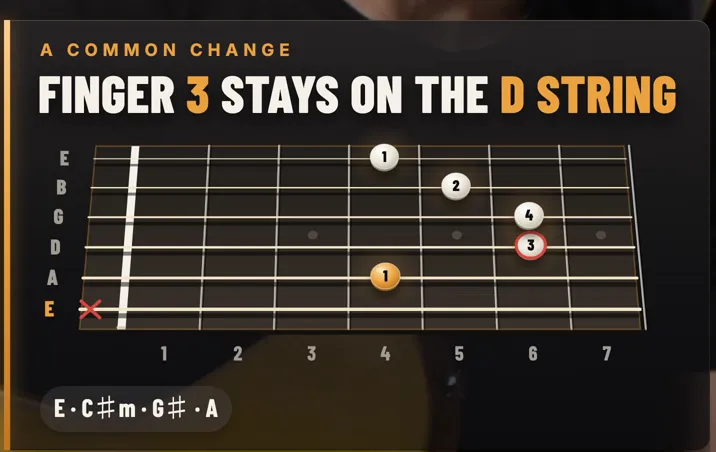
Pivoting around that finger forces you into the build order above. Practise it both ways, E to C sharp minor and back again.
Beyond that, you just have to play loads of songs with barre chords in them. A few good ones:
- Where Is My Mind by the Pixies.
- Wicked Game by Chris Isaak. There's just one barre chord, B minor, then A and E, and that's pretty much the whole song.
- Married With Children by Oasis, a similar one.
- Creep by Radiohead, if you want more consistent barre chords: G, B, C and C minor.
Pick two or three tips that sound like your problem, work on them one at a time, and play one of those songs. To check a shape, use the chord finder.


