Most guitarists I know, myself included, have at some point tried to piece the fretboard together like a jigsaw: learn a handful of scale shapes, then try to sew them together. The trouble is that nothing gives those shapes any meaning, and with no reason to remember them, they're hard to hold on to and harder still to connect.
This exercise comes at it from a different angle. It suits you if you know one or two shapes and feel stuck, and works even if you know none. You need two notes, a backing track and your ears.
Stay in one key, and take a different route to work ▶ 1:24
I use E minor here, but any key works. Whichever you choose, stay with it for now as a master key (pun intended): the point is to learn how its notes and shapes connect, and that's much harder if you keep changing keys. Branch out once you feel you're making progress.
You could learn the five shapes of E minor one at a time. That isn't a waste of time, but it gets repetitive, and it's hard to see how they join up. It's like taking the same route to work every day: fine until you go off track, and then, if you're anything like me, you're lost. On guitar, that's stepping out of pentatonic box one.
Metaphorically speaking, we're going to take a different route to work each day.
Pick two notes at opposite ends of the neck ▶ 2:16
Choose one low note and one high one. In E minor I use the open low E string and the 12th fret of the high e string, both E, two octaves apart.
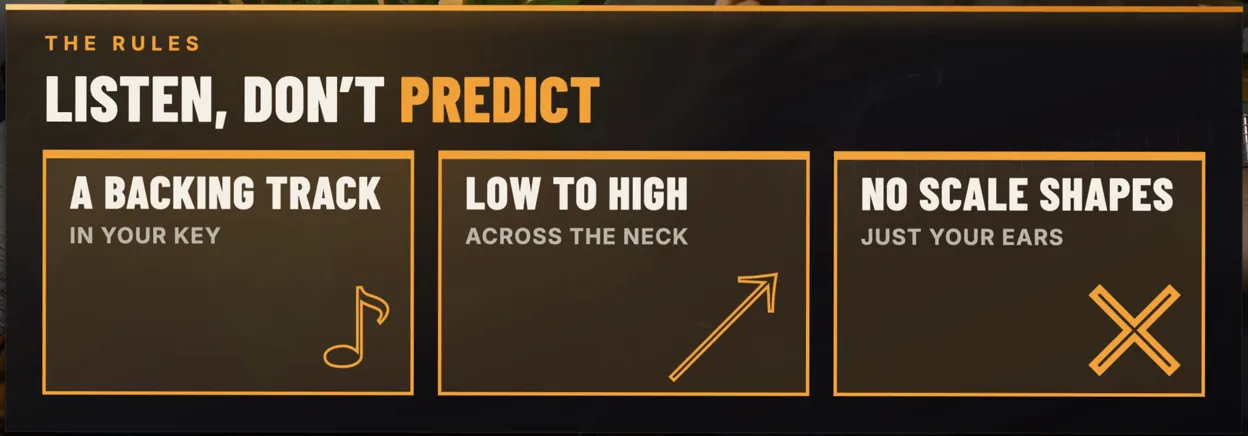
Put on a backing track in E minor, from the Backing Track Creator on my site or any E minor track on YouTube. Then find your way from the lowest note to the highest in any way you can, using only your ears. Start low, finish high, and follow what sounds right.
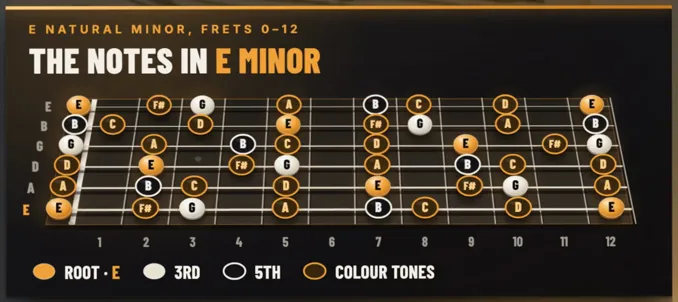
It helps to know which notes you're looking for. E minor contains E, F#, G, A, B, C and D (the E minor scale page has the full reference). For another key, open the Fretboard Navigator, choose the key, and find its lowest note on the low E string and a reasonably high one on the high e.
Finding the route by ear: my first attempt ▶ 3:53
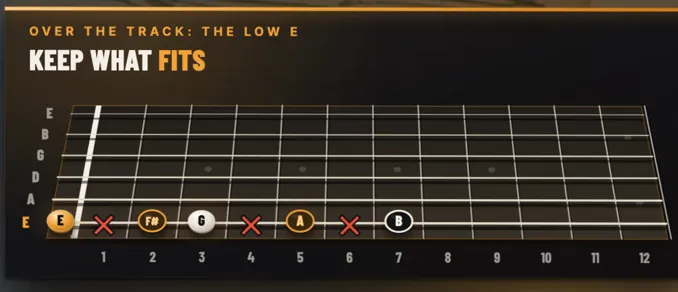
Work up the neck a little at a time, testing notes over the track. On the low E, the open string obviously works. The 1st fret didn't fit, the 2nd sounded odd at first but does work, and the 6th was interesting, but no. That left the open string and frets 2, 3, 5 and 7.
Then I changed string. The 7th fret on the A sounded good. On the D string, the 8th fret didn't work, the 7th did, and I jumped to the 9th, then carried on up to the 12th.
That put me at the 12th fret on the D, with three strings still to cross; I should have crossed sooner. So I went back to the 10th fret of the D and tried the G string: its 10th fret didn't work, the 9th did. A few more tries on the B and high e took me to the 12th fret of the high e.
The finished route: the open low E, then frets 2, 3, 5 and 7 on the low E; the 7th fret on the A; frets 7, 9 and 10 on the D; the 9th on the G; frets 8 and 10 on the B; and frets 8, 10 and 12 on the high e. It sounds good, although it's hard to play.

Come back down, then make it musical ▶ 7:35
If you can, come back down the way you went up. Mine wasn't identical to the way up, and that's normal. If you reach the top and don't know the way back, good: you'll have to think harder, and that's where the exercise does its work. You can also write down what works as you go: 2nd fret, 3rd fret, both worked.
What helps memory most is emotion, tying the moment to something other than numbers, strings and dots. So improvise. Nothing flashy; make an interesting phrase out of the mishmash of notes you've found, up and back down. That ties what your hands do to something more meaningful than running up and down a scale, and when you improvise, you won't fall back on the scale in order.
A different route every day ▶ 9:35
Tomorrow, or whenever you next practise this, pick a different route. My first ran diagonally from the bottom of the neck to the top. Some alternatives:
- Stay in one area of the neck and work across most of the strings there, then travel along the last one or two strings up to the high note.
- The opposite: travel a long way along the low E, then cross the strings higher up the neck.
- Double back on yourself, as if there were roadworks on the usual way.
Meander rather than taking a straight line: the more interesting the route, the more memorable it is.
Connect your route to the scale shapes ▶ 10:45
Once you've done this, learn your scale shapes formally, as you normally would. Now they have something to connect to. When I play position 3 of the E minor scale, I recognise the 5th and 7th frets on the low E and the 7th fret on the A from my route. The 8th fret on the high e is there too: in the shape I play it with my little finger, whereas on the route I used my first finger.
The shapes give you the map; the routes give you a far more interesting way around it.
Stay in one key for now. It needn't be E minor, though I think it's a good, common choice; A minor, B minor, F# minor and C# minor are other common keys.
Wrong notes, and the two intervals to learn ▶ 12:01
Some notes are technically wrong yet don't sound bad. Don't worry about those yet; learning your shapes formally will iron them out.
Ear training develops this too. My ear trainer is free on my site, and the most important thing to learn first is the sound of a minor second (one fret) and a major second (two frets). It matters for your musicality whatever you play.
If you do hit a wrong note, don't panic: moving up or down one fret will very likely put you on a right one. On my low E, the 6th fret didn't work, while the 5th (A) and the 7th (B) either side of it did.
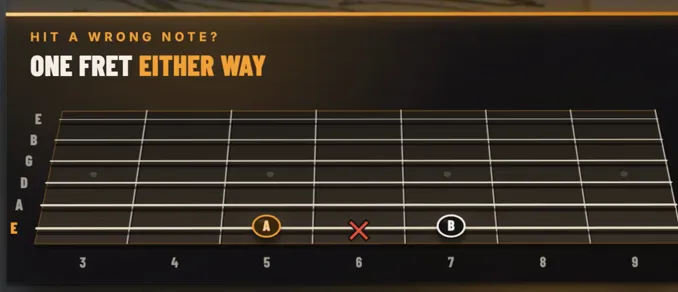
A wrong note is instructive in itself. You'll remember that "ooh, what was that?" moment, and the 6th fret sounding awful against the track. Play the scale perfectly every time and you never get that chance.
The other diagonal ▶ 13:08
One last variation sounds odd, but it works: go from the bottom left of the fretboard to the top right, as you look down at it. Start low down the neck on the high e string and finish high up the neck on the low E. Crossing the strings takes you down in pitch while moving along the neck takes you up, so the notes combine in unusual ways. It can get confusing, but it's good practice once you run out of ordinary routes.
Put on an E minor backing track today, play the open low E and find your way to the 12th fret of the high e by ear, then back down. Tomorrow, take a different route.
Make it easier: choose a top note lower than the 12th fret of the high e, and write down each fret that works as you go.
Make it harder: take a diversion that doubles back on itself, or try the other diagonal, from the high e near the nut to the low E high up the neck.


