Do you remember the scene in Men in Black where they flash the little pen and wipe your memory? If someone did that to me and I had to start my guitar journey again, there are five things I would make sure to do from day one.
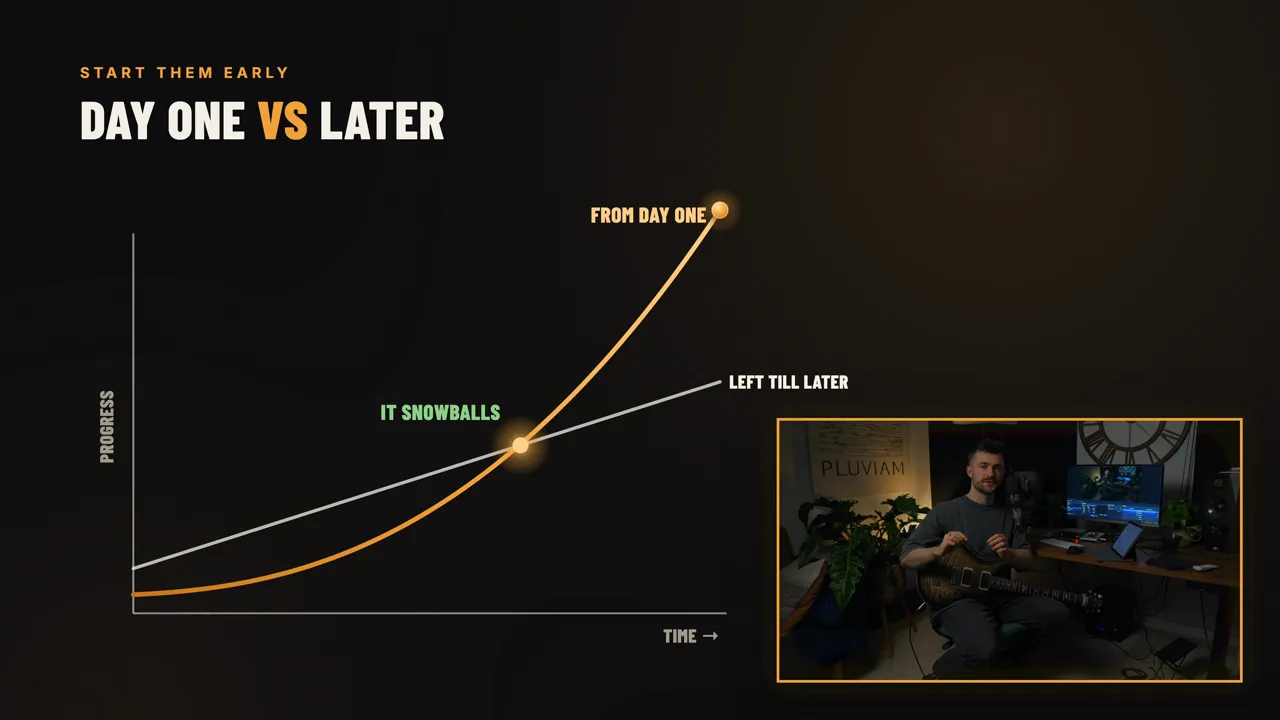
I've been teaching guitar for nearly ten years, and these are the things almost all of my students leave far too late. Start them early, and because everything compounds, you'll learn much faster than you may be learning now.
1. Guitar is physical: your hands come first ▶ 0:43
Almost every student who starts lessons with me thinks the reason they can't do what I can do is technique. That's partly true. But much of it is that they simply don't yet have the strength, motor skills and coordination in their hands, and those only come from time on the fretboard.
It took me a long time to realise that the best instruction is often this:
Press harder.
That isn't pleasant to hear when your fingers are already stinging, but it's often the fix. Nor does it stop at beginner level. You might think the reason you can't shred a solo is that your technique is wrong. Perhaps it is. Or perhaps you simply need to spend a long, long time doing it. Nobody likes that answer, and it doesn't sell many guitar courses, but it's very often the right one.
100 repetitions, not 10 minutes of fiddling ▶ 1:54
How do you work on the physical side? With intentional time on the fretboard. If you sit down for ten minutes, make sure you're physically moving a great deal.
If you're working on a C chord, don't put it down and fiddle with it. Put it down, hear how it sounds, take it off and go again. Repeat that 100 times. At one every few seconds, it takes a few minutes, not an evening.
Fast lead playing works the same way. Set a timer for five minutes and you may be surprised how many attempts at a passage you get through when you aren't distracted.
2. Learn your music theory (it takes hours, not years) ▶ 2:35
Once the physical side starts to come, it's tempting to avoid music theory altogether. Don't. You can learn the theory behind about 90% of contemporary music in a couple of hours. Practising and internalising it takes longer, but the information itself is a few hours' work. There's plenty of material on my website to help, including the theory trainer.
If you only want to learn songs, that's fair enough. But once you understand the theory behind what you're doing, you start to see patterns. You see a fifth fret and come to expect a seventh, an eighth, a tenth or a twelfth to follow it. The same left and right hand patterns turn up in different songs, just on different parts of the fretboard. Each new song surprises you less, and you learn it more quickly.
That's why theory compounds. Learn it early and every new song, scale or solo reinforces it.
3. Learn all your scale shapes ▶ 4:03
Then put that theory on the fretboard. You could learn all your scales in a day, or less. There are five main shapes, and they're the same in the major and the minor key, just placed slightly differently.
Learn the five major scale shapes, and the five pentatonic shapes as well. I'd start in C major or A minor; either will do.
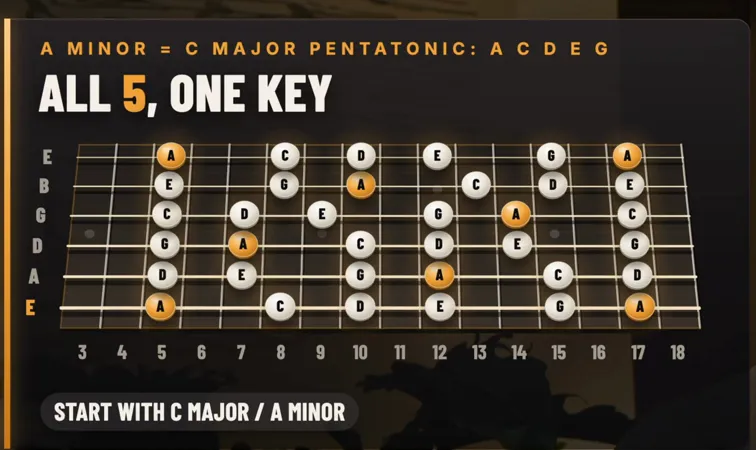
The point is the same as with theory: nearly every song, chord and pattern you learn is built around these scales, so the sooner you know them, the sooner everything else reinforces them. The fretboard navigator is a good place to see them laid out.
4. Learn slowly, practise fast ▶ 5:17
Beware the medium-speed dead zone. Comfortable, medium-speed practice has a place, but a very limited one.
When you're learning something, playing it up to speed only makes your brain work overtime. Before you even think about speeding up, make sure you can play the whole part, or at least the section you're working on, all the way through without having to think about the next note. It doesn't have to be fast; that's the whole point.
Once you've built the muscle memory properly, actually practise fast. People avoid mistakes because they sound bad, but mistakes are often where the progress is. You don't want to make too many, but you do want to be in the zone where you're pushing your limits, because that's where you're most engaged and where you improve most.
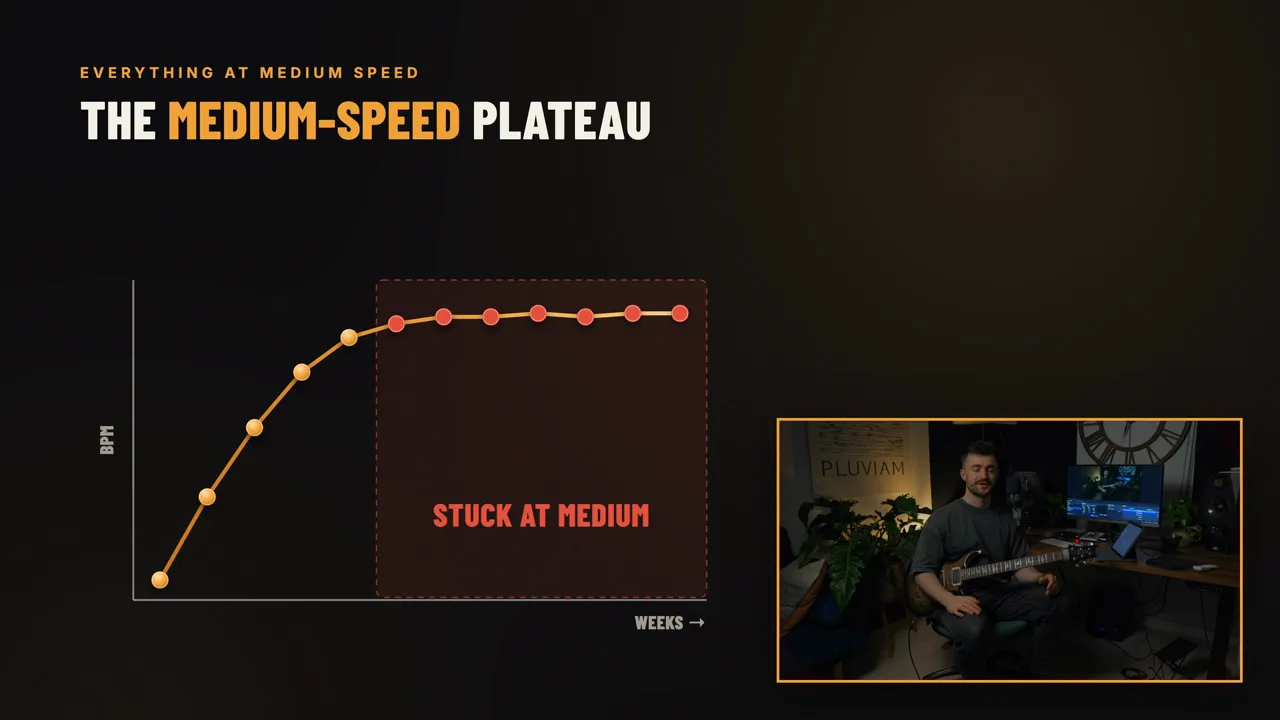
If you practise everything at a comfortable medium speed and wonder why you can't play faster, it's because you don't practise faster. Medium speed has its uses, such as refreshing something the next day, but spend a good share of your time playing either slowly or fast. A metronome keeps you honest.
5. Do ear training, and do it now ▶ 7:03
If you can't hear what's going on, you're missing a great deal. Ear training compounds just as theory and scales do, and it's an entirely separate skill from playing the guitar. You could have a brilliant ear and no guitar playing ability at all.
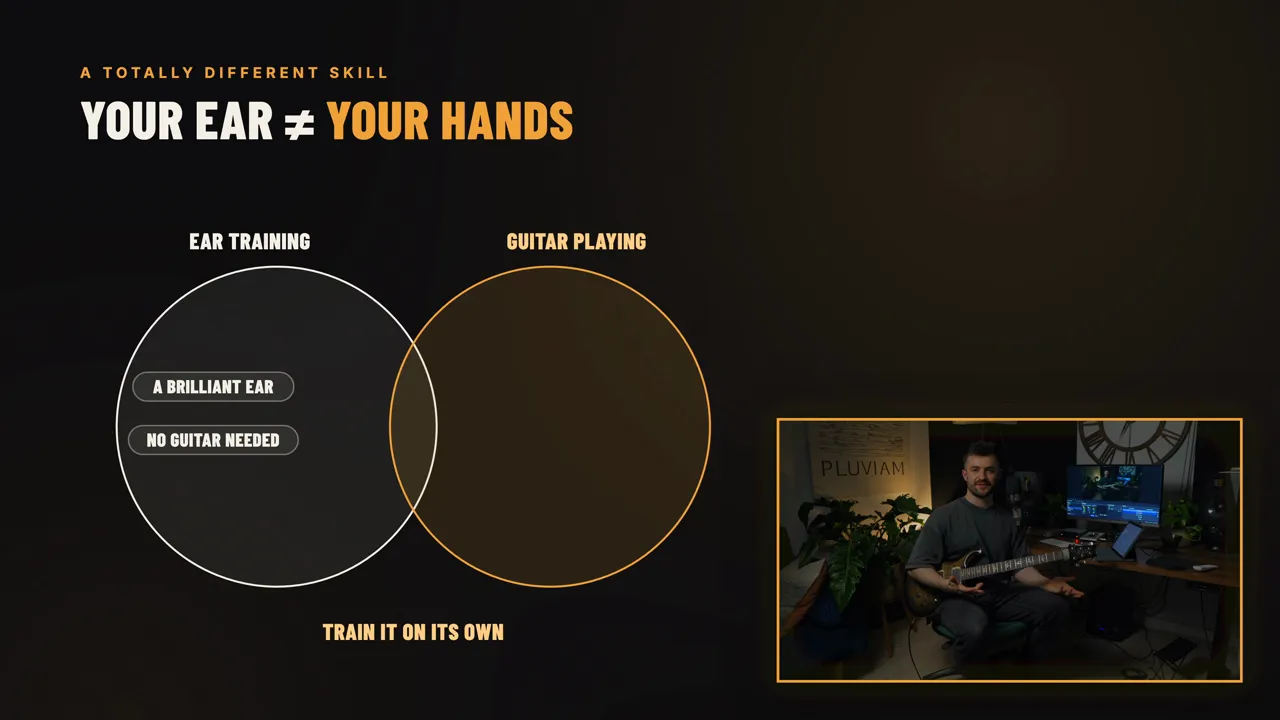
I guarantee this is the one most people will ignore, because they find it boring. But what impresses students most is when they play me a song and I play back something at least 80% right almost immediately. With a half-decent ear that isn't especially difficult, but it doesn't come for free: part of it comes from learning a vast number of songs for my students, and part from time spent training my ear.
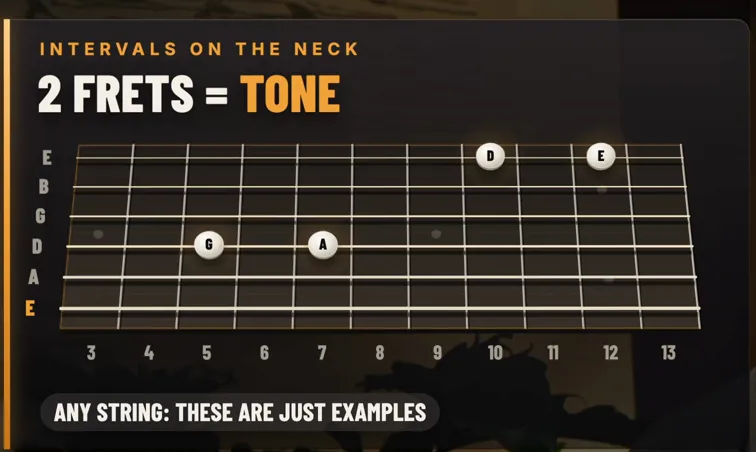
Start with intervals. A one-fret jump, say from the fifth fret to the sixth, is a semitone, or a minor second. A two-fret jump is a tone, or a major second. Wherever you play them, on any string, they sound the same. For reference, the one-fret jump sounds like the Jaws theme, and the two-fret jump sounds like the step from "Happy" up to "birth" in Happy Birthday. You don't have to be able to sing them. The ear trainer on my site will drill them for you, though there are others available too.
Why I remember songs better than my students ▶ 8:44
Students often bring me a song they've worked on for weeks. I look at it once in their lesson, and by the next lesson I often remember it better than they do.
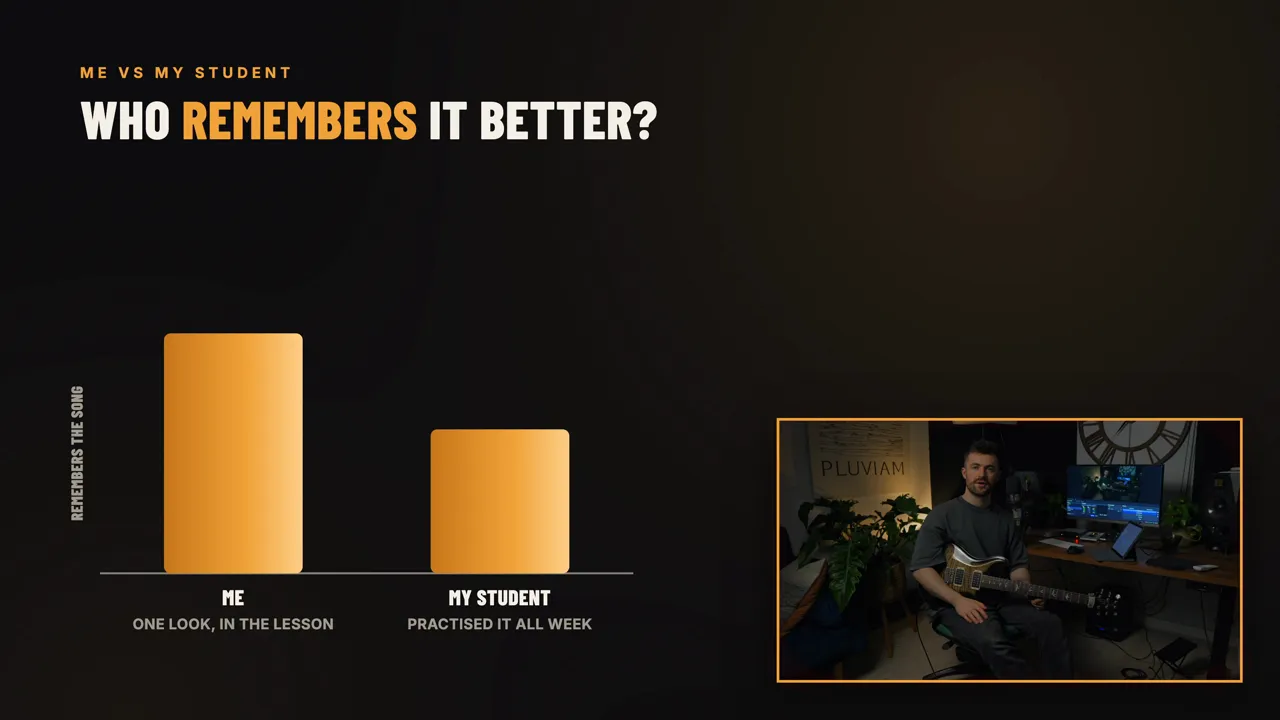
My everyday memory is fairly average. The difference is that I can hear what's going on, and I can look at something on the fretboard and know roughly how it will sound. The more you can hear, the more you notice in songs: that's a minor second, that's a major seventh chord. Then something new appears, you work it out, and now you know what a minor nine chord sounds like.
Bonus: copy the players you like ▶ 9:42
This one applies at every level. When you find a player you like, copy them. I don't mean play the same notes; I mean play the way they play: how they move their hand, how they hold the pick, the rhythm they have.
When I was first getting seriously into guitar, I discovered Mateus Asato, and one day I sat in my bedroom and simply tried to play like him for half an hour. When I went downstairs, my mum, who doesn't know much about guitar, noticed an improvement straight away. Instead of trying to work everything out, I imitated, and that took me a long way.
In time you'll want to know how and why people do what they do. But start by copying how they play, not just which notes they hit.
It all compounds ▶ 10:53
Every one of these compounds: the more you learn them, the faster you learn the next thing, and the more they pay off. Theory runs through most of them. You don't need to study it for hours, but it is the map you navigate the instrument with.
So here's what to go and do. Choose the one you've been putting off longest and give it ten focused minutes today: 100 repetitions of a chord change, five minutes of your hardest passage at a speed that scares you, or the semitone and the tone on the ear trainer. Then choose a player you love and spend half an hour copying how they play.


