How many lessons have you seen promising one simple exercise that sorts out the whole fretboard? I've seen a lot. It's not that they don't work, and I'll even cover one of them here. But most guitar lessons are trying to find a way around doing something.
We're not going around anything. You learn the fretboard by playing across the fretboard, a lot of times. That might sound obvious, but sometimes the obvious answer is the right one. So here are five exercises, each just a different way of doing exactly that. Do them every day, or a few times a week, and you'll build what people call fretboard fluency.
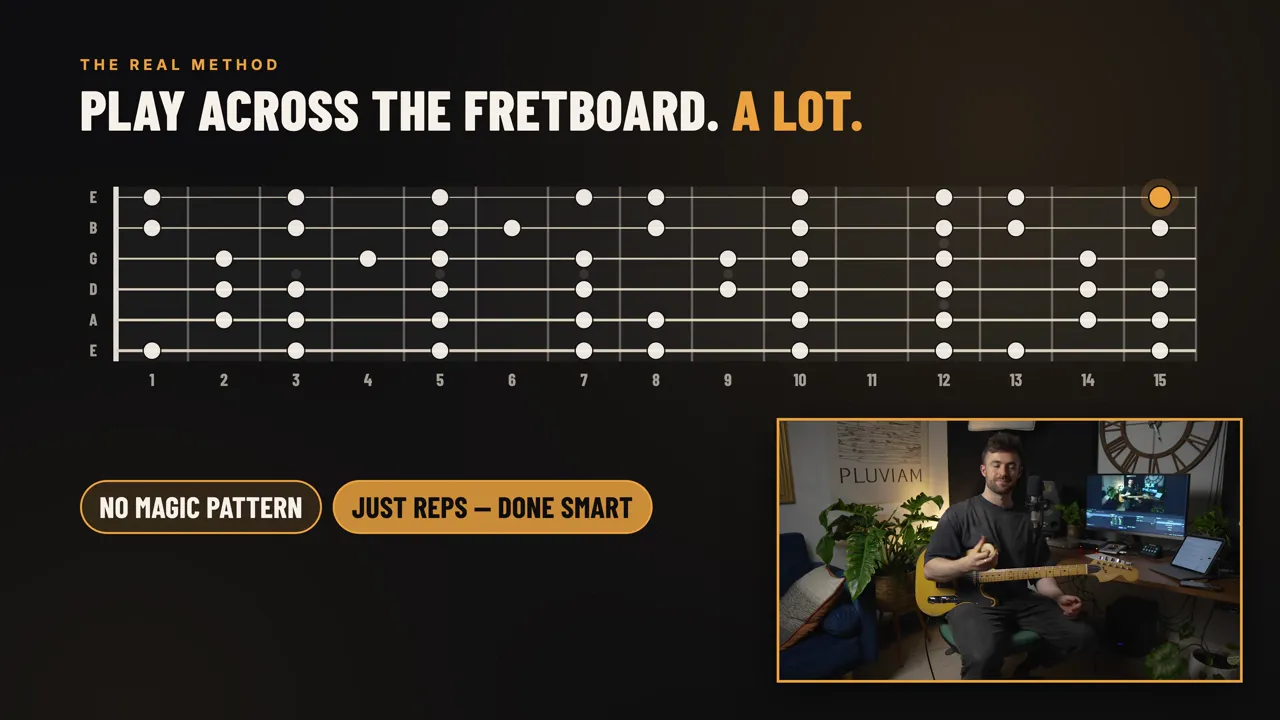
Step zero: pick a master key and its five shapes ▶ 1:05
First, pick one key to work in. I'd suggest A minor, which has the same notes as C major, its relative major.
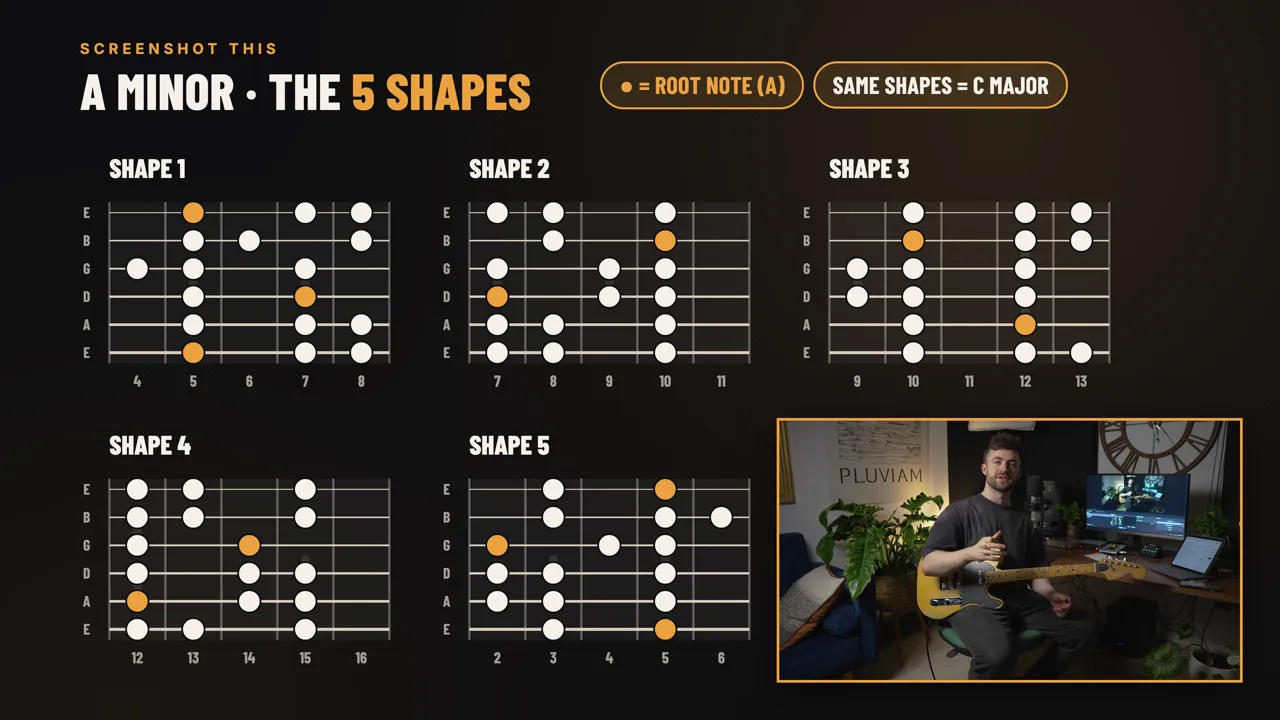
You need all five scale shapes in that key. That can be the five shapes of the A minor pentatonic, or, if you really want to develop your fretboard knowledge, the full A minor scale. Keep the diagrams in front of you if it helps. But the sooner you can look away from them, the better. The more you trust your ear and make a few mistakes, the quicker you'll learn. If you're totally lost, look back. Otherwise, try not to.
Exercise 1: jump between two scale shapes ▶ 2:37
Take two positions, say positions 1 and 2 of A minor.
Version one: play down position 1, then back up position 2, then back down position 1, round in a circle. Then go the other way round: down position 2 and up position 1.
Version two, harder: alternate on every string. On the low E, play the position 1 notes (5, 7, 8), then the position 2 notes (7, 8, 10). Then do the same on the A string: 5, 7, 8 then 7, 8, 10. Carry on across every string. Some positions only have two notes on a string, so on the D string it's 5, 7 for position 1, then 7, 9, 10 for position 2. And whenever you go up, come back down.
e|-------------------------------------|
B|-------------------------------------|
G|-------------------------------------|
D|---------------------------5-7-7-9-10|
A|-------------5-7-8-7-8-10------------|
E|-5-7-8-7-8-10------------------------|
I'll be honest, that took me a few attempts, which is just proof I don't practise it enough. Once you can do it with neighbouring shapes (1 and 2, 2 and 3, and so on, then 5 back to 1), do both versions with shapes that aren't next to each other, like positions 1 and 3. I feel like I know the fretboard pretty well and I still find that one tricky going back.
Exercise 2: cross the whole neck diagonally ▶ 6:27
Using the full fretboard map of A minor, travel from one corner to the other: top left to bottom right, then top right to bottom left. Every day you do this, find a different route. You could go diagonally, or all the way along the low E and then down through one shape, or across a few strings and back up a bit. As long as the general direction of travel is right, you're good.
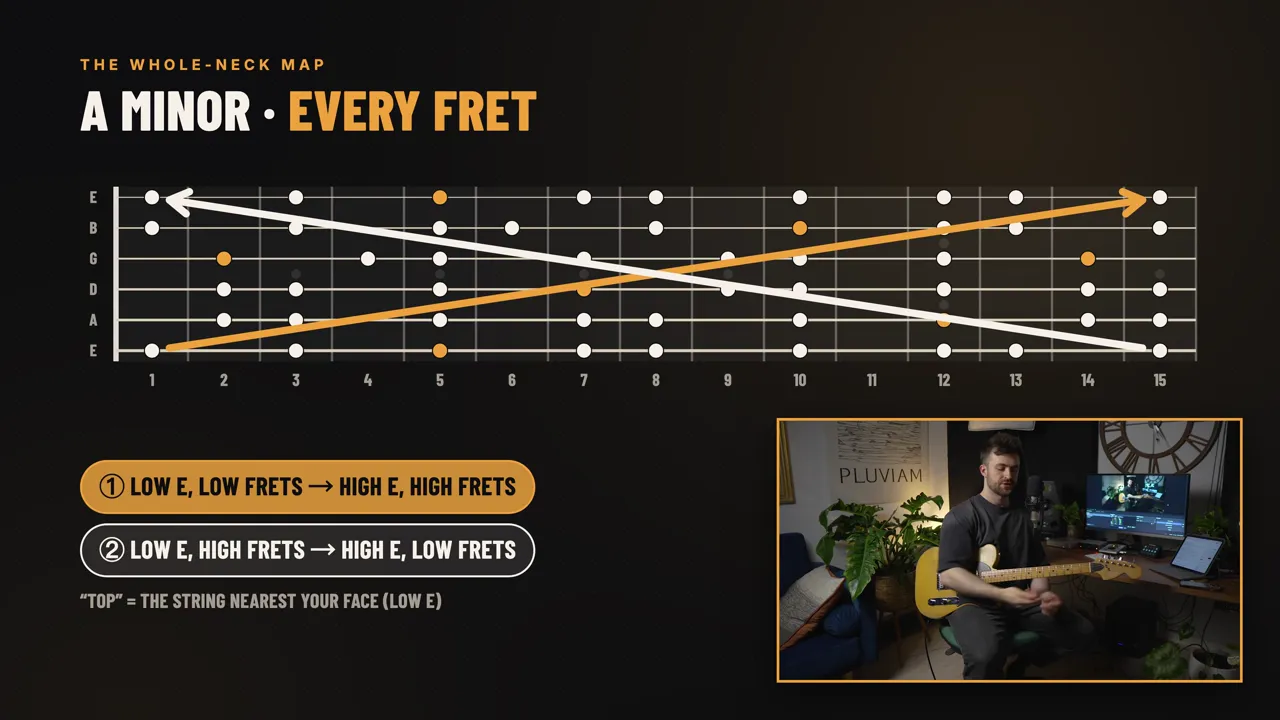
Then try to retrace your steps. I'd usually forgotten my route almost straight away, and that's the point. Trying to remember where you went forces you to memorise the direction you took. Top right to bottom left will sound a bit weirder and be harder to play, because it's not a common way to move, but it's going to help you learn. The Fretboard Navigator is handy if you want the whole-neck map on screen.
Exercise 3: free play across the whole fretboard ▶ 10:08
This is the one I think is ultimately the most useful, and it pulls everything together. Put a timer on for five or ten minutes and improvise freely across the fretboard. A backing track is optional.
You're not trying to be musical. You're just trying to keep moving and never stay still. Aim to touch all four corners of the neck, top left, bottom left, top right and bottom right, within about a minute.
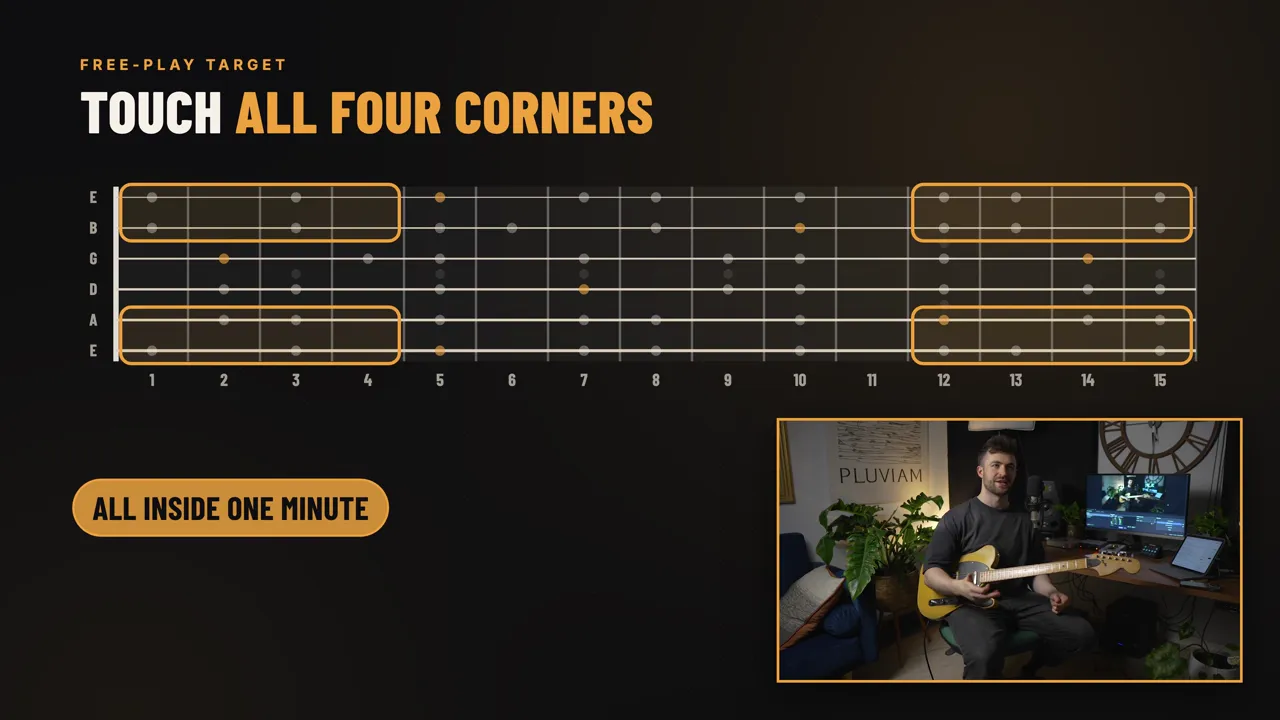
You might think, "But I don't know the fretboard. How do I do this?" Well, this is how you learn it. If you know your five shapes, you're just training your brain to recognise which one you're in and move to the next. If it's too much, limit yourself to frets 2 to 10 for now.
To make it harder, add bigger jumps rather than following the scale one note at a time. That's more realistic, too. You won't always play notes in order. You might play a lick around one area and suddenly be up at frets 10 and 12.
Honestly, if you just did these first three a lot each day, I think you'd get the fretboard down pretty quickly.
Exercise 4: random number shapes and frets ▶ 13:13
For something more rapid fire, use a random number generator.
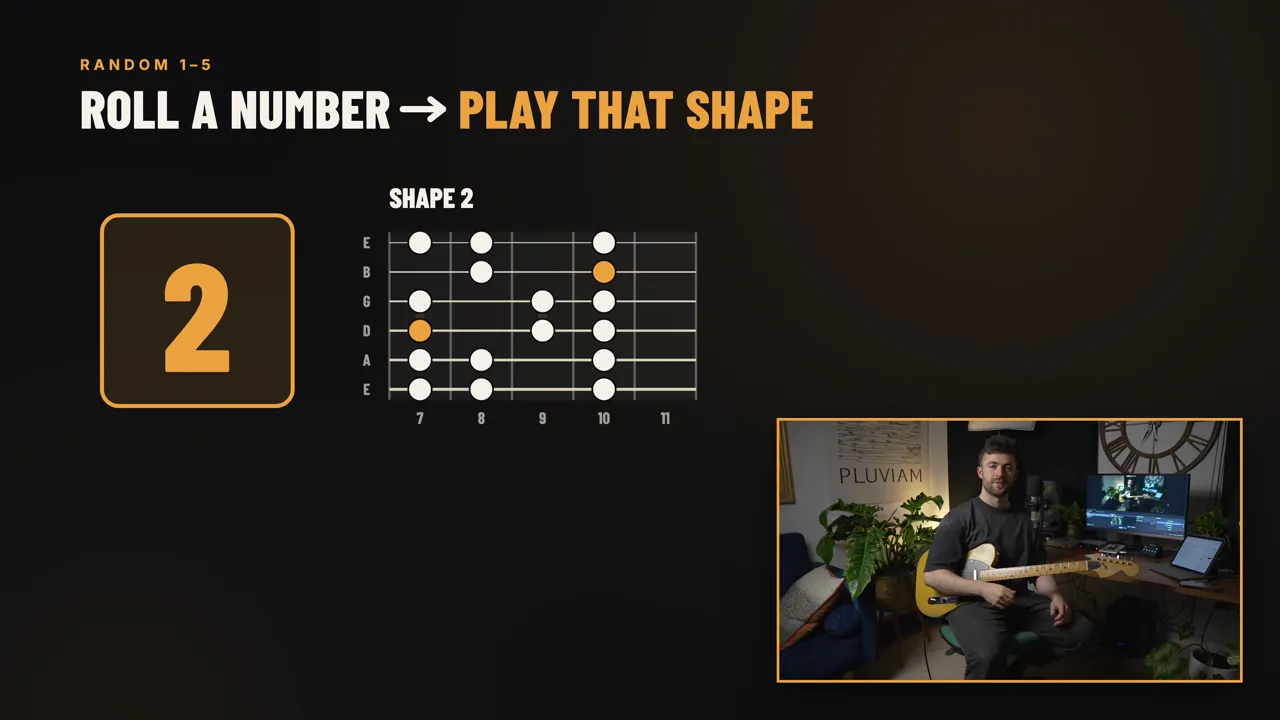
- Set it to 1 to 5. Whatever number comes up, play that scale position. Then roll again.
- Set it from 0 to your highest fret. Play a small group of notes around that fret, and try to surround it rather than just playing above it. Use different strings each time.
Bonus: the octave pattern most lessons teach ▶ 14:19
This is what most lessons mean by learning the fretboard. It's useful, I just don't think it's the only tool, or the most important one.
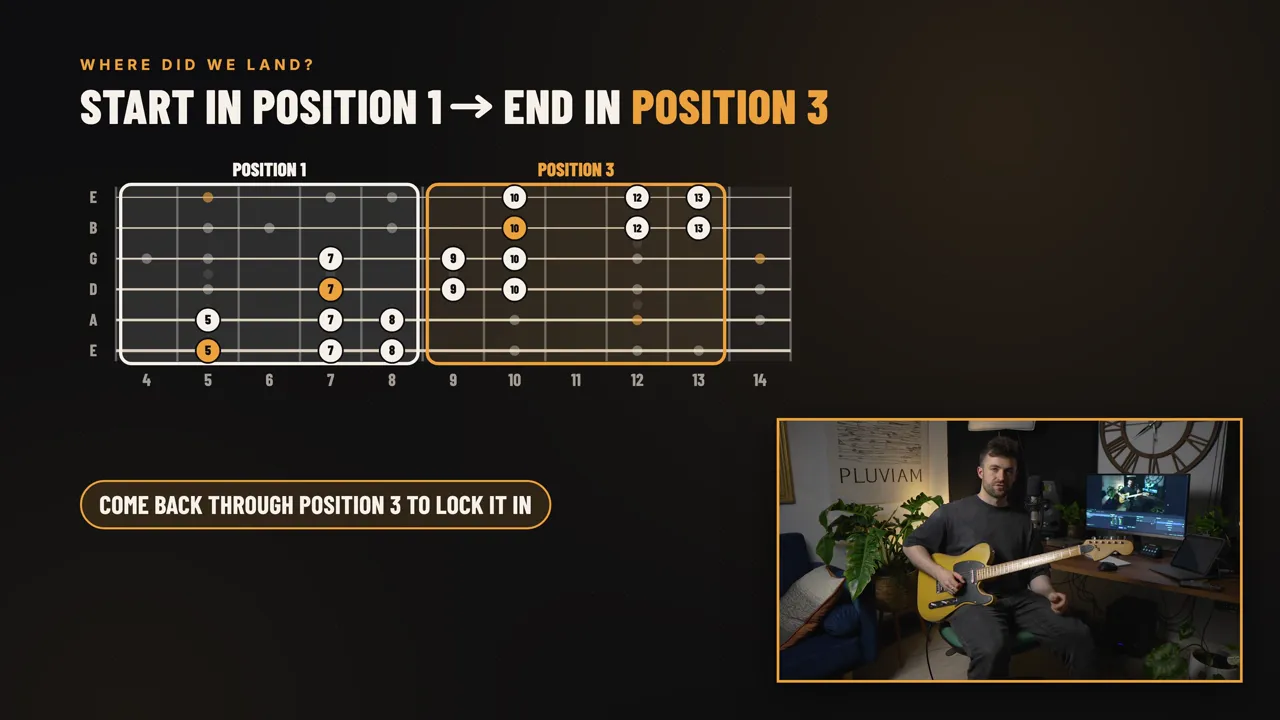
Take the first two strings of any shape. In position 1 that's 5, 7, 8 on the low E and 5, 7, 8 on the A. That fingering pattern repeats an octave higher, two strings over and two frets up: 7, 9, 10 on the D and G. Then it repeats again on the B and high e, but this time three frets up because of how the B string is tuned: 10, 12, 13.
e|----------------------------10-12-13-|
B|-------------------10-12-13----------|
G|-----------7-9-10--------------------|
D|-----7-9-10--------------------------|
A|-5-7-8-------------------------------|
E|-5-7-8-------------------------------|
To take it further, notice where you've landed. You started in position 1 and ended on the last three notes of position 3, so come back up through position 3 to reinforce where you are. Then do it all backwards. Starting from position 2 (7, 8, 10 on the low E and A) you end up in position 4.
Exercise 5: find the key by ear, Minesweeper style ▶ 17:50
This is the one I fear not many people will do, but it's potentially one of the most useful. Move out of A minor, because by now you'll be getting familiar with where you are in it.
Put on a backing track without checking the key. Find one note that sounds good, ideally on one of the four middle strings. Then, like Minesweeper, build a web of notes around it that work. Use your ear to test each one, and start thinking about which scale shape the notes around you suggest.
When I tried it, I found the 7th fret on the G string, then built out to 5, 7 and 9 on the D and G strings and 6 and 8 on the B. That turned out to be A minor, which wasn't planned, but there's a one in twelve chance.
The better you get at this, the less useful it becomes, because you'll find the key straight away. But for a lot of people it's a great way to connect shapes to sounds.
Now it's down to you ▶ 21:56
Notice there weren't many fancy tricks. Reading this hasn't taught you the fretboard, and neither has any other lesson. All I've done is give you different ways to practise playing across it. That's the key point.
If you do all of these things for 20 minutes, half an hour a day, I promise your knowledge of the fretboard will improve.
Nail A minor first. Then try other keys like B minor, E minor or G minor, so you're not just learning which frets work, but how the shapes connect. If a new key feels like a real struggle, that's probably a sign you should spend time on it. So set a timer tonight, pick positions 1 and 2, and start with exercise one.


