If you want faster chord changes, you need to move efficiently from one chord to the other. A lot of people lift the whole hand off, open it right up and then try to drop the next shape on in one go. That's slow, and it's a lot of guesswork.
So here's an exercise I've not seen taught anywhere else. It works with any chord change, not just open chords, but open chords are the easiest way to show it.
The exercise: never lose contact with the strings ▶ 0:32
Pick two chords. I'll use C to G. Now move between them without letting your fingers lose contact with the strings.
Obviously, when you're actually playing, you'd just let go of the C and put the G down. But for the sake of practice, you're going to push your fingers across the strings to get to the next shape. Your fingers will bump over the strings as they travel. That's fine, that's what's meant to happen. Then do the same thing going from G back to C.
Why it works: you learn the route, not just the shapes ▶ 0:58
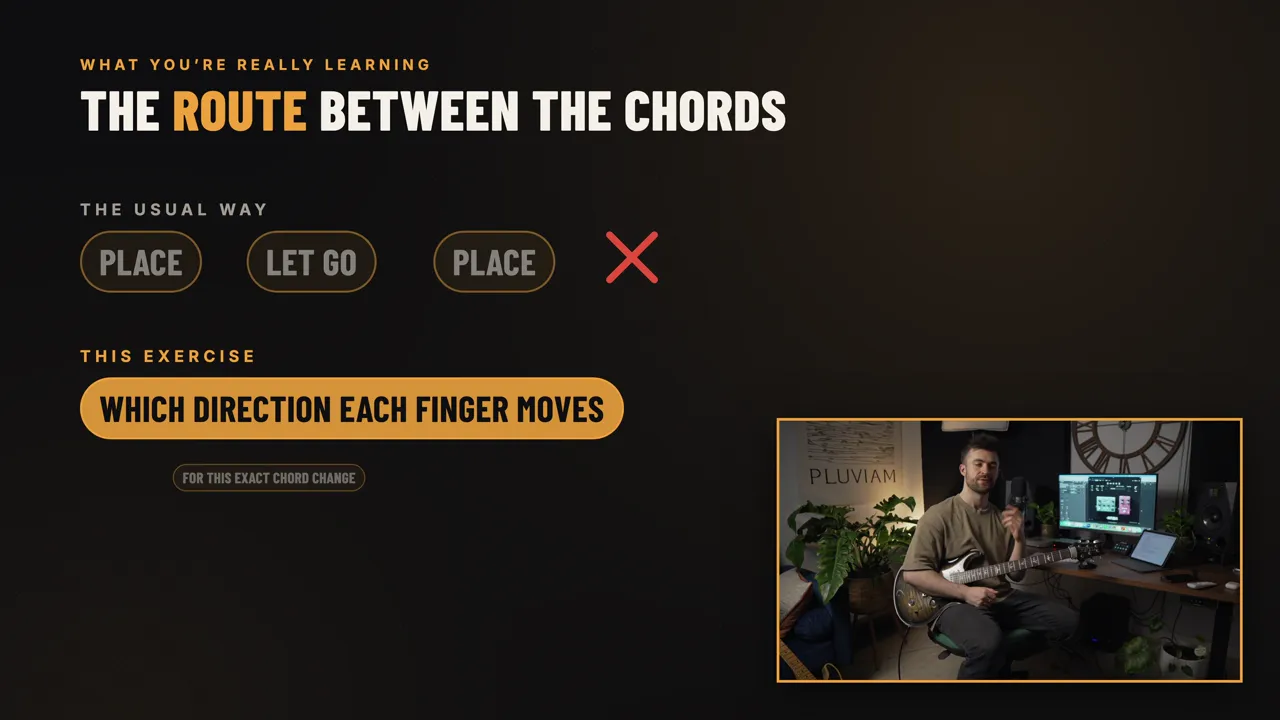
What this does is train you to pivot your fingers rather than releasing them and placing them back down. Most people practise chord changes as "place one chord, let go, place the next chord". This makes you learn how to move from one to the other: the direction each finger needs to travel for that specific change.
Not only that, but it forces your fingers to stay nice and close to the strings. So when you go to play the change for real, you don't have to open the hand up so much. You can just shuffle between the two shapes.
It doesn't have to be perfect ▶ 1:35
It's a little awkward at first. You might find you bump over a few strings on the way, particularly if your fingertips are quite calloused. And if a finger comes off by a millimetre or two, it's not the end of the world.
The key thing is that each finger is always touching a string somewhere. That's the whole exercise.
Speed it up with a metronome ▶ 1:58
Once you've got the idea, start nice and slow and do it to a metronome. Then get faster and faster.
You don't even have to strum the chords. This can be completely silent practice, so it's a great one if you're sat in front of the TV and want something useful to do with your hands.
Another example: D to E ▶ 2:14
Some changes are a bit different. Going from D to E, your first finger can stay on the G string the whole time.
From the D chord, slide your first finger back along the G string from the 2nd fret to the 1st, and shuffle the other two fingers over to the A and D strings at the 2nd fret for the E. Going back to D, the fingers tuck underneath and the first finger slides up again.
Go and try it
I'd love to tell you there's more to it than that, but that's it. Take two chords you know, especially a change that's bugging you, and move between them slowly without lifting off the strings. Then speed it up. If you're not sure of a shape, look it up in the Chord Finder first, and have a go.


