This is all about picking accurately as you play faster. Not sweep picking, legato or tapping, just picking.
I'm not normally the shredder type, so I have to be really careful about how I practise my picking. These are practical tips, whether you feel like a natural fast player or not. It's worth writing them down and putting a tick or a cross next to each one depending on whether you already do it.
The most overlooked thing: visualisation ▶ 1:13
The thing I hear talked about least is visualisation. I know that sounds boring. But any exercise or speed picking technique is useless if you can't mentally follow what both hands are doing. Speed something up without thinking and there comes a point where you're not sure which note you're on, and that's when it gets messy.
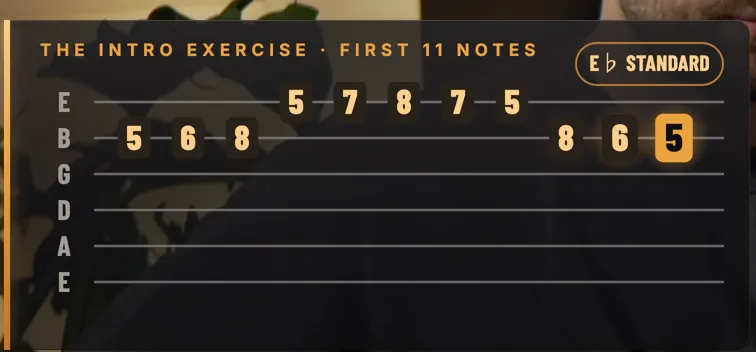
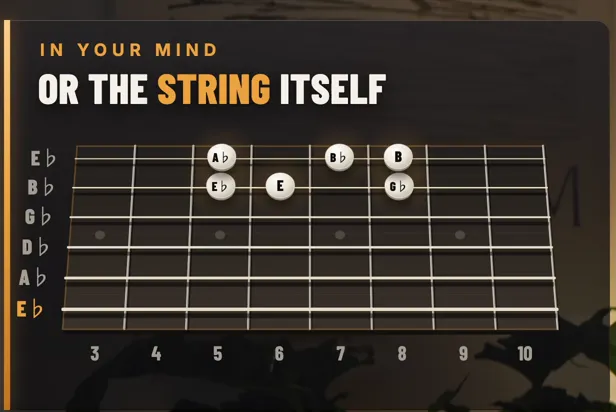
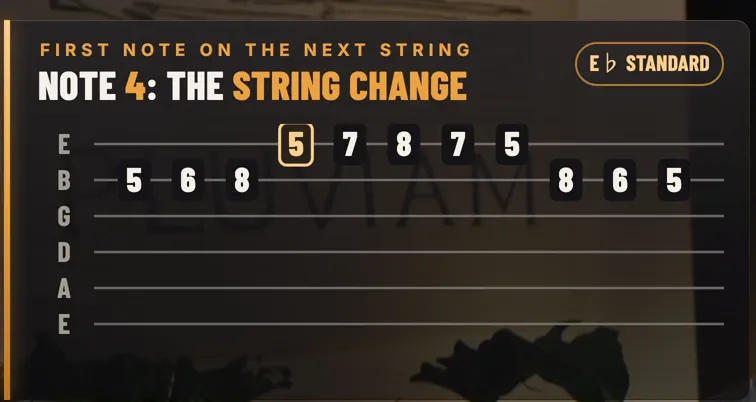
So take a short group of notes. I'm using 5, 6, 8 on the B string, 5, 7, 8 on the high e, then back down. Close your eyes, play it, and try to see it in your head. Which way is the pick moving? Where should the left hand be?
An even better prompt is the sensation: the little buzz you feel in your fretting finger as you pick each note, and the feel of the pick brushing past the string (mute the strings and pick through them to isolate it). When I play fast successfully, I can feel exactly which note I'm on and which way I'm picking, even if I couldn't call it out.
Mindset and approach ▶ 4:23
Give it 20 minutes. I don't expect to hit my top speed, certainly not accurately, until I've been playing for at least 20 minutes. That's how long my brain takes to lock in. So if you play for five minutes and decide you're rubbish, you probably just haven't warmed up yet.
Experiment, but not forever. Try different picks, pick angles and wrist movements. If something new doesn't click straight away, that doesn't mean it's wrong, so give it a few days. But if you're always trying new things, your brain never gets a chance to solidify any of it. You need a balance.
Stop looking at the fretboard. At higher speeds your eyes can't keep up anyway. Play a static position without looking for five or ten minutes and you'll rely far more on feel.
Try the neck pickup. To me it gives a bit more of a thud on each note, so you hear the impact of the pick better.
Get your guitar set up. High action or loads of neck relief makes fast playing a lot harder. A little string buzz is probably a fair trade. A setup is usually around £50 to £100.
Use a pick that isn't too thin. You need to grip it firmly and feel the string. For me that's about 1mm or above; 0.5 to 0.7 is a bit thin for me.
Practice method: set the metronome to every note ▶ 8:42
Everyone says use a metronome. My caveat: a lot of people set one click per beat and play four notes to each click. That's not awful, but what really pushes you is setting the metronome to subdivide, two clicks per beat for eighth notes or four for 16th notes, so that you pick on every single click.
It's painful, but that's the point: you have to land on every click, which is great for synchronisation.
Perfect playing vs pushing the pace ▶ 9:57
I split speed practice into two jobs: perfect playing and pushing-the-pace playing (I should probably think of a catchier name).
Take those notes, 5, 6, 8 on the B string and 5, 7, 8 on the high e, and find two tempos:
- Perfect speed: the fastest you can play them perfectly. Write it down.
- Push speed: the fastest you can play them at about 60 to 80% accuracy. If it's falling apart at 30%, you're too fast.
Use the perfect speed for the visualisation work, but don't live there. Since the goal is to play faster, a good chunk of your practice should be in the uncomfortable push zone. The perfect practice is there so you don't ingrain the mistakes you make.
A useful tool is an increasing tempo setting, where the metronome goes up by, say, 5 BPM every 16 bars. Start around 90% of what you can do and see where you get to.
Preemptive movement and snapping to each note ▶ 12:00
Preemptive movement is mostly about string changes. Play 5, 6, 8 on the B string then the 5th fret on the high e. The moment my little finger lands on the 8th fret, my first finger drops onto the high e. It's there before it needs to be, not moved at the last second.
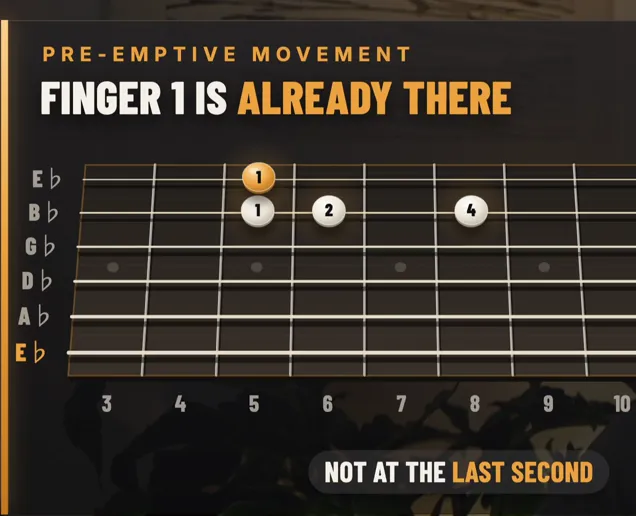
Reverse it too: play 8, 7, 5 on the high e, and as you hit the 5th fret, bring your little finger over to the 8th fret on the B ready to play. This gets rid of that feeling of the strings running away from you.
Snapping is about how your fingers move. Play the same notes slowly, but instead of a flowing movement, snap to each note. Think of your fingers as binary: on the fret or not, never in between. When you slow down it's tempting to get a bit pedestrian, but what you want to practise is moving fast and holding the note longer.
Practise on the thinner strings, clean, and relaxed ▶ 13:59
I find I can mask sloppy playing on the lower strings. The thinner strings really expose your synchronisation; I nearly copped out and played the opening lick on the low strings because it sounded cleaner. So focus on the higher strings, and turn off delay and reverb. A clean channel exposes everything.
And every five minutes or so, set a checkpoint to relax both hands. Tension creeps in as you speed up. Shake out the left hand and keep going.
Learn each group plus the next note ▶ 15:55
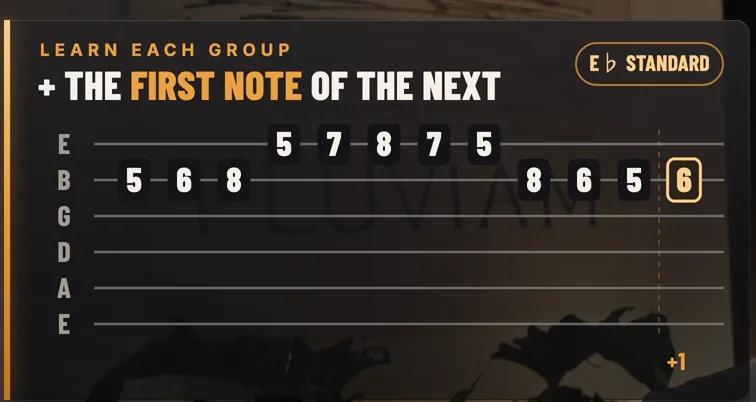
The exercise I opened with plays up and down three-note-per-string shapes on the B and high e strings, moving to the next shape each time, in 11-note groups (3, 5, 3). Whatever exercise you use, don't learn it in separate blocks. Learn each group plus the first note of the next, so it doesn't feel like chunks you have to stop between.
And work on one thing at a time. If you've got ten things wrong with your speed playing and you fix one, you're maybe 10% better and you've got one less thing to think about.
Technique: attack, grip, posture and string changes ▶ 18:39
Pick with a decent bit of attack. It's about commitment. When you're unsure, it's tempting to wash through the strings. Pick harder and you'd best know where you're going.
Hold the pick firmly, tight enough that it doesn't move, so the movement comes from the wrist rather than the thumb and finger.
Try the classical position. Sitting with the guitar higher, more like when you stand, helps me on faster and stretchier lines.
Economy or alternate, stick with what you do. With economy, push through the strings rather than bouncing off them. With alternate, look into pick slanting and escape angles.
Change strings with the arm, not the wrist. Your arm, mostly from the elbow, should decide which string you're on, so the wrist only has to move down and up and the pick stays at a consistent angle. Think of Paul Gilbert playing with a drill: you just move where the drill is.
Assess your playing: five quick checks ▶ 22:11
Break your lick into its components and test each one. I'm sure you'll have a weak point in one or two.
- Each hand on its own. With the metronome on 16ths, can the right hand pick the pattern cleanly with the strings muted? Can the left hand fret it in time without picking? For most people it's the right hand that falters.
- The takeoff note. If you keep hitting the first note over and over, practise going straight into the first three notes with no count-in.
- Escape notes. Going up (5, 7, 8) is usually fine. Coming back down (8, 7, 5) is where the little finger doesn't lift off fast enough.
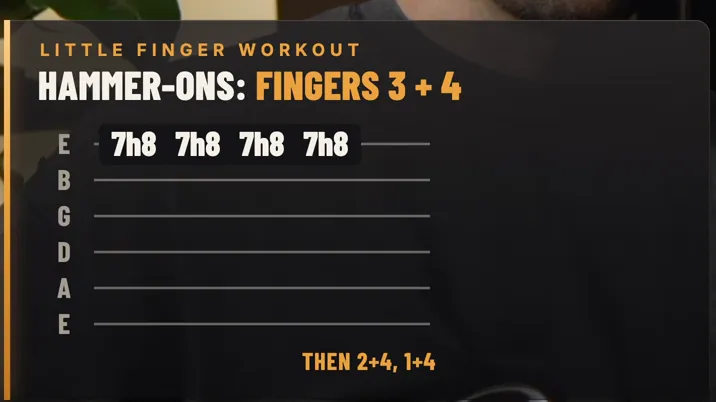
- Little finger strength. Hammer on 7 and 8 on the high e with your third and little fingers. Then second and little, and first and little.
- The first note on the next string. In this lick that's note four. I often clunk over it lazily. Keep your fingers upright and arched, like typing, so a flat little finger doesn't mute the next string.
Where to start
That's a lot of ideas, so don't try them all at once. Go through the list, tick off what you already do, and pick one thing that's missing. If you're not sure where to start, set the metronome to 16ths, find your perfect and push speeds for those 11 notes, and spend most of your time just past comfortable. Have a go.


