If you're stuck in box 1 of the minor pentatonic scale and you want to break out, but learning all the other shapes and travelling the fretboard feels like a big task, this is for you.
Lots of people learn box 1, usually in A minor at the 5th fret, and that's where all their licks and ideas live. So here's a very easy way out: learn just one more position, position 4, and move your licks between the two.
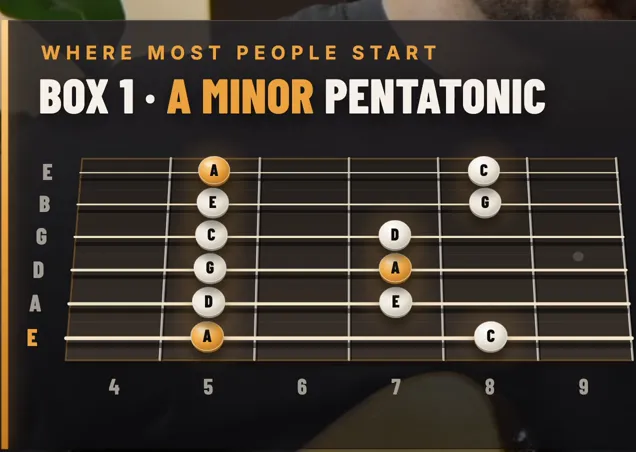
Why position 1 and position 4 ▶ 0:37
I'm going to use F minor here, partly because it's the key of the backing track I picked, and partly because it's handy to learn this in a key other than A, just to shake you out of the box a bit.
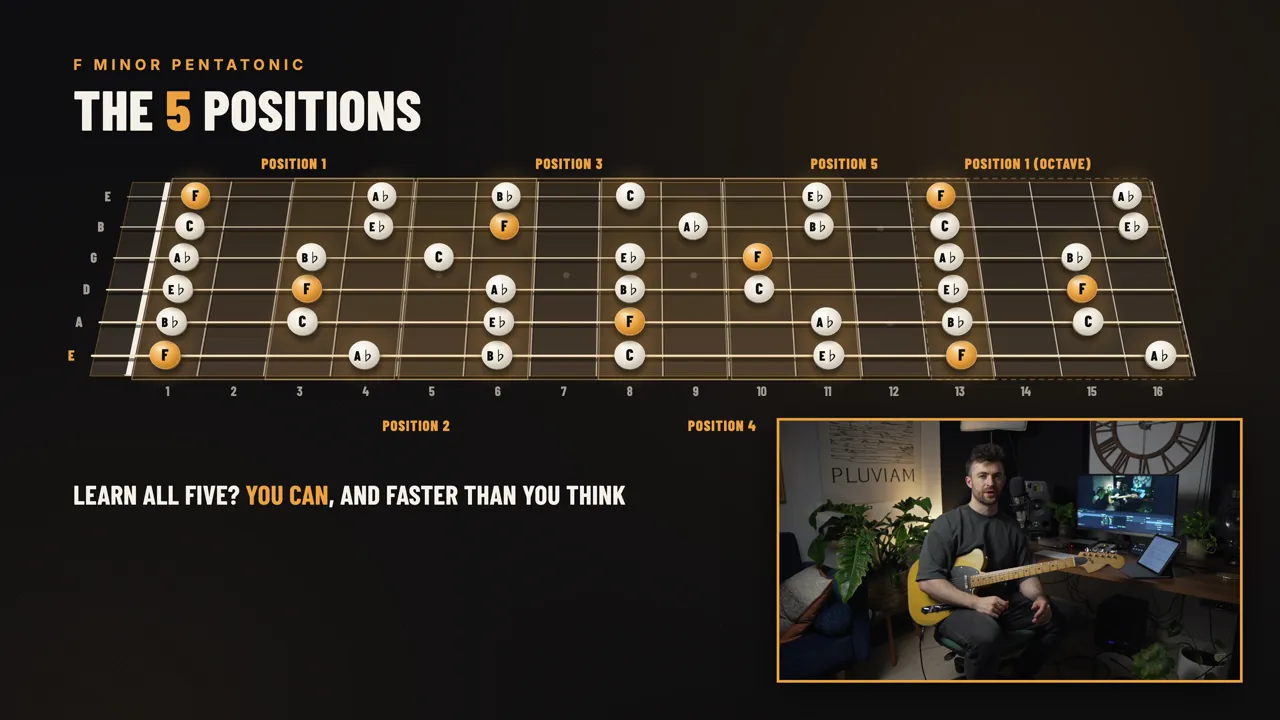
Of course, you can just go and learn all five positions. You'll probably learn them quicker than you think. But we're going to be a bit more efficient and focus on positions 1 and 4. They're actually quite similar shapes, a lot of the licks you know in position 1 can be moved and adapted to position 4, and position 4 sits at a nice halfway point up the neck.
In F minor, position 1 is at the 1st fret. And the same position an octave higher is at the 13th fret. That's just position 1 played 12 frets higher: the exact same notes, an octave up.
How to find position 4: seven frets up ▶ 1:47
Whatever key you're in, position 4 starts seven frets above position 1. So from the 1st fret in F minor, count up seven and you're at the 8th fret.
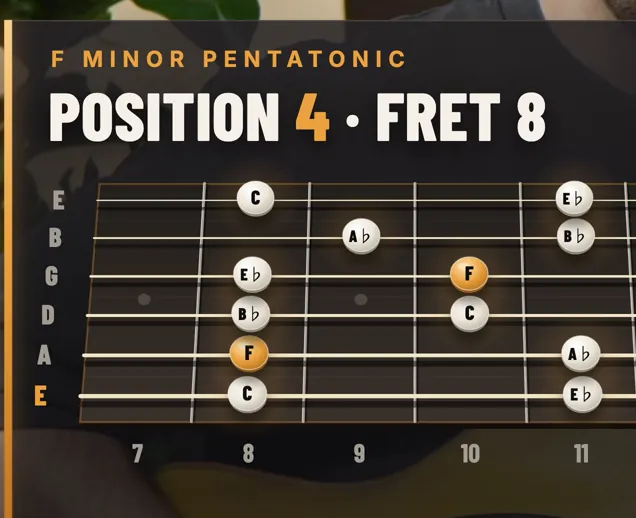
Look at it on the diagram and you'll see it's quite similar to position 1. The two middle strings, D and G, are exactly the same shape. The low E and high e strings are the same too. The only strings that are different are the A and the B.
Why your box 1 licks still work up there ▶ 2:30
Even then, if you fill position 4 out into the full minor scale, not just the pentatonic, you can actually map the position 1 pentatonic shape on top of it. So in theory, if you take something you play in position 1 at the 1st fret and play the same shape at the 8th fret, it should work.
You won't be playing the same notes any more, and they won't all be in the pentatonic scale, but they'll be in the minor scale, so they should still sound in key. They might not all be as effective as you'd like, and that's where the practice comes in. But it translates.
Take the lick I opened with. It uses the same shape on the 1st and 3rd frets, moving down across the strings. Then I take that exact pattern and play it on the 8th and 10th frets, and again on the 13th and 15th. That's a really neat way to travel across the fretboard, and you can hear the lick develop, because in position 4 they're literally different notes with a different flavour. Then at 13 and 15 you're back to the same notes as at 1 and 3, just an octave higher.
Finding position 4 on the fly ▶ 4:27
Counting seven frets is quite hard when you're playing on the fly, so there are a couple of things that help.
First off, learn the notes on the low E and A strings. That's worth knowing anyway for loads of other things, and it makes this a lot easier.
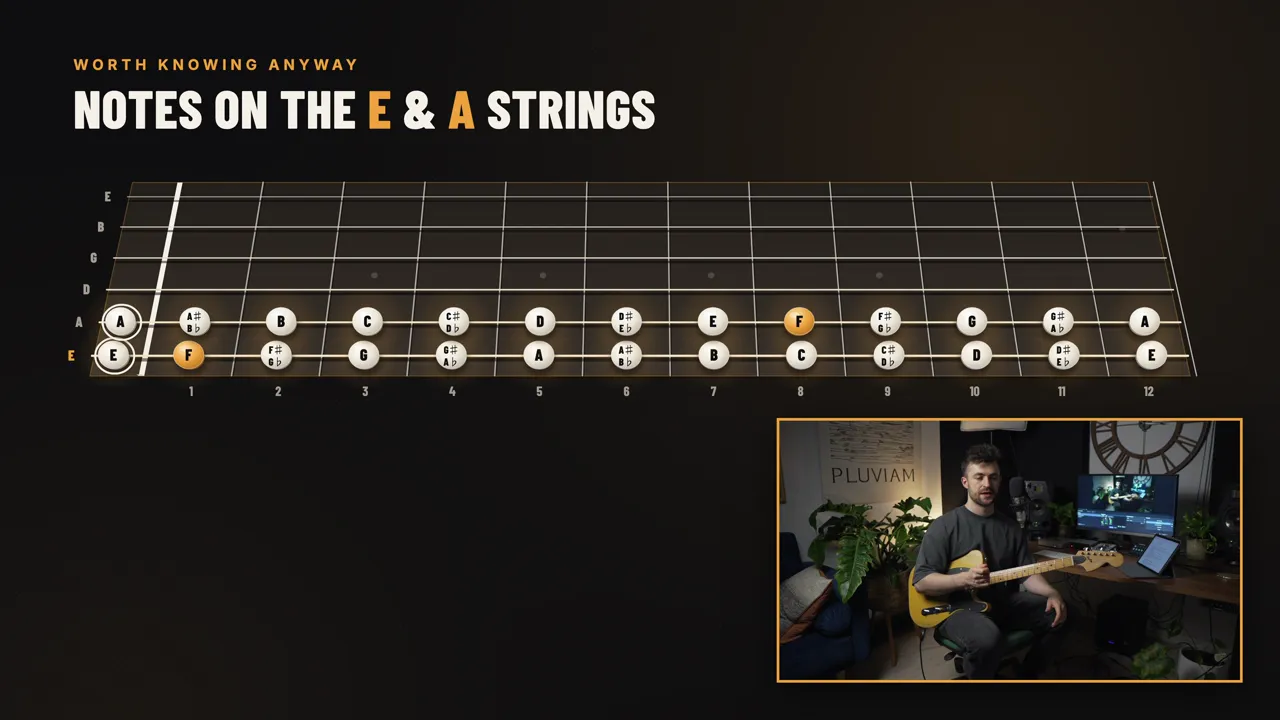
In position 1, the root is the first note of the scale on the low E string, so F at the 1st fret. In position 4, the root is the first-finger note on the A string, which in F minor is the 8th fret. So if you know where the root is on the A string, you know where position 4 is.
The other thing is a rule of thumb I use for my own thinking. When you move between positions 1 and 4, you tend to go from dotted frets to non-dotted frets, or the other way round. G minor at the 3rd fret, for example: position 4 is up around the 10th, straddling the 12th, mostly on the unmarked frets. It's not hard and fast, and you'll still play some dotted frets, but you might find it helpful visually.
Filling in the gaps with positions 2, 3 and 5 ▶ 6:09
The other useful thing about learning position 4 is that you no longer have big empty gaps when you go to learn the rest. Position 2 tags onto the end of position 1, and they overlap. Position 3 comes just before position 4 and overlaps with it around the 8th fret in F minor. Position 5 tags onto the end of position 4 and links you back round to position 1.
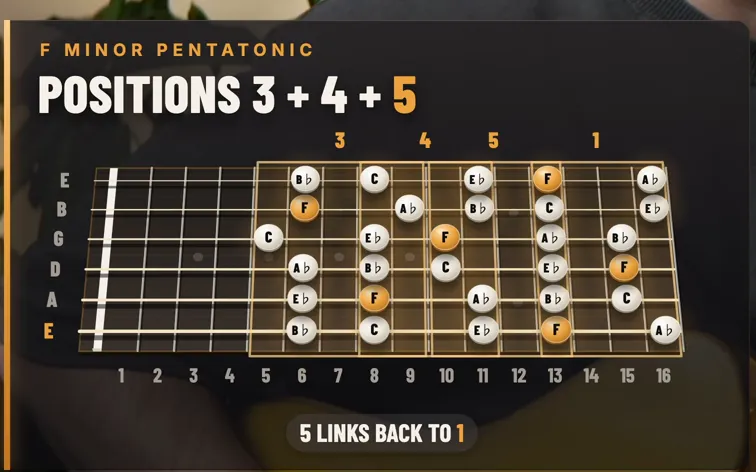
So when you do learn those other three, everything should connect up nice and neatly.
A takeaway exercise in A minor ▶ 7:05
Find a lick, or take one you already know, and play it in position 1 of whatever key you're in. In A minor, for example, take a classic lick in the box at the 5th fret, then play the same shape seven frets higher in position 4, up on the 12th and 14th frets, and then the octave on the 17th and 19th.
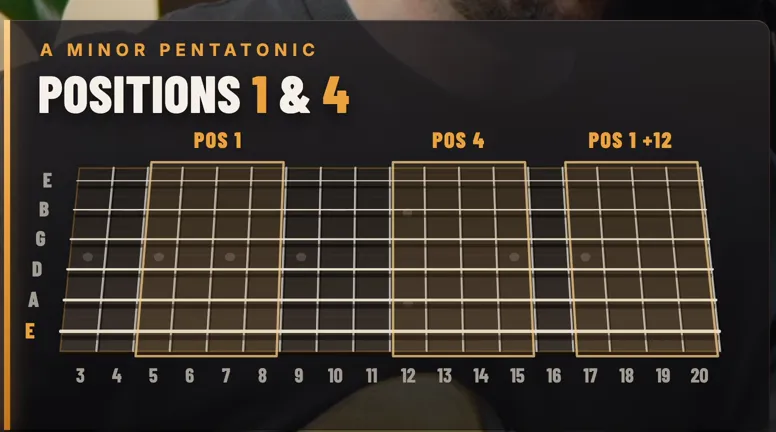
Put on an A minor backing track (or make one in the Backing Track Creator) and move the lick between the two positions.
Honestly, if you can, I'd just learn all your scale positions. Maybe for you it's 1 and 2 that make more sense. But I think 1 and 4 is a really useful way to break out of the box without feeling like you have to learn the whole fretboard at once. Take one lick, move it up seven frets, and have a play around with it.