Do you ever feel that, despite learning plenty of songs, you can never quite make them sound like the original? Or that when you improvise, it feels flat?
The reason is that guitar playing is made up of hundreds of tiny details, all happening at once. Here are the small details in three entirely different pieces of music, followed by how to rethink your practice so that you start to sound like the guitarists and songs you love.
Master of Puppets: the details in one riff ▶ 0:32
First of all, you should warm up. I didn't, and I felt rusty playing it. That aside, here's what goes into that riff:
- Down-picking. You need strength and stamina in your picking hand, and you need to down-pick all of it. The Metallica police will come for me if I don't mention that.
- One finger per fret. The riff covers frets one, two, three and four, so fingers one, two, three and four fit it neatly.
- Palm muting control. You mute the first two notes and play the next one unmuted.
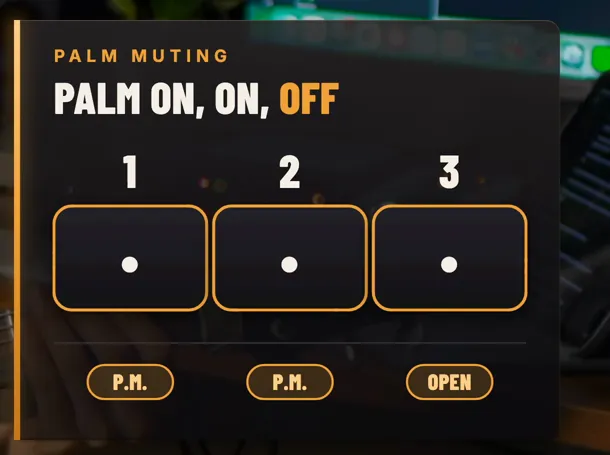
- Groups of three over sixteenth notes. You're playing groups of three inside a four-beat bar, which creates an interesting overlap where the group starts in a different place on each beat.

You also definitely need warm hands.
Le Freak: muting and a light touch ▶ 1:23
Le Freak is about as far from Metallica as you can get. Here's what matters:
- Good right-hand muting. Without it, you get extra notes that shouldn't be there.
- A nimble, light touch with your fretting hand. That's how you draw the lovely dry sound out of the strings.
- Left-hand muting. When I play a note, all I want to hear is that note, not the higher strings, which I'm muting with the inside of my finger.
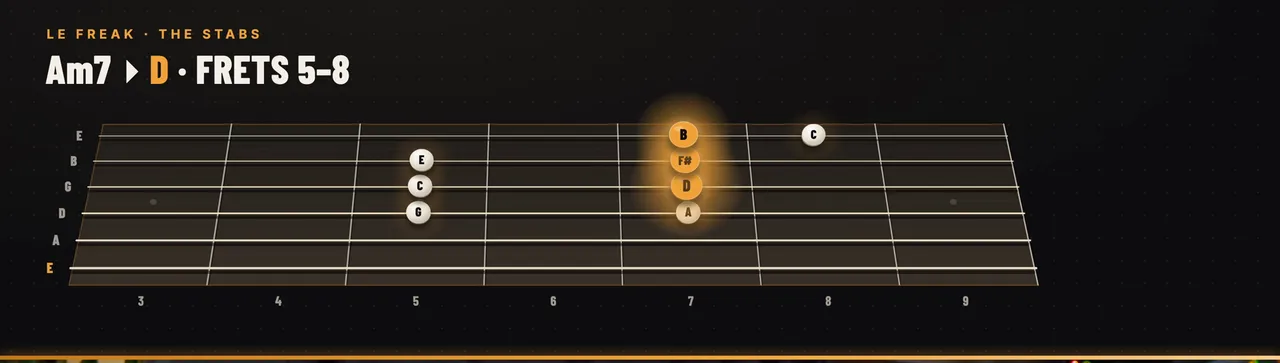
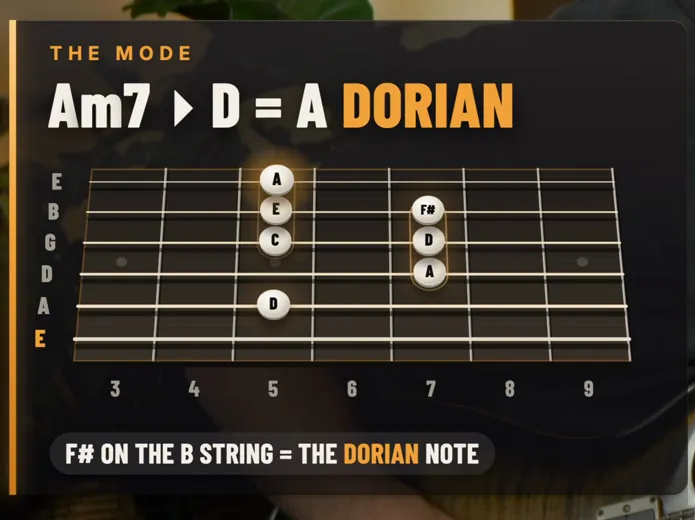
If you want the theory, there's an element of the Dorian mode in there. Moving from Am7 to D brings in an F sharp, and that F sharp is the note that makes it sound like A Dorian rather than plain A minor.
Blackbird: fingerstyle details ▶ 2:02
Then there's a classic, Blackbird by The Beatles. I played it well until I forgot it partway through, which brings me to the first point: you need to remember songs thoroughly. After that:
- Decide which fingers you're going to use, and stay consistent. If you use a different finger each time, you'll lose your place.
- Move across the fretboard quickly and accurately.
- Slide without losing the note.
- Adapt your fingers readily to some very different chord shapes.
The list goes on.
Why tiny details are worth the time ▶ 3:00
You might be wondering whether you really want to spend all this time on one tiny detail from one section of one song, when you're working on plenty of others. The answer is that guitar playing is made up of hundreds of small things done right.
Perhaps your timing isn't great, or your strumming comes out unevenly because your right hand isn't consistent, or you let a string ring out just this once. None of that may ruin the song, but these details add up, and quickly.
As a beginner, there were probably 10 or 12 things going wrong whenever you held down a C chord. You fixed enough of them for it to sound acceptable, and if you stop there, you'll always have an acceptable C chord. But as you learn more songs and skip more of these details, your playing starts to sound like a plastic replica of the real thing. You miss the small nuances: how you manipulate the string, and the little pushes and pulls in the timing.
Improvising is the same. Perhaps you avoid chord tones because your theory isn't there yet (the Theory Trainer can help), or you can't play triplets and so stick to fairly tame rhythms. You can still do plenty of interesting things. But if you want to capture the sound of a particular player, or develop a sound of your own, you need to work on these things in detail.
The same details turn up in very different songs ▶ 4:19
Many of these details come up again and again. Master of Puppets and Le Freak are practically polar opposites, yet both demanded strong control over where my palm was placed for the right-hand muting. They're very different songs that call for very similar skills.

Your challenge: pull one song apart ▶ 4:37
Choose a song you're working on, or one you've got to grips with that still doesn't feel quite right, and pull apart all the small details the original guitarist put into it. That might mean analysing a small group of notes, or a single bar at most.
It is a lot of work, especially the first time. You may need to look up lessons on the song, or ask someone more experienced to show you the details if you can't find them yourself. It's worth starting now, though, because the whole process snowballs.
Think about learning to drive. You're thinking about the road, which gear you're in (here in England we have a gear stick) and keeping two hands on the wheel. There's a lot going on, and a lot going wrong, but every detail you master is one less thing to think about. Once you've learned the pedals, you can suddenly focus a little more on the road, and then on whether you're in the right gear for your speed.
Once you knock one domino down, the rest start to fall.
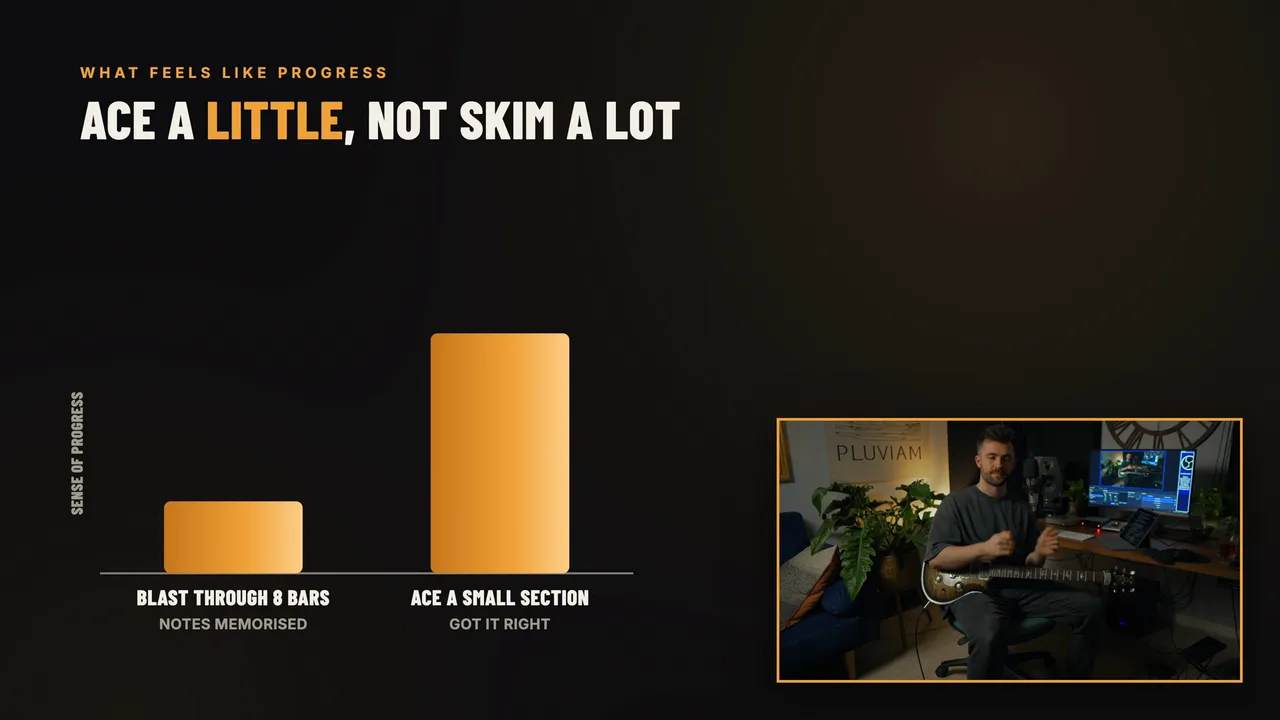
You'll also feel better about yourself. Rush through eight bars and memorise the notes, and you won't get anything like the sense of having bettered yourself that comes from truly mastering a small section.
Progress you can't measure ▶ 6:16
Speed is easy to measure. If you go from 100 BPM on the metronome to 120, you're 20% faster. But if your vibrato, timing or muting improves, there's no number for that, so it's harder to reward yourself for it.
That doesn't mean you shouldn't do it. If anything, do more of it, because it's a large part of what makes the guitar so interesting. This is where recording yourself really helps. Listen back to how you played something two months ago and you'll hear the difference, even though day by day you might never notice it.
One detail at a time ▶ 7:07
Fix every detail, but don't try to fix every detail at once. Focus on one thing at a time, over a small section of a song or improvisation. You'll see daily, or at least weekly, progress, and you'll be learning the core skills that make the guitar what it is.
Each detail you sort out makes the next one easier. Keep going long enough and you reach the point where I like to think I am now: I learn a new song and there are perhaps one or two new things to worry about. My muting isn't quite right in one section, or my string bending doesn't suit this particular song. That's manageable. If I'd never focused on the details, it could be 10 or 20 things, and that would be overwhelming.
You might be looking at that long list right now. That's fine; you have to start somewhere. Guitar is hundreds of things done right. I was going to say done perfectly, but I'm not doing them perfectly either.
So choose one song this week, pick one bar that doesn't sound like the record, and list every detail you can find in it: the picking, the muting, which fingers go where and the timing. Fix one, record it, then move on to the next.
Make it easier: instead of a whole bar, take a group of just three or four notes and look for a single detail in it, such as the muting or which finger plays each note.
Make it harder: pull apart a second, very different song as well, and look for the details it shares with the first, the way Master of Puppets and Le Freak share their right-hand muting.


