Have you ever watched great shred guitarists such as Yngwie Malmsteen, Steve Vai or Zakk Wylde and wondered how on earth they do it? The answer, obviously, is a great deal of practice. But they also have patterns to fall back on that sound exciting and interesting as they play faster. Here are five to try for yourself, whether you're just getting into faster playing or you're already a shredder.
Everything here is in A minor, three notes per string. If you don't know your scale shapes yet, don't worry. The A minor scale page shows every position, and you can work with what's here and learn the shapes properly another time.
Just play the scale, fast ▶ 0:40
People spend ages trying to develop their lead style, devising all sorts of clever ways of navigating the fretboard. In my opinion, though, nothing sounds faster than simply playing the scale in order, fast.
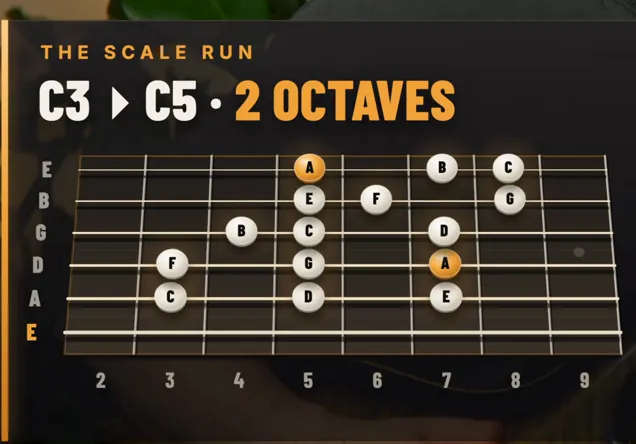
You travel from quite low notes to quite high ones very quickly, and you get a real rush of excitement as you move across the fretboard. The more exciting patterns below don't mean you have to abandon this one.
Pattern 1: each string twice ▶ 1:23
Take the same scale and play each string twice before moving on: 3-5-7, 3-5-7 on the A string, then the same on the D string, and so on. You can do the same in reverse, coming down from the high e.
The appeal is that the arrangement is very simple. You don't have to memorise anything new, but you get more of a sense of building as you move through. In effect, you get twice the value from the same notes.
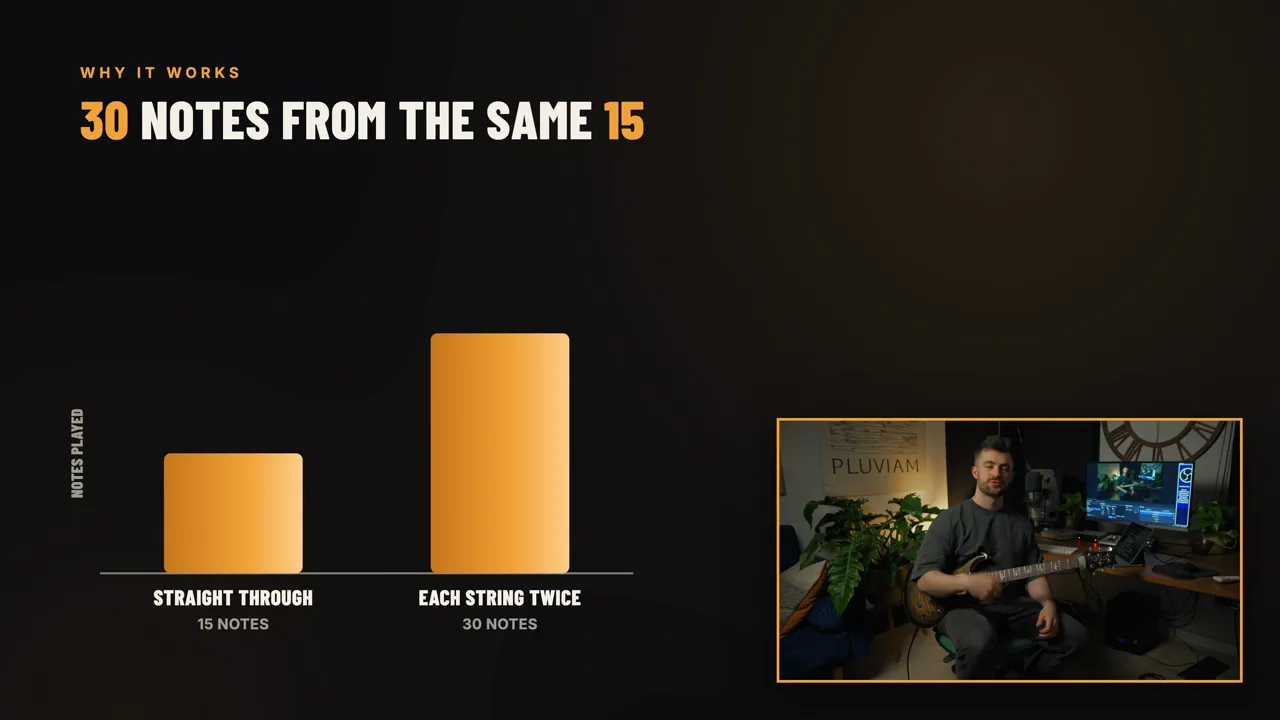
It also gives you a pleasing rhythmic overlap. Six notes per string fits neatly as triplets, but play it as straight 16th notes and the groups of six drift across the beat: groups of three or six in the space of four or eight.
Pattern 2: one note up, back down the string below ▶ 2:21
This is where most people's picking falls apart, sometimes mine included, because there's much more string changing. Play one note on the higher of two strings, then go down and back up the three notes on the string below it. On the G and D strings, that's the 9th fret on the G string, then 12-10-9-10-12 on the D string. Once you have it, move it across the scale, down through the positions on the same two strings.
Angle the pick slightly upwards, facing towards you, as you go to strike the higher string. That gives the pick an escape route, which makes the higher string easier to reach.
Pattern 3: six notes on one string ▶ 3:00
If string crossing is difficult for you, this may be the one. It's a six-note pattern on a single string: take three notes, play the highest, pick back to the lowest, then come up and back the way you came. On the G string, that's 12-9-10-12-10-9.
It looks like one of the simpler patterns because you don't have to change strings, but it's deceptively hard.
Which hand is tripping you up? ▶ 3:30
In my opinion, when it comes to synchronisation, it's often the right hand that causes problems with string crossing, but the left hand when you're on a single string. Most people can play fairly fast and evenly on one string, but try to coordinate something with the left hand on top of that and it becomes difficult. Equally, plenty of people can play legato fast across the strings, but the mistakes appear when they isolate the right hand.
Speaking of legato, pattern 3 is a popular one for legato playing too: pick the first note, then hammer on and pull off the rest.
Pattern 4: up one position, down the next ▶ 4:10
The patterns so far have been fairly static; this one gets you moving. Take any two neighbouring strings of any scale position, go up through one position, then move to the next position along and come back down. Then go up again, a little higher in pitch, and back again. It has a cascading, climbing quality, and it's excellent for building momentum.
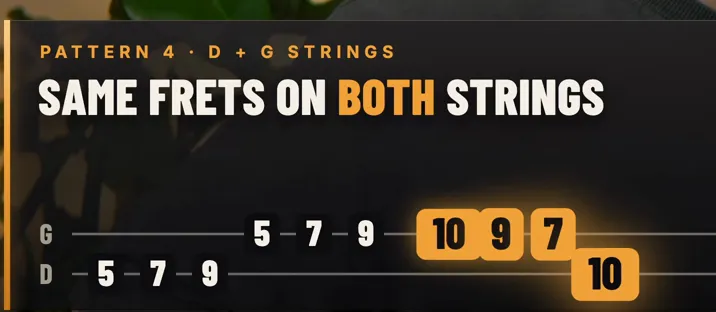
It's also excellent for fretboard awareness and hand synchronisation, because the frets change as you move. Sometimes there's symmetry, such as 5-7-9 on the D string and 5-7-9 on the G. Lower down in A minor, though, you get 3-5-7 on the D string and 4-5-7 on the G, and that small change is quite awkward.
Pattern 5: thirds ▶ 5:23
Finally, there's playing the scale in thirds. Instead of moving step by step through the scale, as the other four do, you skip a note each time.
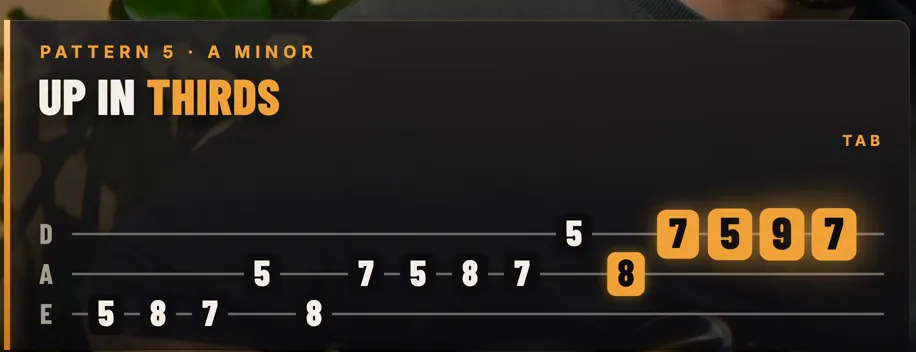
It's a far more winding, tongue-twisting pattern. It certainly needs more rehearsal, and it changes much more depending on which scale position you're in. That makes it great for your playing, and it sounds superb, with a tumbling quality as it goes up and down.
What to practise
Every one of these is in the exercise generator, so you can put them into whatever key you like. Choose one, loop it with the metronome set nice and slow, and see whether you can start connecting them, perhaps even going from one pattern straight into another. That's where things become really interesting.
Make it easier: start with pattern 1 on just the A and D strings, 3-5-7 twice on each, slowly, before adding the remaining strings.
Make it harder: once two patterns are comfortable on their own, play one straight into the other without stopping, and raise the metronome a little at a time.


