There's a super simple trick that pretty much every guitarist on Instagram seems to be doing. It's a little overdone, but it's really cool, and it's an easy way to make the most basic licks sound quite professional.
The idea: put a quick grace note, as a hammer-on or a pull-off, into each note of a simple melody.
Start with a really basic melody ▶ 0:28
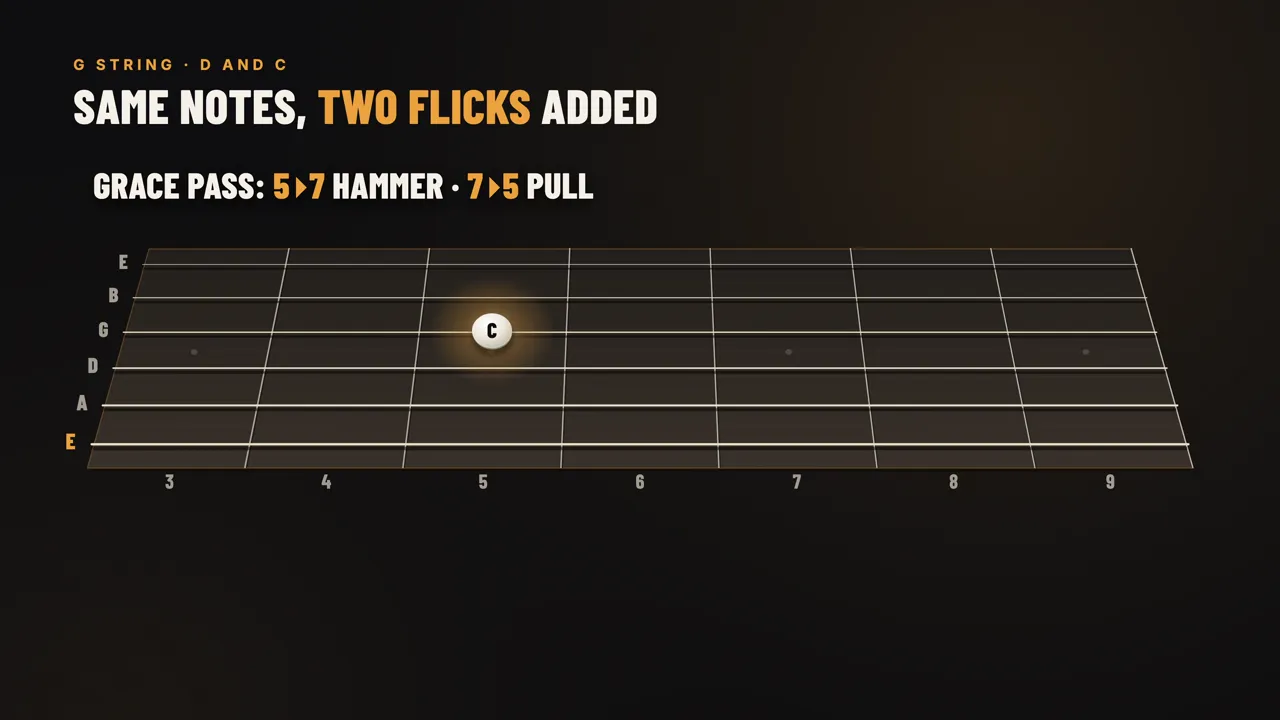
Take something not very exciting, a simple melody using the 7th and 5th frets on the G string, so D and C.
Instead of just picking the 7th fret, pick the 5th and hammer on to the 7th straight away, so the 5th is just a ghost of a note. To get back to the 5th fret, pick the 7th and pull off to the 5th. Same melody, but every note now has a little flick into it.
The key thing: be quick ▶ 0:47
You have to be very quick with this. A fast hammer-on is quite easy. Done right, the 5th fret is barely audible. You basically just hear the 7th fret note, but you know the hammer-on was there.
The pull-off is a bit harder to do quickly. It has to be really responsive, within milliseconds of picking the note. Do it too slowly and it stops sounding like a flick and just sounds like two separate notes.
Once it's working, those two simple notes have a lot more texture and a bit of a professional shine. Most notes in the line get a grace note before them, but it's still just 7s and 5s.
How to practise it ▶ 1:39
A lot of people do this with slides into notes, which is fairly easy. Hammer-ons and pull-offs are harder, especially at higher speeds. So to work on it, write a really basic melody and hit every single note with a grace note, either a hammer-on or a pull-off.
Here's another one: 8, 10 and 12 on the B string.
- Pull off from the 10th to the 8th fret.
- Hammer on from the 8th back to the 10th.
- Hammer on from the 10th to the 12th. That one felt a bit forced when I tried it, so a slide works better there.
e|-------------------|
B|-10p8--8h10--10/12-|
G|-------------------|
D|-------------------|
A|-------------------|
E|-------------------|
Suddenly it sounds much more like guitar playing than a simple melody. If a particular hammer-on feels awkward, swap in a slide. If you want to write your own melodies down to practise, the Tab Creator is good for quick ideas like this.
Don't overdo it ▶ 2:31
If you overdo it, you sound really choppy, and it's hard for the listener to follow the melody. This works best sprinkled into your more normal melodic playing. I think it sounds particularly great with a bit of a rake underneath it.
So use it sparingly, but do use it. Little details like this are the things that make great players great. Mateus Asato is a big one for this kind of playing. Watch him for a bit and it won't be long before you see him do it.
Grace notes on double stops and chords ▶ 3:11
One extra tip: you can do the same thing with a double stop or even a chord shape.
- Double stop: barre the 5th fret on the D and G strings, and do the hammer-on on just the D string. It sounds quite Hendrixy.
- Chord: barre the 5th fret on the D, G and B strings, then hammer on to the 7th fret on the D string and the 6th fret on the B string at the same time.
e|-------|
B|-5h6---|
G|-5-----|
D|-5h7---|
A|-------|
E|-------|
The melody is really just the chord, but what you hear is something a lot more interesting.
Write a four-note melody of your own today, put a hammer-on or pull-off into every note, and keep at it until the grace notes are so quick they almost disappear. Then use them sparingly in your normal playing.


