Don't you hate it when you've been scrolling and you look up and half an hour has gone? Social media, apps and even online gambling are designed to keep you hooked. So what if you stole those tricks for your guitar practice?
Here are over ten of them, grouped into six steps: make starting effortless, use the slot machine effect, keep yourself playing, feel like you're already winning, make sure you come back tomorrow, and a bonus one.
Step 1: Make starting effortless ▶ 1:16
First off, remove every bit of friction between you and playing.
- Keep the guitar ready. Plugged in, in sight, in reach, in a nice space. Decorate the area a bit. You're not going to want to play in a dingy cellar.
- Make it nice to play. The easiest thing is a fresh set of strings and a clean fretboard. Strings cost less than £10 and fretboard cleaner and polish are pretty cheap. If you haven't done it for a couple of months, just do it. It'll sound better and you'll play better. An older or cheaper guitar might need a setup, which isn't a super expensive job. If the frets are buzzing and it's never played right, it might need a fret level or even a refret. Those cost more, but they're well worth it if they get you playing again.
- Hijack your algorithm. Search up a load of guitar videos, find guitar stuff on Instagram, and like it, save it, send it to people. Soon your feeds are full of guitar. I watch a lot of videos about growing a YouTube channel, and having them in my feed makes me want to come up with new ideas. All you might need is the one video that makes you pick the guitar up.
- The one-minute rule. Every day, and especially on the days you don't feel like it, say you'll play for one minute. Once the guitar's in your hands, it's hard to play for less than five. You get a bit lost in it. And 10 or 15 minutes is something, and it keeps the habit there.
Step 2: The slot machine effect ▶ 3:56
Slot machines, and as far as I'm concerned Instagram too, give you just enough wins that you keep going. Win every time and the novelty goes. Never win and you stop playing.
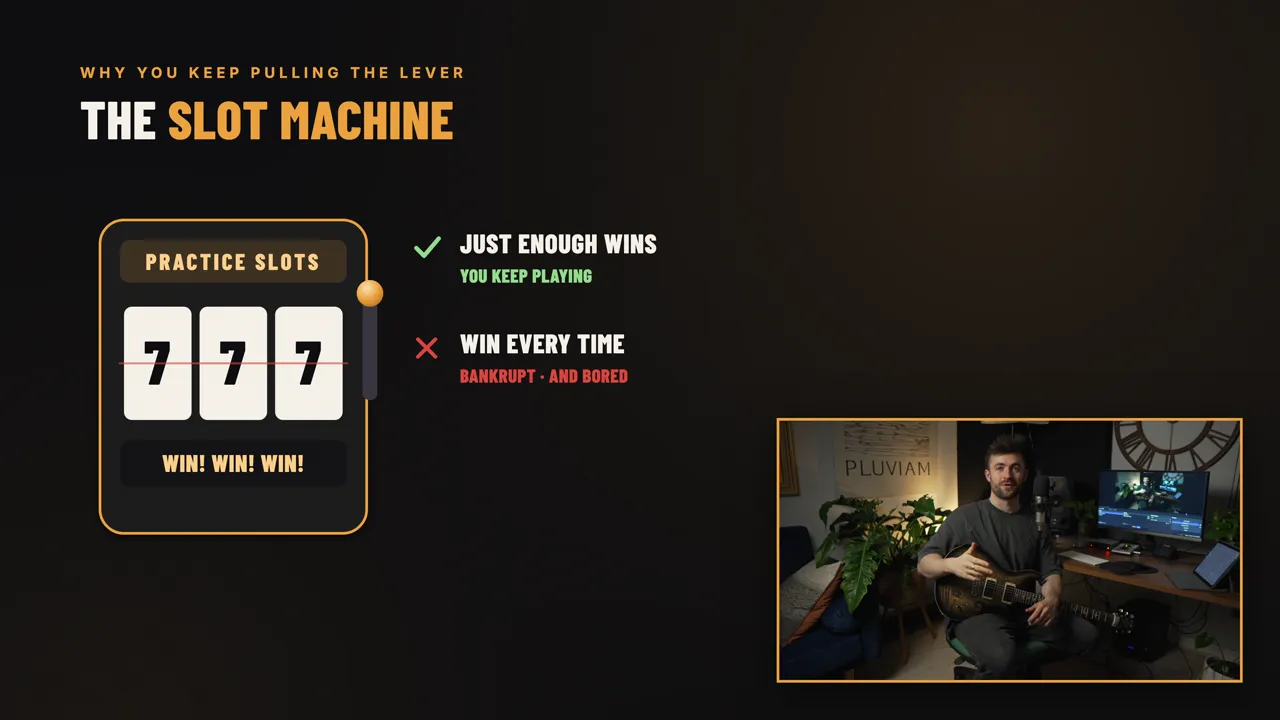
So practise things at the edge of your ability, or play your exercise at the edge of your ability, enough that maybe one or two attempts in ten sound good. You don't know which attempt is going to land, so there's an element of luck. A short exercise can be played five or ten times a minute, so that's a few wins a minute to keep you going. This isn't about the optimal balance of clean practice against pushing speed. If you're not picking the guitar up as much as you'd like, getting you to pick it up is the only thing that matters for now.
Then add novelty:
- Try something new every day. Maybe for 30 days. The point isn't necessarily to get better, though you probably will. It's to get you interested again. Or for a bit of balance, a new thing every two or three days. If you sit on one song for months, flip it and do a new song every day for a week.
- Lucky dip. Write down 10 to 20 things you actually want to practise, put them on bits of paper in a jar, and pull one out. That's today's practice. Will today be the really fun one? That little gamble keeps you interested.
Step 3: Keep yourself playing ▶ 6:22
The obvious one: no cue to stop. If you're practising to a metronome, press play and leave it running, even while you're not playing, and dip in and out. If you're improvising, queue up an hour of backing track and see how far you get. If you're working on part of a song, loop it in an app like Songsterr.
You also need some actual wins, and the best way to get them is to nail a really tiny bit of music: four to eight notes. It might sound boring, but if you start playing it well you won't get bored, and if you ace it, add another four or eight. Sit down for 20 or 30 minutes with no distractions and you'll struggle not to improve on four to eight notes. Do that over a week and you might have a whole section of a song.
People get short-sighted. Most would be happy to learn the song they want in a month, but they try to do it in a day and get frustrated. Defer that gratification a little and it goes a long way.
Tracking is a bit of a double-edged sword. If you're making progress, writing down the tempo of an exercise or how many bars of a song you've got feels good, so track it. But if you've plateaued and you're a bit stuck, stop measuring anything and just play for the sake of it. There's probably progress happening in your head that just hasn't shown up on the fretboard yet.
Step 4: Feel like you're already winning ▶ 8:56
Think about a coffee shop loyalty card that comes with two stamps already on it. You feel like you're already some way to the free coffee.
So if you want to play something at 200 BPM and you can already play it at 100, write down that you're 50% of the way there. In real terms you're not, and nobody plays anything at 1 BPM and calls it 1%. But as a psychological trick, I think it works. If you've aced the intro of a song and you're stuck on the verse, and the intro is 10% of the song, you can play 10% of the song.
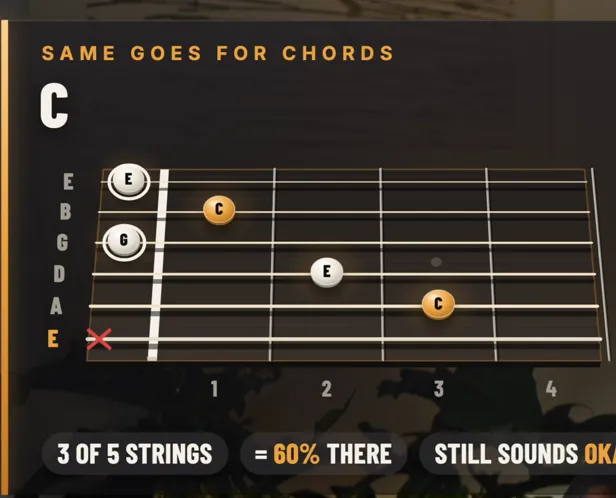
Same goes for chords. If you can play three of the five strings of a C chord, you're 60% of the way there, and for the record, three notes out of five on a C chord sounds okay. The guitar isn't a binary instrument where it's either right and good or wrong and bad. There's a very real middle ground where you sound all right, and you can feel good about that.
Step 5: Make sure you come back tomorrow ▶ 10:35
Think about a Duolingo streak. I have loads of friends with 500-day streaks who can't speak another language. That's not meant to be discouraging. Anyway.
- Keep a streak. Just tick off each day you practise. You don't even have to write down what you did. When I went on a mini diet recently I logged my weight every day, and even when the number didn't move, logging it got me up. The practice log does this nicely.
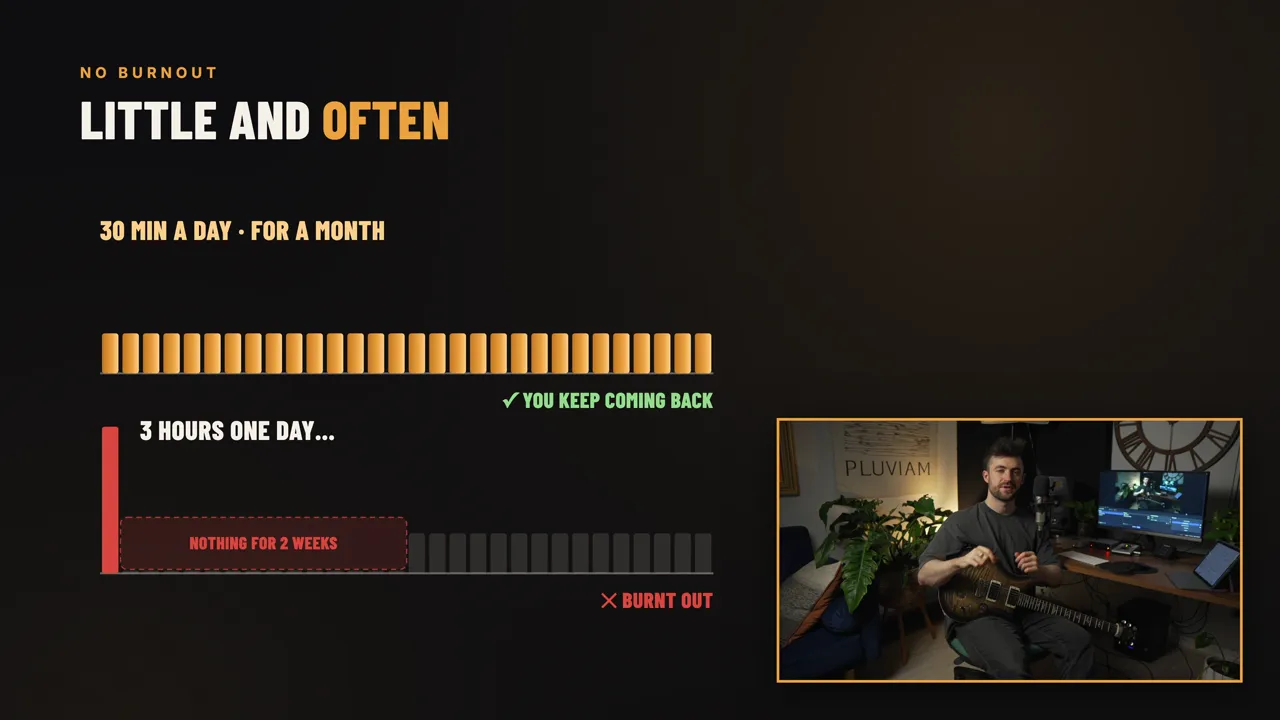
- Use cliffhangers. Stop just before you feel done. If you're making great progress, stop. It feels counterintuitive, but I'd rather you practise half an hour a day for a month than three hours in one day and then not come back for two weeks. Leaving on a high also stops you burning out and running into a rut, which leaves a sour taste.
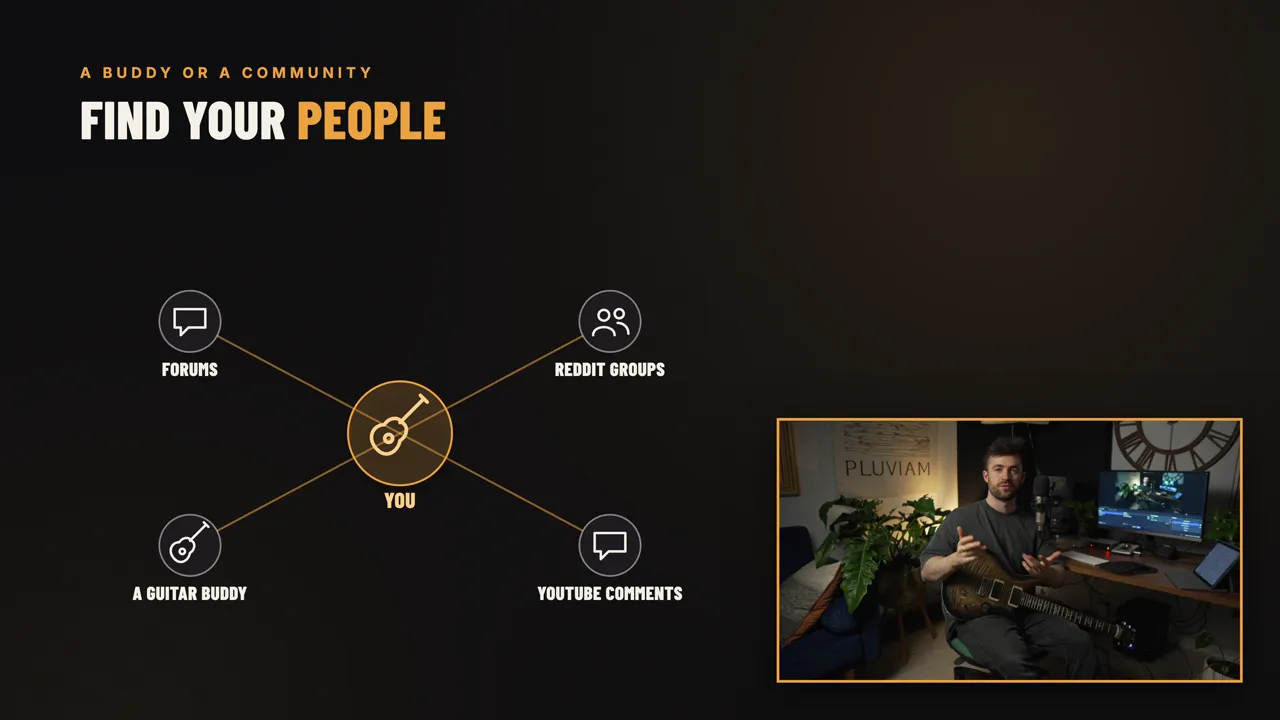
- Find a buddy or a community. Forums, Reddit groups, even YouTube comment sections, plus local jam nights or just going to gigs. Having people around you who play keeps you accountable and keeps guitar at the front of your mind. It stops being just a hobby and becomes part of your social life, and in a world where everyone feels a bit disconnected, that's really important.
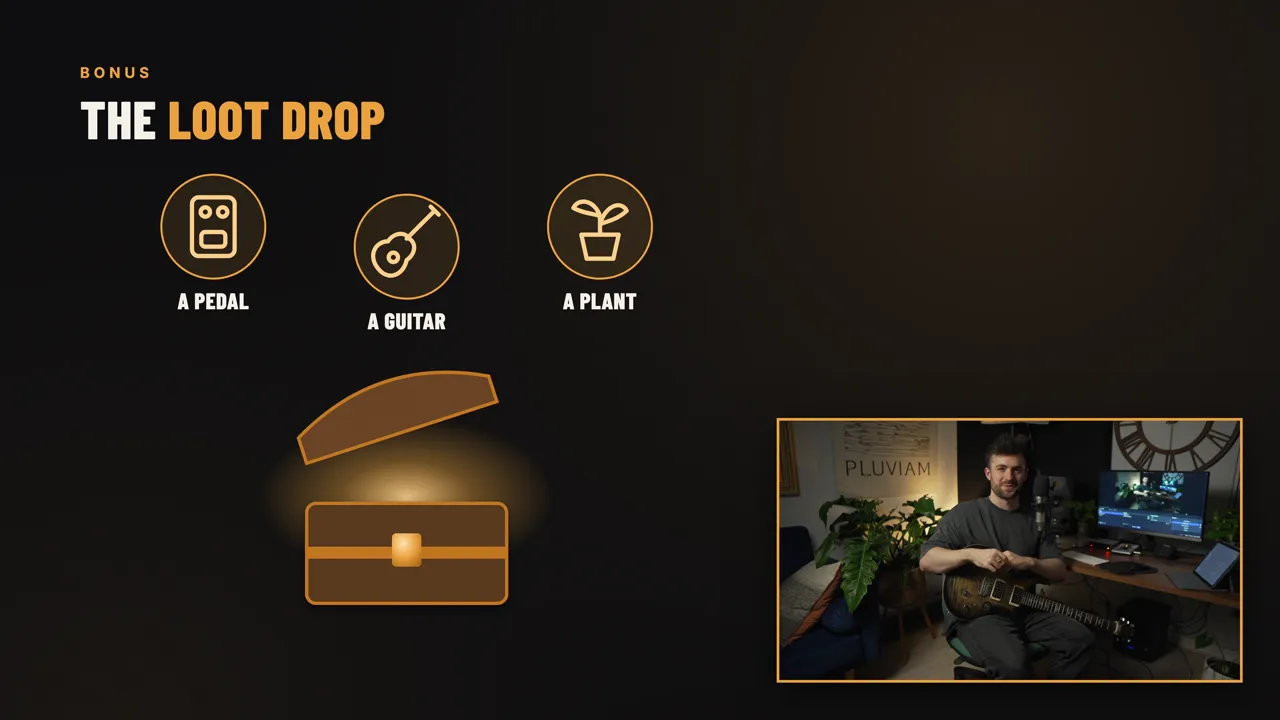
Bonus: the loot drop ▶ 13:00
This is the one your other half is going to hate. If you have the money, buy something new: a pedal, a guitar, or just a plant for the practice room. Sometimes all you need is that startup energy. A new guitar doesn't have to cost thousands. A couple of hundred can get you something different from what you've got. I saw a Gretsch for about £300 and quite fancied it, but I'm trying to be sensible.
Pick three of these tricks, start them today, and see how your practice feels after a week. For something new to try each day, the free Exercise Generator and Backing Track Creator are a good place to start.