There's a study called The Hidden Cost of Personal Quantification. The idea is that when people quantify and measure things, they do them more, but they enjoy them less.
It's really common to measure your progress on the guitar, and that can be a great way to monitor your practice and know what to adjust. But measurement can also turn guitar into an exercise, something that has to be achieved, rather than something you do because you enjoy it. Here's why, and what to do instead.
When the number becomes the goal ▶ 0:29
There's a thing called Goodhart's Law. It says that when a measure becomes the target, it stops being a good measure. In other words, you start playing guitar just to hit the BPM you're after, or to tick off the solo, or whatever it is you're measuring.
I've got things I want to achieve on the guitar, and I'm sure you have too. But counterintuitively, I'd bet that you and I will get there far quicker if we stop thinking about them so much.
If you worry about it, you probably don't need to ▶ 1:02
I can relate this to conversations I have with friends who tell me they're worried about something, like underperforming or not showing up for someone. I often end up saying: if you're the kind of person who worries about this, you're probably not the kind of person who needs to. It's already at the front of your mind. Ironically, the people who need to worry are the ones who don't think about it at all.
It's the same with your guitar goals. If you're conscientious enough to measure things, you're probably conscientious enough to get there without measuring them.
Rewards can kill motivation ▶ 1:33
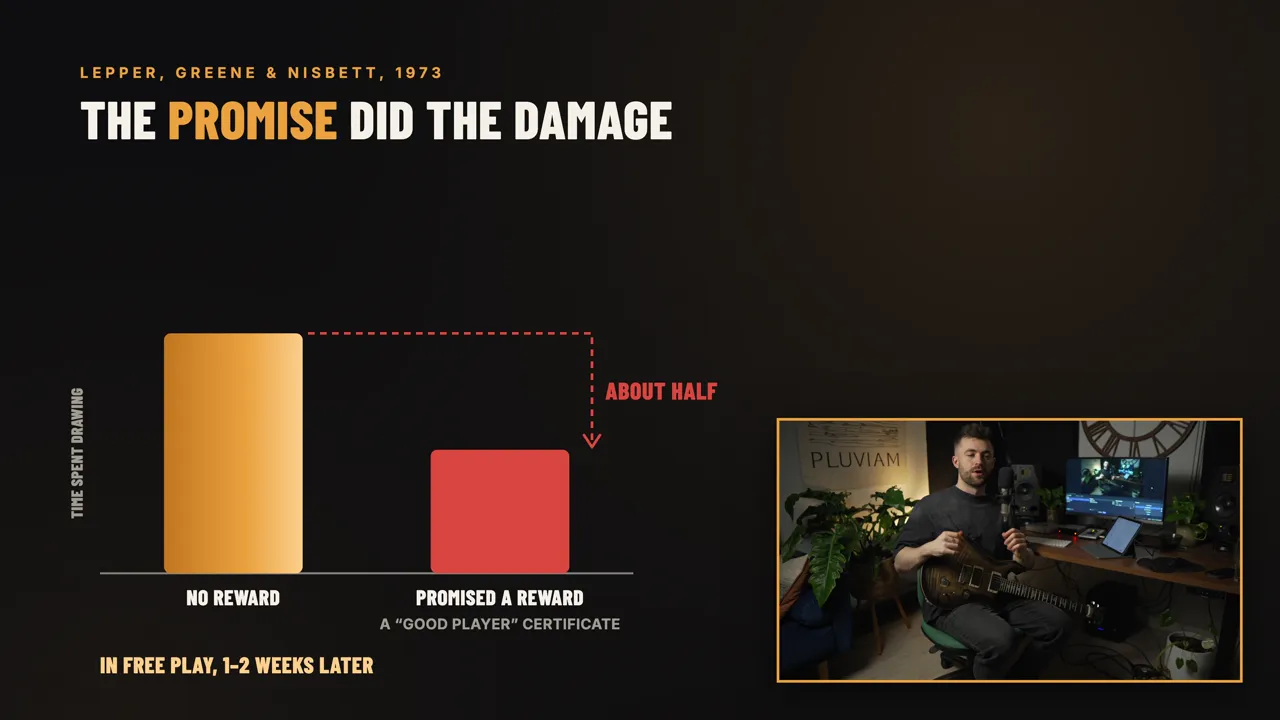
One more study. You don't need to remember all of these, I just looked them up anyway. It's about the overjustification effect. Kids who already loved drawing were given rewards for drawing, and they started drawing less. The reward killed the motivation for the very thing they already enjoyed.
So ask yourself why you're playing the guitar. If you've got goals, like playing open mics, jamming with friends, joining a band or writing your own music, then sure, there are some things worth measuring. But measure them selectively.
Measure one session, not months ▶ 2:05
If you're going to measure your playing, I'd measure it over one session, not over weeks and months. You can achieve quite a lot in a single session.
I always say if you're practising for an hour, don't do more than two things, three at absolute most. Maybe just one thing for the whole hour, and by one thing I mean a bar of music, maybe a couple of bars, and really nail it. That's something you can measure and improve on in the moment. Once you've done it, put it aside and come back to it the next day.
The plateau problem ▶ 2:35
A little graph of your BPM going up each week might look nice, but it won't go up forever. Everyone knows about plateaus, and they're very real. When the line stops going up, that measurement is going to really suck to look at.
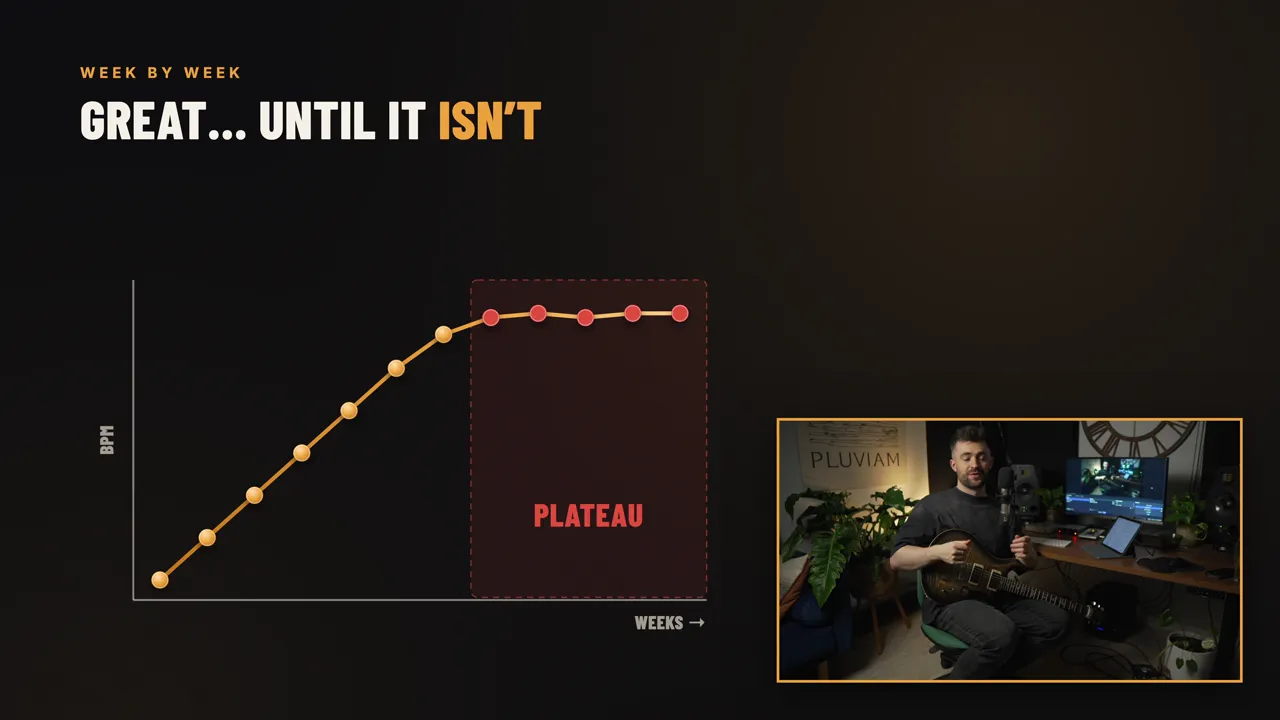
You could argue measuring helps you spot a plateau you didn't know you were on. But I'd argue that if you experiment enough, you'll naturally avoid most of them. Keep changing things: your wrist angle, how you hold the pick, how you approach your soloing. Plateaus become less common, or you find your way round them in creative ways.
Track inputs, not outputs ▶ 3:12
If you really do want to track something, track your inputs. How much time are you spending on the fretboard? What are you doing each day? That's not so much measurement as evidence that you're doing the thing, and evidence is what you really need.
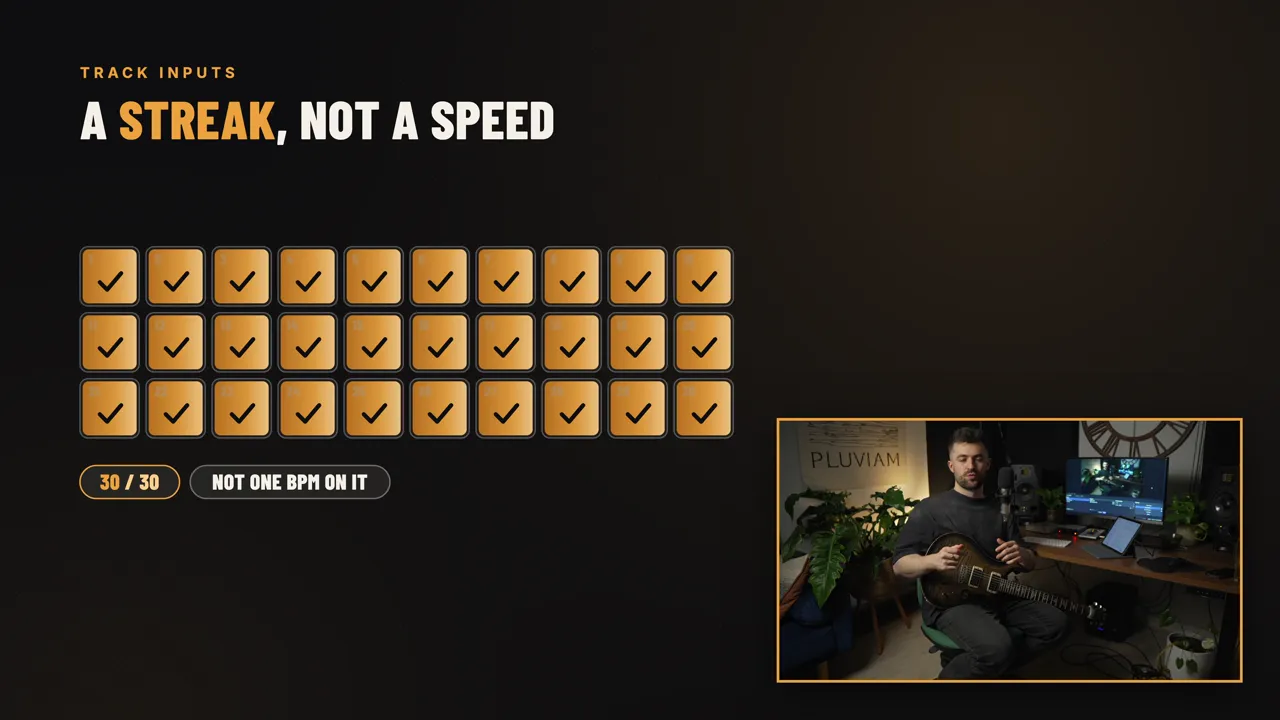
If you can see that you showed up and did something for 30 days in a row, that's motivating in itself. If you look at 30 days of a line that isn't going up, it can be pretty hard to show up on day 31.
There's a practice log on my site, but honestly I think the best thing is your own pen and paper practice diary. Don't make it a chore. Keep it right by your amp and just write a few bullet points or tick boxes: warmed up, exercises, pentatonics, a bit about your improvising, whatever you're working on. Draw a line under it and do the same tomorrow.
Play more, measure less ▶ 4:02
For most guitarists, unless you're playing for hours a day, you'd be much better off spending that time playing a bit longer than measuring anything. If all you want is to sit down and enjoy playing, I'd argue there's almost nothing you need to measure.
Next time you sit down to play, think about what you're really sitting down to do. Pick one or two bars to nail in that session, tick a box when you're done, and leave the graphs alone.