If you're an intermediate guitarist and your improvising feels a bit stale, there are loads of things we could talk about. But there's one principle that gets overlooked all the time, and it's the simplest thing in the world.
Pick less.
That sounds like the whole lesson, and you might be thinking, right, got it, off we go. But there are a couple of ways of thinking about it that will help you actually use it.
Why your licks sound uninspired ▶ 0:30
One of the main things I hear in a lot of players is a lack of techniques beyond picking. And not only that, they don't string their techniques together. So they pick through some notes, do a little hammer-on or a slide, and then pick the rest.
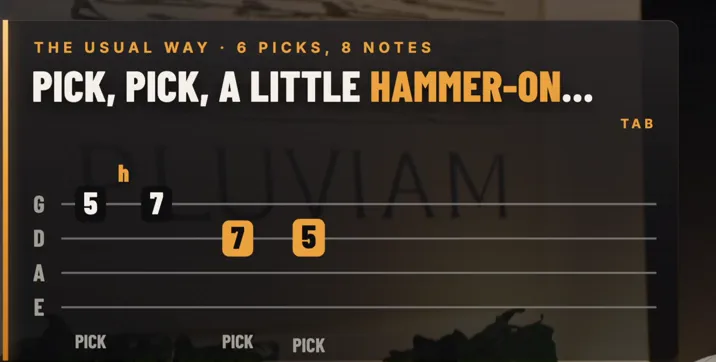
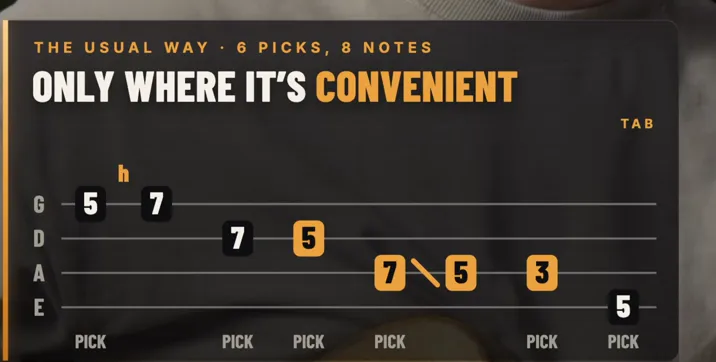
The other thing is that those hammer-ons and slides tend to only turn up where they're physically convenient. A slide that lands you back on the root note of the pentatonic scale is really easy to do, so that's where it goes. And because of that, it doesn't feel like a very inspired idea.
What compound techniques are ▶ 1:03
So with this pick less idea, we're going to look at compound techniques. That's simply stringing together more than one technique in a row. Hammer-on into a bend, bend into a slide, slide into a pull-off. The combinations are pretty limitless.
Building a lick with one pick ▶ 1:20
Let's build one. Start on the G string and pick the 5th fret.
- Hammer on to the 7th fret. That's two notes we could have picked, but we didn't.
- Bend the 7th fret up to the pitch of the 9th.
- Slide up the neck to the 12th fret and do another whole-tone bend.
- Finish with a little pull-off to the 10th fret.
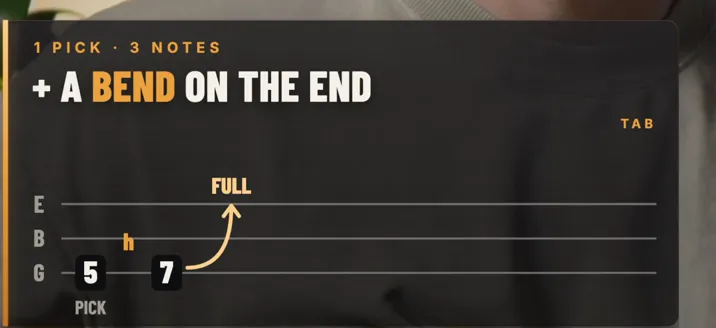
Funnily enough, if you strip the techniques out, what you're playing is essentially just a major scale. Pick each of those notes one at a time and it sounds pretty flat. Play the same notes with one pick and it's immediately so much more vibrant.
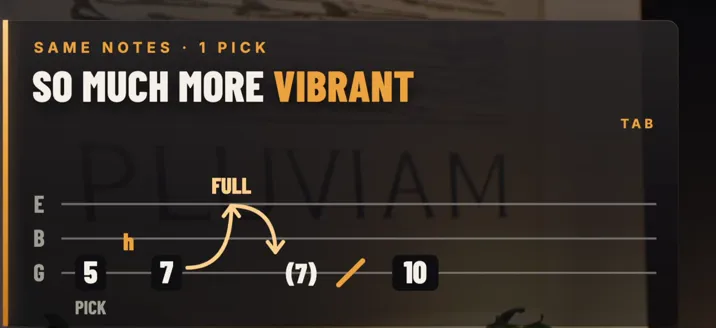
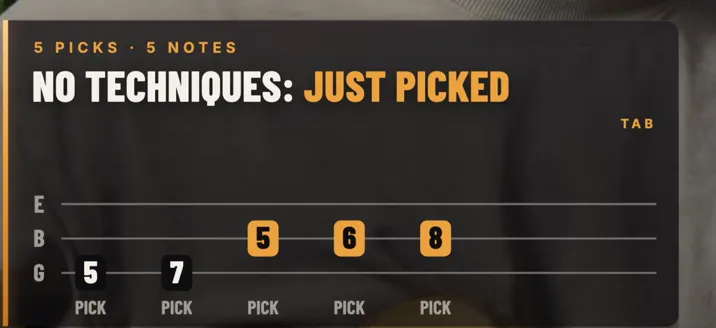
That's also why I moved the second bend up to the 12th fret. If you keep going in a straight line you're just following the major scale again, so sliding further up the neck for the next bend makes it more interesting.
Where you start and end phrases like this depends a lot on which chord tones you're trying to target and the vibe of the backing track. So what sounds a bit odd in isolation might sound brilliant over the right track.
Blurring techniques into one idea ▶ 2:53
Now, to get a bit more interesting, you can really start to force these techniques together so they overlap rather than happen one after another.
Here's one you'll hear people do quite a lot. Play the 7th fret on the G string and do a bluesy bend up to the pitch of the 8th fret. While the bend is still up at pitch, slide up to the 8th fret and back, then pull off to the 5th fret. That's a bend, a slide and a pull-off, but the bend and the slide blur into one idea.
You can do a similar thing with a hammer-on into a bend. The moment the hammer-on lands, start the bend. So it's not 5, 7, then bend. It's straight from the hammer-on up into the bend in one movement.
Take that a step further: pick the 5th fret, hammer on to the 7th and straight into the bend. As the bend comes down, slide back two frets to the 5th and do a full-tone bend back up to the pitch of the 7th. Notice how much more colourful that sounds than just picking a few notes in the same spot.
Why you don't need the pick so often ▶ 4:00
All the while, you're barely picking at all. That also makes it a really good way to start playing faster, because your right hand just doesn't have to do as much.
Think about it. You probably use the pick 70, 80, 90% of the time to make a note. But why do you need to? Once you've picked the first note and there's sound coming out of the guitar, there's no reason a picked note is better than a hammer-on, a pull-off, a bend, a slide or a tap. We just default to picking throughout.
Dynamics and texture are such a massive part of your playing that it's well worth introducing more unpicked variations.
The one-pick challenge ▶ 4:38
Here's an exercise. Put on a backing track, pick one note, and see how far you can go without picking again. Go as far as you naturally can, then pick again, maybe on a different string this time, and build another phrase from there.
Mateus Asato is fantastic at this. Not only that, but he has great picking dynamics, so when he does pick, the attack varies a lot and it doesn't always sound the same. That's worth listening out for too.
If you haven't got a track handy, make one in the Backing Track Creator, set it going and have a go at the one-pick challenge over it. Have a play around with it and see how far one pick can take you.


