Why is it so hard to play faster than 120 beats per minute? The sticking point could be 80, 100 or 150, yet it is nearly always 120. You tick off 80, then 90, then 100, and as you approach 120 progress stalls in what feels like the Bermuda Triangle of tempos.
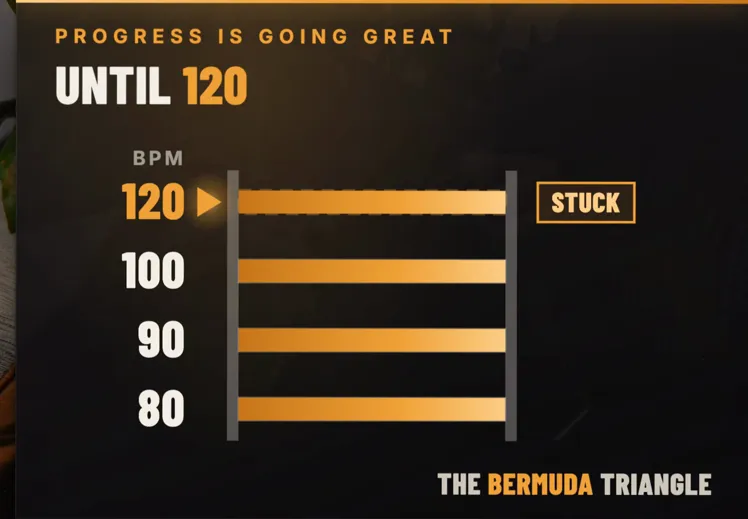
Below is my reasoning for why the plateau sits there, a practical way over it, and three quick tips for the finish line.
Why guitarists get stuck at 120 BPM ▶ 0:48
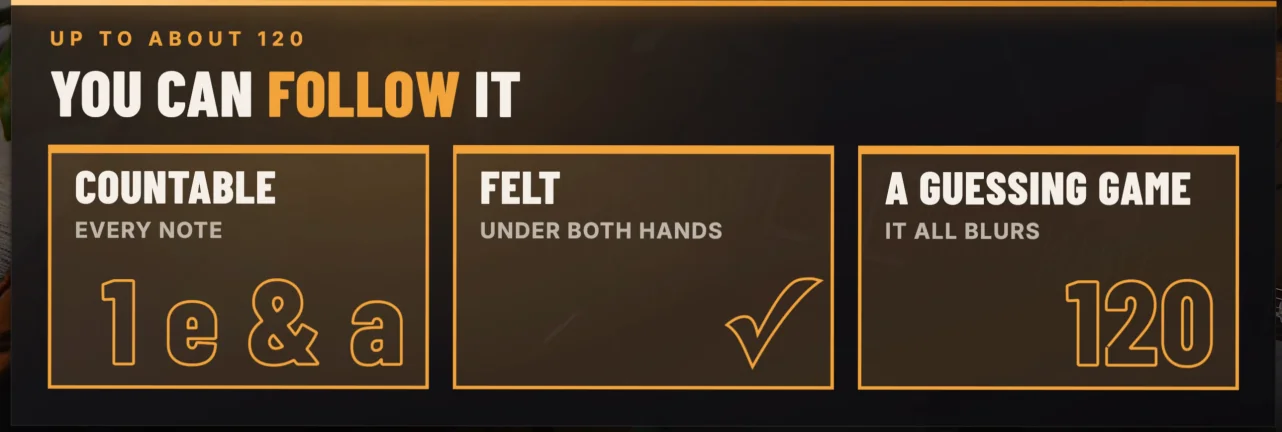
My view is that everything up to around 120 is countable, and you can feel every note under the fingers of both hands. Near 120 it becomes a guessing game. If you could freeze time mid-run, there is a good chance you couldn't tell me exactly which note or which string you were on. Sixteenth notes at 120 BPM are eight notes a second, and the mind-muscle connection isn't there yet. That is what we need to develop.
Build the mind-muscle connection ▶ 1:24
Anyone who trains seriously in the gym talks about the mind-muscle connection: noticing which muscles you are using, so that your form builds the right ones. Swing your whole body through a bicep curl and you are working far more than your bicep.
We can do the same on the guitar with anything you are working on. I use the first octave of G major in 2nd position, at whatever speed lets you feel every note go past.
e|-------------------|
B|-------------------|
G|-------------------|
D|-------------2-4-5-|
A|-------2-3-5-------|
E|---3-5-------------|
     D U D U D D U D   pick
     2 4 1 2 4 1 3 4   finger
Feel the string buzz each time a finger goes down: under my second finger on the 3rd fret of the low E, under my little finger on the 5th, and so on. Then do the same with the picking hand: the direction of each stroke, which string you are on, the pick passing through the string. I economy pick this, so I know it went down, up, down, up, down, down, up, down, while the fretting fingers went 2, 4, 1, 2, 4, 1, 3, 4. Near your limit, around 120 for many people, that awareness erodes into a blur.
Set the metronome to a comfortable tempo and stay aware of exactly what both hands are doing at every moment. That may humble you, because you might need to play very slowly. Beyond about 120 your conscious mind can't monitor all of this, so it has to be automatic, and for most players it isn't yet.
Stop looking at the guitar ▶ 3:32
The best way I know to feel the frets is to stop looking at the instrument. If that sounds daunting, the feeling is telling you something: you don't really know where things are while you play.
Eyesight is a slow sense to rely on. Your eyes take in what is happening, pass it to your brain, and only then do your fingers find out. Stare at a point on the wall instead (or at whatever posters you have up; I won't ask) and you can home in on what you are playing. Students of mine who struggle with timing always improve when I tell them to stare at the wall, because they stop focusing on the instrument and tune in to the music.
What does "stuck at 120" actually mean? ▶ 4:23
Nobody seems to ask this. A couple of notes at 120? A whole passage? Part of a song? I think most people mean playing comfortably and consistently, on demand, at that tempo, and for that your subconscious has to know exactly what you are doing at every moment.
In any other skill you wouldn't expect that without building up to it in small increments. Yet many guitarists assume that if they can play something at 100 or 110, everything they play will work at 120. It won't.
Start at 120 with just two notes ▶ 5:18
Train it with tiny, embarrassingly tiny, amounts of music. Set the metronome to 120, think in sixteenth notes (four to each click), and play only the first two notes of the scale: the 3rd and 5th frets of the low E. I fluffed it on my first go.
Then try three notes. If you get stuck at three, or even two, stay there for a while. Notes 2 and 3 cross from the 5th fret of the low E to the 2nd fret of the A, so watch the picking hand. I pick the three notes down, up, down, so notes 2 and 3 are always up, down. Keep that the same every time. If they give you trouble, go back to notes 1 and 2, then play 2 and 3 on their own, feeling which string you are on, then combine all three at 120.
Add the fourth note, the 3rd fret of the A string, the same way: if notes 3 and 4 are the problem, play just those, or 2, 3 and 4, before all four. You can always drop the tempo a hair, to 110 or 100, to recalibrate, then go straight back to 120.
Four notes may not feel like much, but instead of attempting the whole scale and failing every time, you have ticked something off. Add another four tomorrow, or even one more, and you are at five.
Go micro, not macro ▶ 7:55
Most people try to build a whole passage up to 120. I am asking you to do the opposite: start at 120 with a tiny part of it. If you can't play three notes at 120, slow them down, build them back up, and branch out from there.
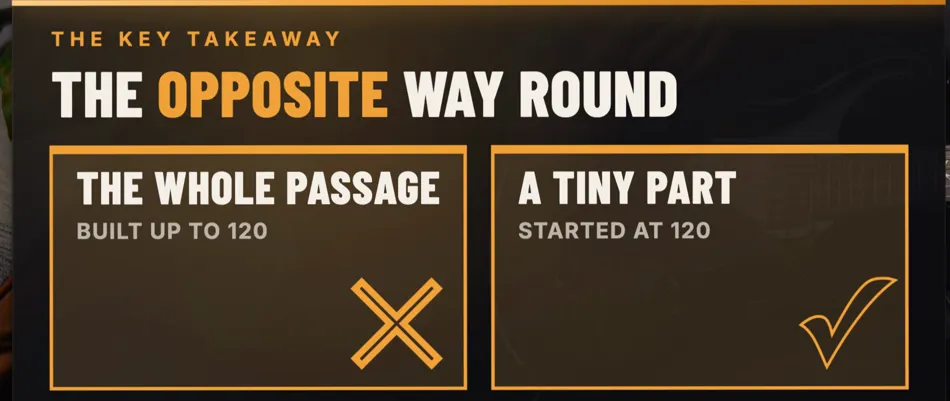
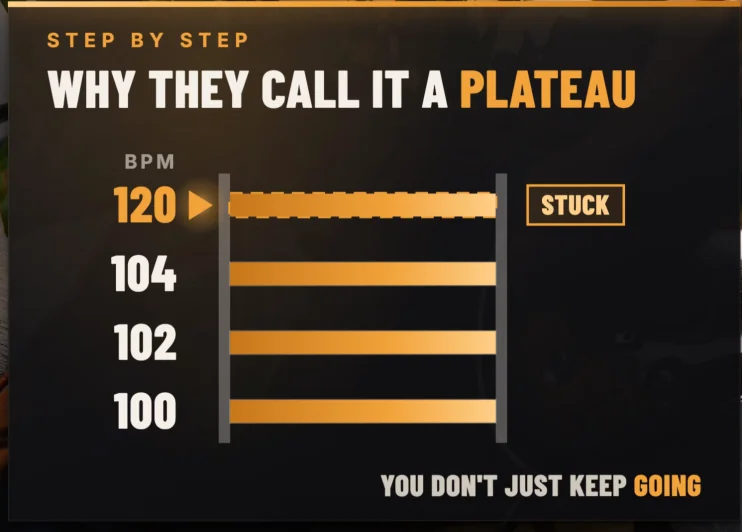
Stepwise progress, 100, 102, 104 and so on up to 120, suits some players. But that is where most people get stuck, which is why it is called a plateau: you don't keep climbing forever. Going micro means speeding up a tiny portion of music rather than the whole thing at once.
Three quick-fire tips ▶ 8:57
Make sure each hand can play it on its own. Most people check the fretting hand (fingers 2, 4, 1, 2, 4, 1 and back) but not the picking hand. Can it play down, up, down, up, down, down, up, down by itself (or strict down, up if you alternate pick), at 120? Can the fretting hand put the notes down at 120 without the pick? If either hand can't manage alone, the two together will very likely struggle. I find the picking hand the harder test: without the fretting hand to tell it where to go, and once you stop watching the neck, it can fall apart.
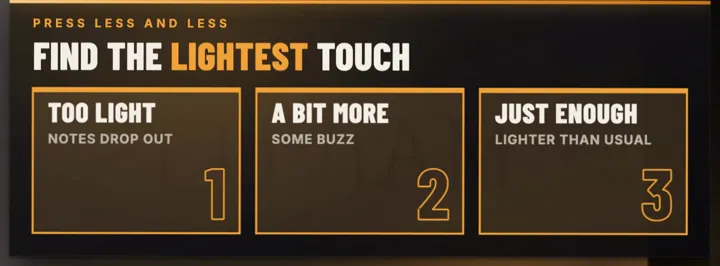
Relax the fretting hand. Press so lightly that notes drop out even on the right frets, then a little more until they buzz, then a little more until they sound. I ended up pressing more gently than I normally do, and you probably will too. Repeat that reset every ten minutes.
Cruise at 130. Set the metronome to 130, perhaps 140, play a few notes as before, then come back down. Much of playing faster is not panicking at speed, so accuracy up there doesn't matter yet; the aim is to feel comfortable. You may still not be accurate, but you might feel a weight lift, and feel more able to picture and connect with the notes on the fretboard.
There may be no hidden answer ▶ 11:55
One last point, which won't sell any guitar courses but might be true. If you feel you have tried everything, you may simply need to keep going, practise more, or examine how you practise. It is easy to feel down if you suspect the answer is buried away somewhere, and YouTube is a great place to convince yourself of that: your hand position, your guitar, your strings. Those things do add up, and everything above is valid, as are many other teachers' answers. But if you keep practising, you will probably get over it.
I find a lot of comfort in knowing that if I just keep doing something, eventually I'll get there.
Today, set a metronome to 120 BPM, think sixteenth notes, and play only the 3rd and 5th frets of the low E without looking at the guitar, feeling every note and every pick stroke. When that feels solid, add the 2nd fret of the A string, picking notes 2 and 3 up, down every time. Tomorrow, add another note or two.