What if I told you that you're a thousand mistakes away from being able to play exactly what you want to play? It sounds like a lot, but in many ways it isn't.
Suppose you had two options: get all thousand out of the way as soon as you can, or let them drag on for years. You'd choose the first. Here's how to think about mistakes in that way, how to count them, and how to get through them more quickly. Everyone makes mistakes, so we might as well enjoy making them.
What a video game boss fight teaches you about mistakes ▶ 0:43
Think of the final boss fight in a video game. (Apologies to anyone I've lost already; stick with me.)
You start the fight and he beats you straight away. You work out his first move and adjust to it, and he soon beats you with something else. You keep losing, and it takes a great many attempts, but you get further each time. You keep pressing different buttons and trying different combinations until one of them lets you survive a little longer, and eventually you beat him.
You may feel that your guitar playing is stuck in the losing part of that fight. The trouble with guitar is that everything is a boss battle, and there's always another one after it, but that's a separate problem.
"Don't practise your mistakes" can go too far ▶ 1:24
You'll often hear that you shouldn't practise your mistakes, because they'll become a habit you then have to unlearn. There's certainly some truth in that, but it's possible to go too far the other way.
Here's the reframe. Imagine there are a thousand mistakes between your first attempt at an Eddie Van Halen lick and getting it right. (A lick, not a solo. A whole solo could be a few thousand if you're anything like me.) That's daunting. But how many of them could you get through in a day? Probably a good number.
It's impossible to put a real figure on it. What I tell my students is to imagine there are a thousand mistakes between them and what they want to play, and that they can either get them out of the way now or spread them over several years.
Count your mistakes with a tally ▶ 2:10
If that still feels like a lot, there's a simple way to take the pressure off. Start counting them.
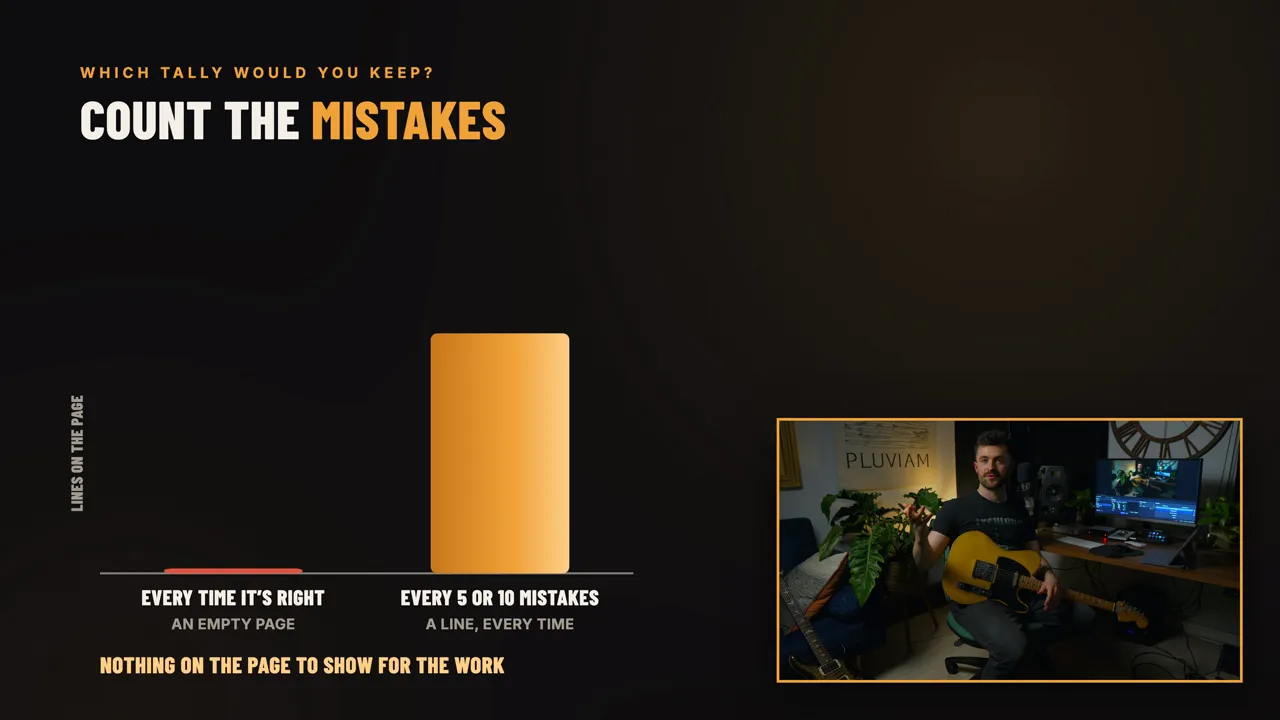
It's awkward to put your pick down and make a mark every time you slip, so count every five or ten mistakes in your head, then draw a small tally line on a piece of paper and carry on. Suddenly your benchmark is making mistakes.
That feels counterintuitive, so think about it the other way round. If you drew a line every time you got it right, that would be fine while things were going well. When they weren't, you'd be left with an empty sheet of paper, criticising yourself because it wasn't quite there. Admitting you made a mistake, on the other hand, is something I'm sure you'll do quite happily.
You probably won't need a thousand, either; it depends on what you're working on. With each set of ten, the mistake should become less noticeable or happen less often.
Your mistakes repeat, and that's how you fix them ▶ 3:05
Once you start keeping track, you'll probably notice that your mistakes repeat. It's very rare to make one mistake and then a completely different one.
Say you're aiming for the D string and you hit the G string. If you miss again, the chances are it'll be the G string again, and again, because the real mistake is that you're overshooting. If you rarely make that mistake, you won't realise overshooting is your habit; you'll only know that you miss now and then. Make it often enough and you'll think, hang on, I keep doing that.
Then you can train it. When you go for that note on the D string, draw the pick back ever so slightly. You may need to slow down to manage it (a metronome helps), but now you know exactly what to fix.
Practise a tiny part, not the whole passage ▶ 4:08
Even a hundred mistakes can feel like a great deal of time. If that's how you feel, look at how much of the music you play on each attempt.
Say your mistake is that change from the D string to the G string, and it's two notes in a 32-note passage. If you play the whole passage, get it wrong and start again from the top, you spend a lot of extra time and energy on the parts you already play correctly.
When it comes to fixing mistakes, I have students focus on a trivially small part of the music: two notes at least, because you want to connect things together, and up to five or six. Playing that a hundred times feels nowhere near as daunting as playing the whole passage a hundred times.

Once it feels fixed and you want to work it back into the four bars you're learning, extend it gradually from either end. Add a note on each side so that a four-note chunk becomes six, then eight, ten and twelve. Before long you'll have tied the whole thing together.
It works for things you can't measure, too ▶ 5:11
It doesn't matter what you're working on. It might be something measurable, such as your speed, your pitching or hitting chord tones, or something much harder to pin down, such as your feel, your vibrato or your choice of chords. All you're counting is how many attempts you've had, or, oddly enough, how many you got wrong.
Say you're working on the feel in your soloing. Draw a tally line for every ten licks that don't sound right. When a good one does come through, you'll really notice it. You'll notice yourself noticing, and you'll ask what you did there. The same applies to voice leading in your chords, or anything else.
Things often don't make sense until afterwards. Some things you have to bulldoze your way through before they add up. Perhaps that's just how my brain works, but I doubt I'm the only one.
You're going to make the mistakes anyway. Might as well start counting them.
Choose one lick you keep fluffing and put a piece of paper next to your guitar. Find the two or three notes where it actually goes wrong, loop only those, and draw a line for every ten mistakes. Give yourself a small pat on the back for each line, and when it feels fixed, add a note on each side and keep going. If you like keeping a record, there's a practice log on my site, but a pen-and-paper tally is all this needs.
Make it easier: loop just the two notes where the mistake happens, slowly, and count every five mistakes rather than every ten so the lines come quickly.
Make it harder: once the two-note chunk feels fixed, keep adding a note on each side until you're back to the full passage, and keep the tally running all the way.