Guitar advice tends to arrive as a rule: always do this, never do that, learn this first. I took twenty of the most common pieces and ranked them from S tier, the best, down to D tier. One judgement kept returning as I went: much of this advice is too prescriptive, and whether it is any good depends on what you are trying to achieve.
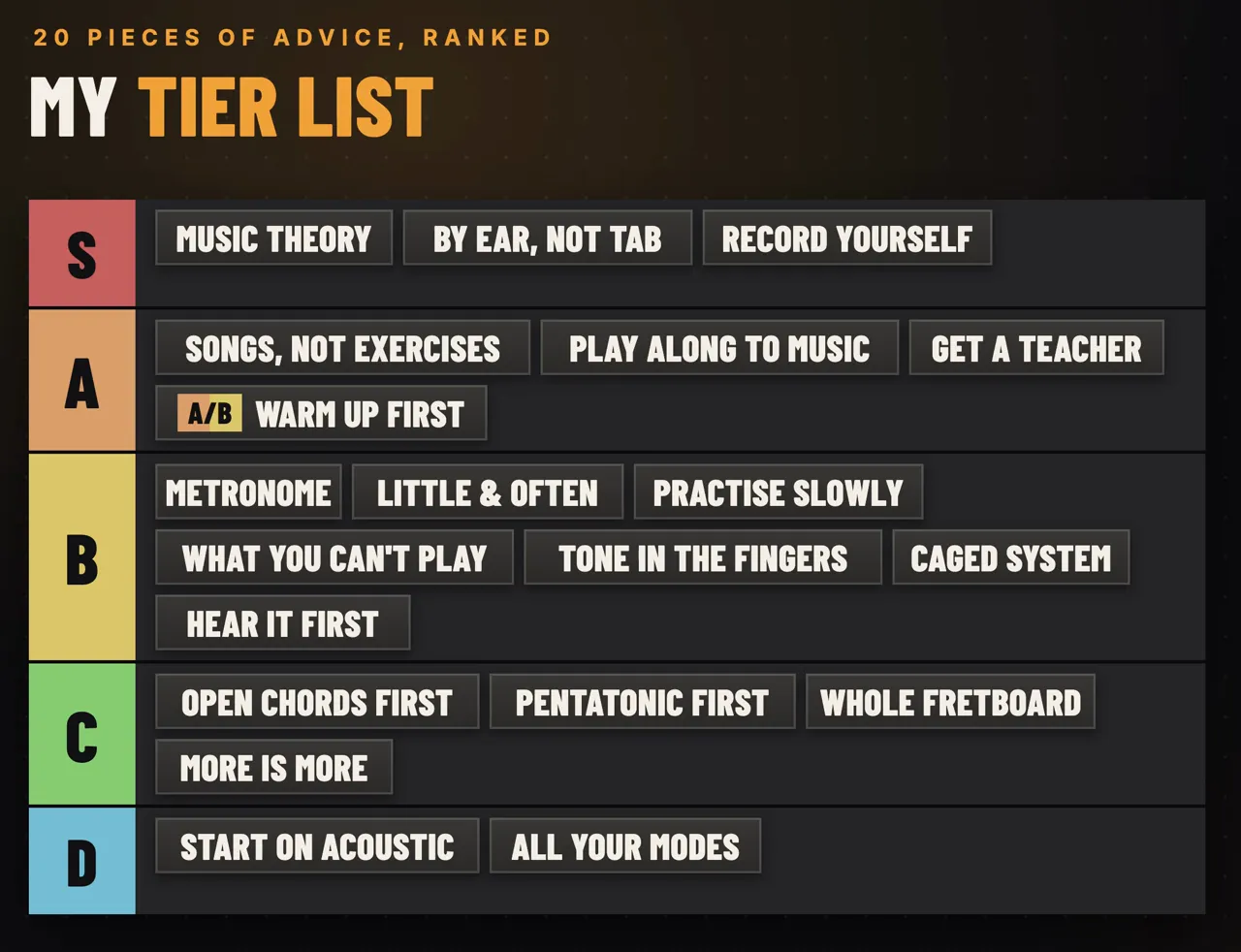
Below is each verdict with my reasoning, grouped by tier.
S tier: learn theory, learn by ear, record yourself ▶ 6:55
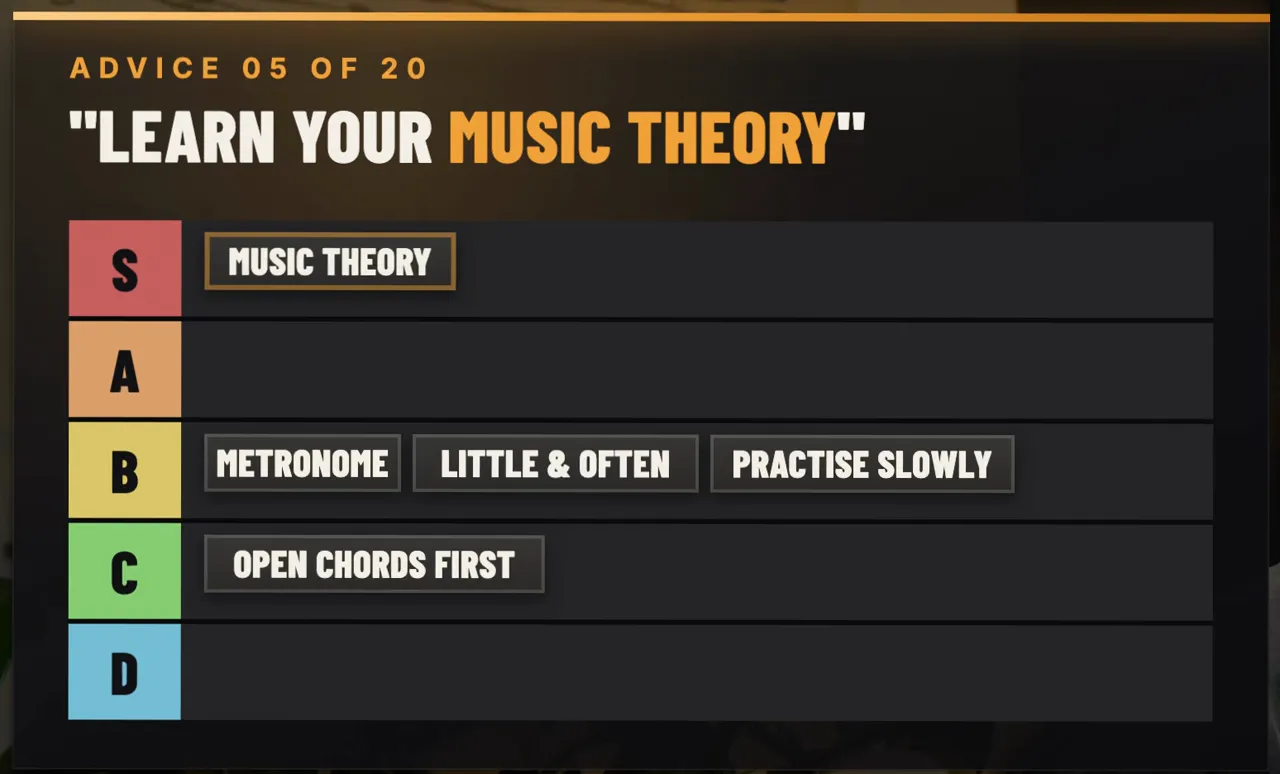
Learn your music theory. People who dismiss theory claim that you lose feel when you learn it. To me, music theory is to music what maths is to engineering: maths gives you the formulae to build a bridge, although if all you do is sums, no bridge gets built. Learning theory is like improving your vocabulary in a language, and I can't see why you wouldn't. After that, you have to work out how to speak it.
Learn it by ear, don't use tab. Learning by ear is S tier. It took me from being a guitarist to being a rounded musician. It is also difficult and slow to develop: I can play a note, a student can play the note one fret higher, which ought to sound awful against mine, and not notice. "Don't use tab" is too prescriptive. I use tabs I trust as the quick way to learn a song, because working everything out by ear would leave no time for my technique.
Record yourself. In the moment you are too busy thinking about what you are doing to know what is going wrong. Listen back and you realise that you weren't in time, or that a bend was flat. A related point: several of my students practise without the amplifier on, then play to me plugged in and discover that the mistakes and the string noise come through. Turn the amplifier on.
A tier: songs, playing along to music, a teacher, warming up ▶ 8:28
Learn songs, not exercises. I am assuming here that you want to learn songs. An exercise is usually a means to an end, and the songs themselves will inevitably contain things that challenge you. I used to avoid learning many songs because I thought it would make me sound like everyone else. The opposite is true: learn a wide enough range and you become an interesting blend of several artists.
Play along to backing tracks. I broadened this to playing along to music, whether a backing track or a song. Students who only noodle freely, with no track and no metronome, can lose their sense of rhythm.
Music doesn't exist in a vacuum, and neither does your soloing. It all exists in context.
It misses S tier because sometimes you need to turn the music off and simply practise.
Get a teacher. Since I teach for a living, S tier would have been disingenuous. As with recording yourself, nothing replaces an outside view: even a proactive self-starter veers off course slightly, and a good teacher nudges you back. A bad one nudges you the wrong way, and lessons are expensive.
Always warm up first. This gets a split verdict, A/B, because it depends on your time. With fifteen minutes, don't bother: just play. With an hour, I warm up for five minutes, and ten might be better, because the difference between how I play at minute zero and minute fifteen is substantial. Keep it physical and simple, enough to get the blood flowing.
B tier: metronomes, slow practice, CAGED, tone in the fingers ▶ 0:49
Practise with a metronome. This is worth doing if your timing needs work, but it grows stale and can kill your inspiration. One tip: many people set one click for every four sixteenth notes. Try one click for every note you play on the metronome. Often the real problem is consistency within each group of four, and a click on every note gives you a grid to play against.
Practise little and often. It depends how little. Five minutes achieves almost nothing, and the shortest useful session is probably fifteen, ten at a push. There is a start-up cost: it takes me at least fifteen minutes before my fingers move as they should. Half an hour or an hour every couple of days might let you get your teeth into something.
Practise slowly. This is very important when you are learning a part, because your subconscious can't take things in if you play too fast. It won't help you bring a song up to speed. If you want to play fast, you need to play fast.
Practise what you can't play. Always playing things you struggle with is demoralising, and a singer-songwriter may gain more from writing more interesting parts with what they can already do. There is a lot to be found in the pursuit, however. Students ask me for something easier, and a week later they are bored because they can already play it.
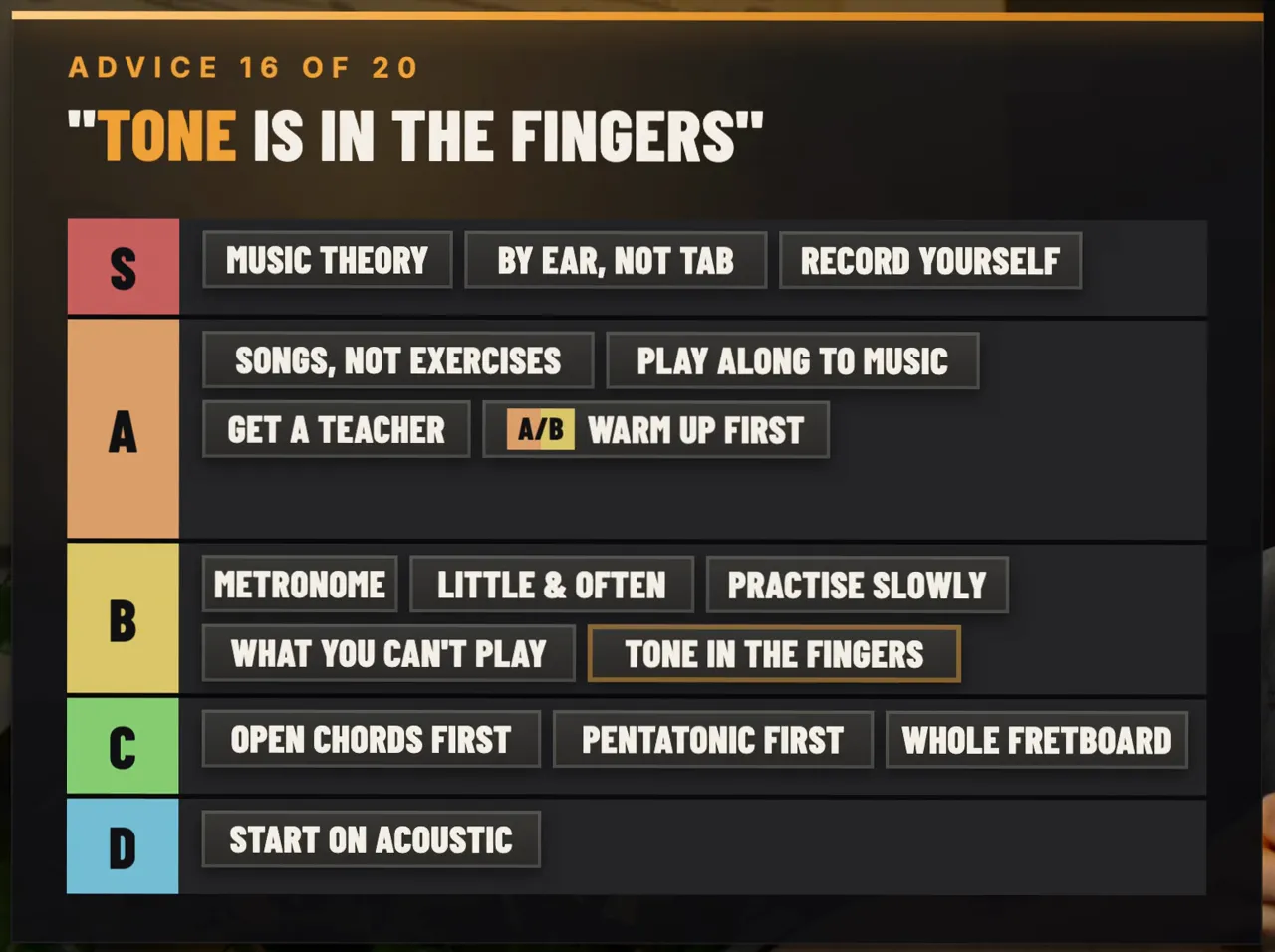
Tone is in the fingers. I gave this an A, then revised it to B. It is true up to a point: I was at a talk where Nuno Bettencourt described plugging into Van Halen's rig and being disappointed, because he just sounded like himself. Gear still matters. Students arrive with a dusty guitar from the attic, its old strings far above the fretboard, and I would sound bad on that too. You need an instrument that inspires you, which need not cost more than two or three hundred pounds.
Learn the CAGED system. As it is usually framed, you learn one chord, say C, in several places along the neck. Without the scale that sits around each shape, I'm not sure what use that is, although if CAGED makes sense to you, use it. I would sooner master one area first, such as position one of A minor at the 5th fret: look up the chords in the key of A minor, find their arpeggios and piece them together there. Ironically, you will absorb CAGED by osmosis as you branch out.
Hear it in your head before you play it. Many people would say S tier, and I think there is some snobbery around this one. Hearing a phrase before you play it is a real connection with the instrument, but if you have a brilliant ear and all it offers you is Hot Cross Buns, you won't sound interesting. Jump to a part of the neck without knowing which note you will hit. It may be a pleasant surprise or it may be rubbish.
C tier: open chords first, pentatonic first, the whole fretboard ▶ 4:09
Learn the open chords first. This is too prescriptive. For a blues improviser, open chords are among the last things to think about. One student of mine, interested only in blues improvisation, wanted them purely so as not to feel left out when talking guitar with his friends. It avoids D tier because open chords help your coordination and hand strength, and the more accessible ones let you play songs quickly.
Learn the pentatonic scale first. It is an easy scale, so not the worst place to begin. If you are learning theory, though, it isn't immediately compatible: there are seven notes in the key and you are playing five. The full natural minor scale corresponds more directly to the theory, and it trains the third and fourth fingers, where position one of A minor pentatonic leans heavily on the first.
Learn the whole fretboard. I think this is overstated as a goal. Most people want it for more options in their phrases, and you have enough options in one position. If you don't sound good there, you won't sound good anywhere else on the neck. It does help later: once you know how the scale positions connect, the songs you learn surprise you less and are easier to memorise.
More is more. This is Yngwie Malmsteen's famous line, by which he means more notes. Most of my students who improvise play too much, and I am always asking them to play exactly what they just played again. Imagine a song in which you heard the chorus only once. It stays out of D tier because a blast of shredding across the fretboard is fun.
D tier: start on acoustic, learn all your modes ▶ 16:42
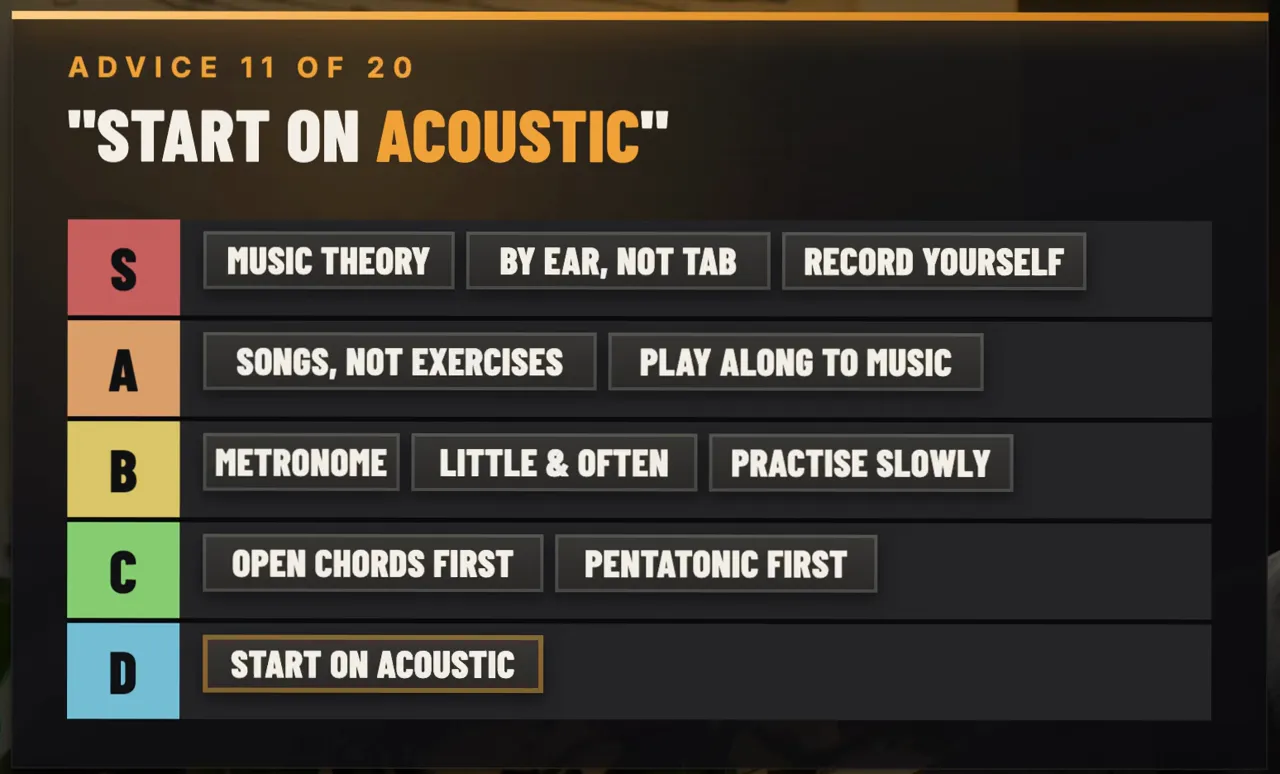
Start on acoustic. I think this is really bad advice. Start on whatever you want, but the acoustic is harder to play than the electric. A barre chord that won't come on the acoustic may come on an electric, perhaps because the strings are thinner and closer to the neck, and what you find transfers back. If acoustic is what you want to play, go down a string gauge from the 11s or 12s I think most come with. There is no pride to be had in thick strings.
Learn all your modes. Modes are useful and interesting. The D is a reaction to how guitarists treat them, as a silver bullet that will make you a brilliant player. In reality modes often sound a little odd, and there is a reason pop songs sit in the major or the minor key. Talking about music in general, I would put modes in upper C tier.
Before you follow any of them, mine included, decide what you want from the guitar, because that is what moves a piece of advice up or down the list. Then do the S tier job you can do today: plug in, turn the amplifier on, record yourself playing something you believe you know, and listen back for the timing and the bends.


