If your open chord changes still don't feel as efficient as you'd like, or you sense there's something you're missing when you move from one chord to another, this is for you. We're going to work through all 33 of the main diatonic changes you'll come across with open chords.
Diatonic simply means chords in the same key, so these are the common changes. The chords are A, A minor, B, B minor, C, D, D minor, E, E minor, F and G. We'll go alphabetically, and you'll notice the list shrinks as we go: by the time we've covered A, B, C and D, we've already dealt with every change to E. Every change works both ways, so reverse it to get back.
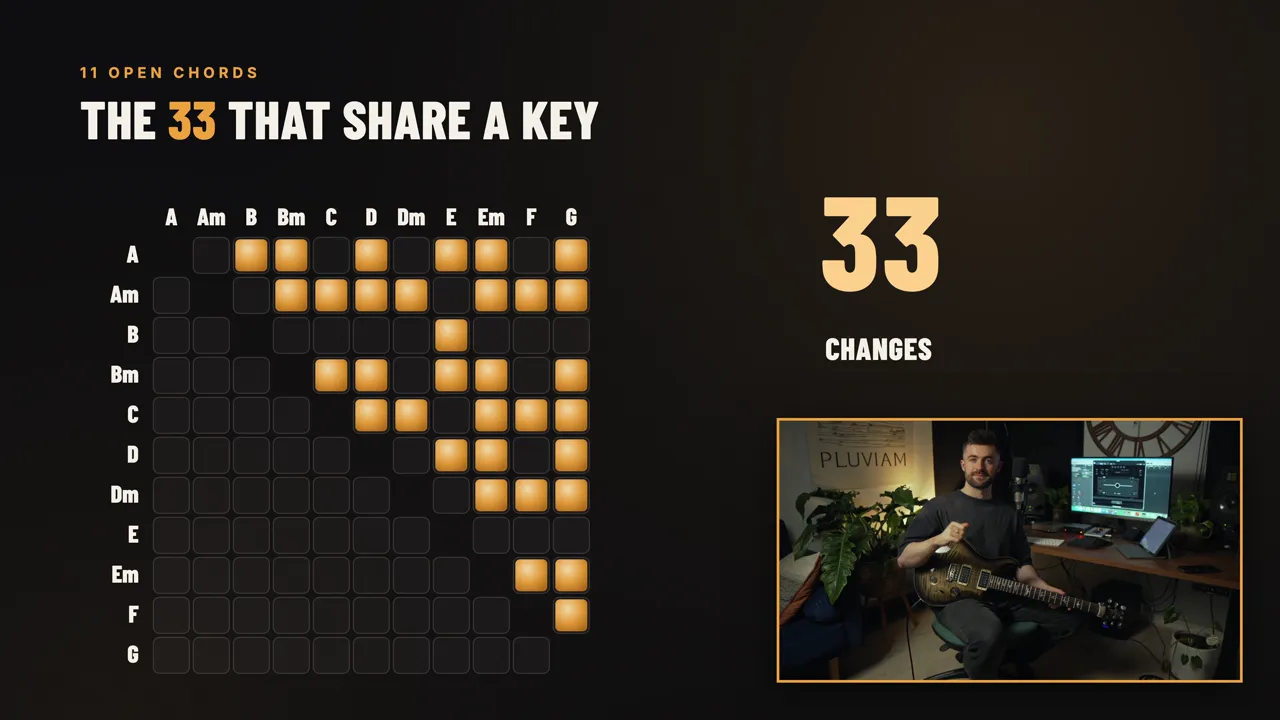
You don't have to read every one. If you work through the first few and how I think about them, you'll start to see the principles behind efficient changes, and then you can simply dip into the ones you need.
Four habits before you start ▶ 1:16
Practise your changes quickly. Many people practise them slowly and perfectly. You need to do that to make sure you can play the chords well, but if you're struggling to speed up your changes, you have to actually push the speed. Use a metronome, or let your right hand set the tempo: decide on "chord one, chord two" and that's the speed, ready or not.
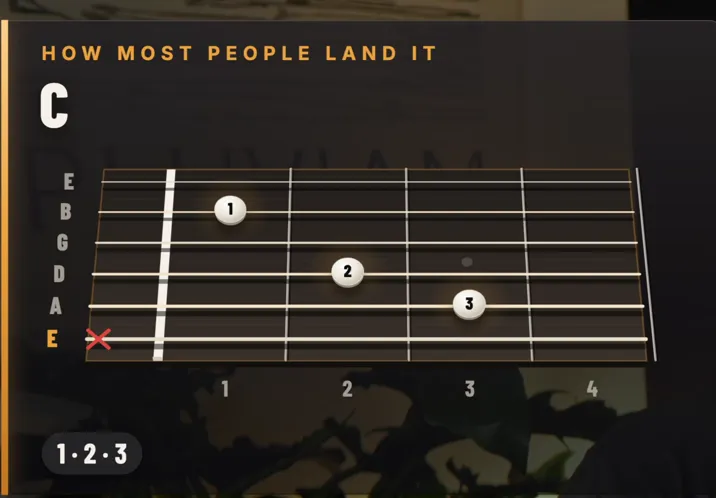
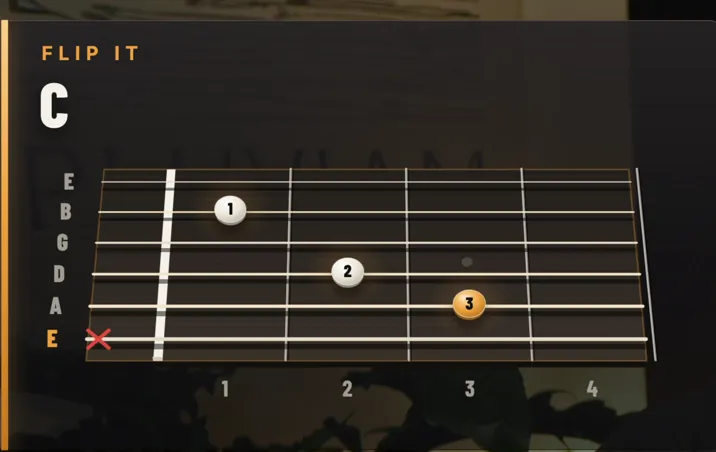
Flip the order your fingers land. With a C chord most people go one, two, three. Flip it and go three, two, one instead. That puts your brain to work on the weakest part of the change, and leading with the third finger also draws the hand in.
Keep your fingers arched. When I hold a C chord there's a definite bend in my fingers, particularly in the top third of each fingertip, which points directly at the string. The moment your fingers straighten too much, they get in the way of the other strings. Keep your palm close to the underside of the neck, but not glued to it, or you might mute the high e.
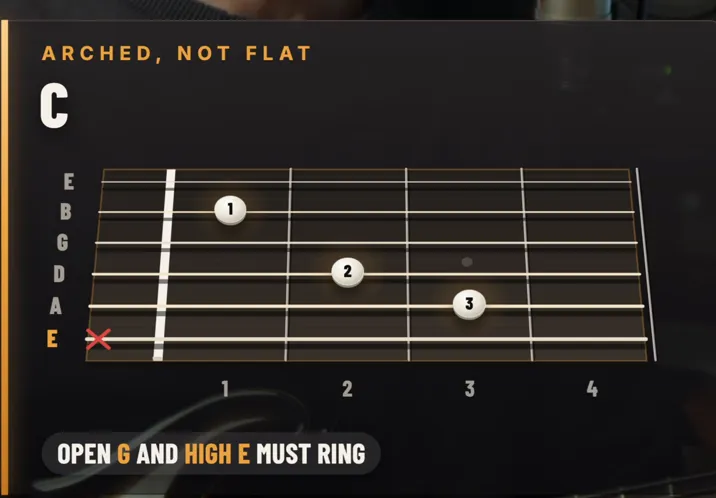
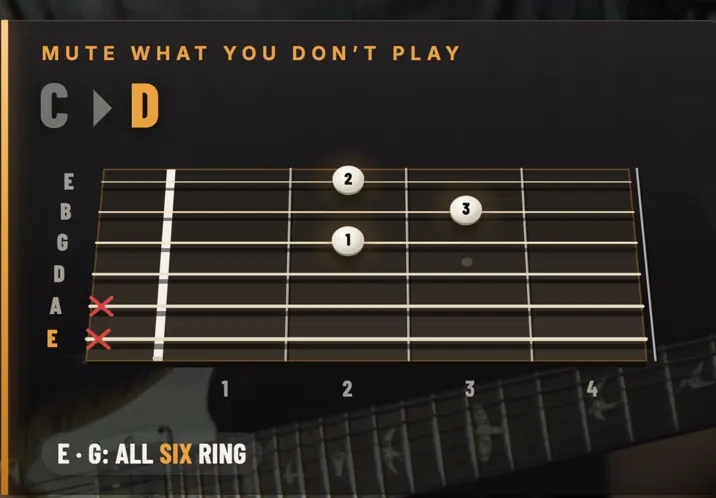
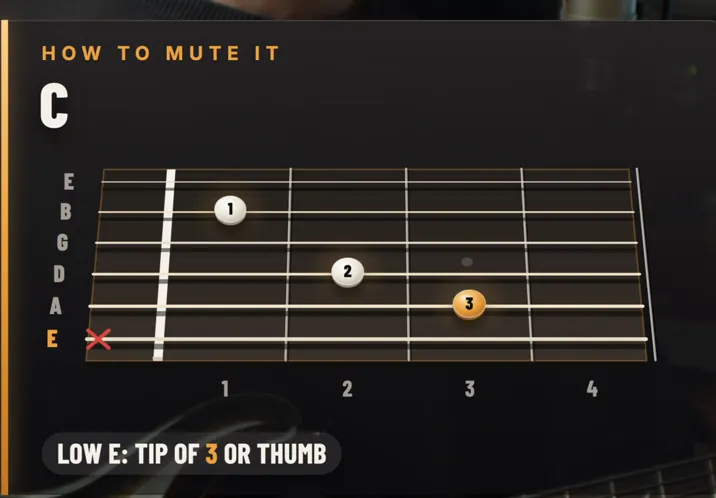
Mute what you don't play. With most chords you'll want to mute the low E, except for E, E minor and G. With D you need to mute both the low E and the A. You'll usually use the thumb for the low E, or the tip of a finger: on a C chord I might use the tip of my third finger, or simply the thumb.
Changes from A and A minor ▶ 3:05
A to B. If you barre the A across the 2nd fret, decide which finger, the third or the little finger, will barre the B chord, and keep it hovering over the 4th fret. Your first finger then simply hops up one string. I actually find the little finger more comfortable.
A to B minor. Not much is shared here. For any barre chord, lead with fingers two, three and four, ideally all together, then drop the first finger barre on afterwards. Keep the first finger close and let your wrist come round.
A to D. A friendlier one. Your third finger stays on the B string and moves up to the 3rd fret, and fingers one and two tuck in behind it.
A to E and A to E minor. Take your first finger off and move fingers two and three up two strings together. For E, drop the first finger back on at the 1st fret of the G string; for E minor, simply leave it off. Keep those two fingers glued together.
A to G. Keep the third finger on the B string, move it up one fret, tuck your little finger onto the 3rd fret of the high e, then form the two low notes of the G. Whichever version you use, everything should move towards the next chord rather than lifting off and being replaced.
A minor to C. One of the pleasant ones. Fingers one and two stay put, and the third finger moves from the 2nd fret of the G string to the 3rd fret of the A.
A minor to D. Little is shared, but your first and second fingers sit on either side of the third finger, and they swap round between the two chords. Focus on that swap and keep the movement small.
A minor to D minor. It looks like a big move, but it's essentially the same shape moved down one string, with the third finger shuffling across to the 3rd fret.
A minor to E minor. Take the first finger off; the other two stay locked together and move up. Keep your thumb out of the way of the low E.
A minor to F. They share the 1st fret on the B string, but if you simply roll the first finger down to catch the high e, you can lose pressure on the B. Annoyingly, then, I recommend a slight lift onto the flat of the finger. The second and third fingers also swap round.
A minor to G. It looks harder than it is. Ignore the third finger. The first and second fingers keep the same arrangement, with the first diagonally below the second, and the gap simply closes by one string. Then the third finger (or the little finger) goes on the high e.
This first-and-second-finger pattern recurs often, in C to G, D minor to G and F to G too.
Changes from B and B minor ▶ 12:07
B to E. Not much is shared, but if you barre the B with your third finger, that finger can more or less stay on the D string. Watch your thumb here. It drops a long way down the back of the neck for the major barre chord, and it needs to be adaptable. That applies to many barre chord changes.
B minor to C. Look at how your second and third fingers relate. That arrangement carries over to C, and the gap closes from two strings to one. Ideally the first finger pulls down and across onto the C rather than lifting right off.
B minor to D. There's a small cheat: take fingers three and four off and barre from the G to the high e with your first finger. In practice, I'd probably just play a normal D. Either way, the B minor without the little finger forms a triangle, and so does the D. You're looking for common shapes, not just shared notes.
B minor to E and E minor. They share the third finger on the D string. Take everything else off, move back two frets, and bring the other fingers back on. For E minor the first finger stays off.
B minor to G. They share the 2nd fret on the A string, played with your first finger. Keep it anchored and pivot around it.
Changes from C ▶ 15:53
C to D. Fingers two and three keep the same arrangement, one fret and one string apart. Take the first finger off, move the other two down, and bring the first finger over the top. Ideally it's one smooth motion rather than one, two, three.
C to D minor. Both chords are one finger per fret. Everything pulls down, just by different amounts: fingers one and two drop one string each, and the third drops to the B string.
C to E minor. Some people keep the second finger anchored and hold E minor with fingers one and two. That isn't wrong, and it's a handy cheat for beginners; I simply find E minor easy enough with two and three.
C to F. As with A minor to F, they share the 1st fret on the B string, but you should still lift the first finger slightly to get the pad on for the barre. Fingers two and three keep their arrangement and move down a string.
C to G. The same idea as A minor to G. Fingers one and two keep their arrangement, then the third finger (or the third and little fingers) drops on.
Changes from D, D minor, E minor and F ▶ 18:15
D to E. I rather like this one. The first finger stays on the G string and slides back a fret.
D to E minor. Not much is shared. You could argue it's easier with fingers one and two, which stay on the 2nd fret and simply move apart by a string.
D to G. One of the most common changes there is. Pivot on the third finger at the 3rd fret. If you play the G with the open B ringing, use your little finger on the high e, so the third finger comes off.
D minor to E minor. Use fingers two and three, not one and two, or the first finger has to jump across five strings.
D minor to F. Pivot on the shared note, the 2nd fret on the G string.
D minor to G. They share the 3rd fret on the B string, and the first and second fingers form that same arrangement again.
E minor to F. The third finger stays on the D string and slides up a fret.
E minor to G. If you hold E minor with fingers one and two, your first finger is already on the 2nd fret of the A string for the G.
F to G. Release the barre and the first and second fingers are in exactly the arrangement they need for G. When the third finger moves, send it downwards into the G rather than lifting it far away.
Bonus: three harmonic minor changes ▶ 22:21
A minor to E. That neoclassical sound. It's the same shape, one string apart. Keep the hand stable and don't let the first finger break away from the second and third.
D minor to A. The third finger stays on the B string and the second stays on the 2nd fret of the G. Only the first finger has to move.
E minor to B. Barre the B with your third finger and it stays on the D string as you return to E minor, with a slight adjustment.
Keep a closed hand ▶ 23:35
One tip I forgot to mention earlier: apart from the barre chords, my fingers, including the little finger, are almost always glued together and rarely lose contact. Everything is small and cagey (pun intended). That helps with stability and consistency, whereas spaced-out fingers wobble around and are hard to bring down together.
We're looking for common shapes here, not just shared notes and strings.
Choose the two or three changes that trip you up most, find what stays put or keeps its shape, and practise them at a speed that feels slightly too fast. If you want to check a shape, the Chord Finder has them all. Have a go.
Make it easier: start with one of the changes where a finger stays put, such as A minor to C or D to E, and let your right hand set a steady "chord one, chord two" tempo until the change lands every time.
Make it harder: take one of the changes with little in common, such as A to B minor, land the fingers in flipped order and push the metronome until the change is just beyond comfortable.


