Wouldn't it be great if, instead of relying on endless YouTube videos or hours of lessons to fix your playing, you had the tools to assess and improve your playing by yourself? That might sound unrealistic, but it's possible. It's the whole "give a man a fish" idea.
Think of whatever you're struggling with right now. It might be speed, creativity, string bending, theory, anything. If you've searched online for the answer, you're in the majority, and there are answers out there. But here's how to start working these things out for yourself.
The process: change one thing, measure, keep or bin it ▶ 0:56
It's very simple. You pick one variable in your playing, change it, and measure how that affects your playing. Then you keep it, bin it, or adapt it slightly, and next week or next month you try another variable.
That's basically the scientific method, but we don't need to call ourselves scientists. It's not that deep.
I think two things stop guitarists working like this, even if they've never put it into words. One is confidence: not knowing if they're wasting their time going down a dead end. The other is not knowing which variables to mess with. Let's deal with both.
Split your practice 80/20 ▶ 2:02
First, don't experiment all the time. If all you do is try new ways of playing, you never solidify the things you can already do.
So for starters, try something like an 80/20 split. Spend 80% of your time just practising what you're working on, and 20% trying something new. Maybe an hour or an hour and a half a week. It could be less, could be more, it's up to you. A practice log helps you keep track of what you tried and what happened.
Where to find variables to test ▶ 2:30
This is where, funnily enough, online lessons are really useful. Go on YouTube or Google, or ask a guitarist you know, and find one piece of advice that might work for your problem.
Say someone suggests angling your pick differently to pick faster. In your experiment time that week, try three angles: completely flat, slightly angled and very angled. Record how fast you can play a scale or a part you know with each, and note the tempo you reach on a metronome.
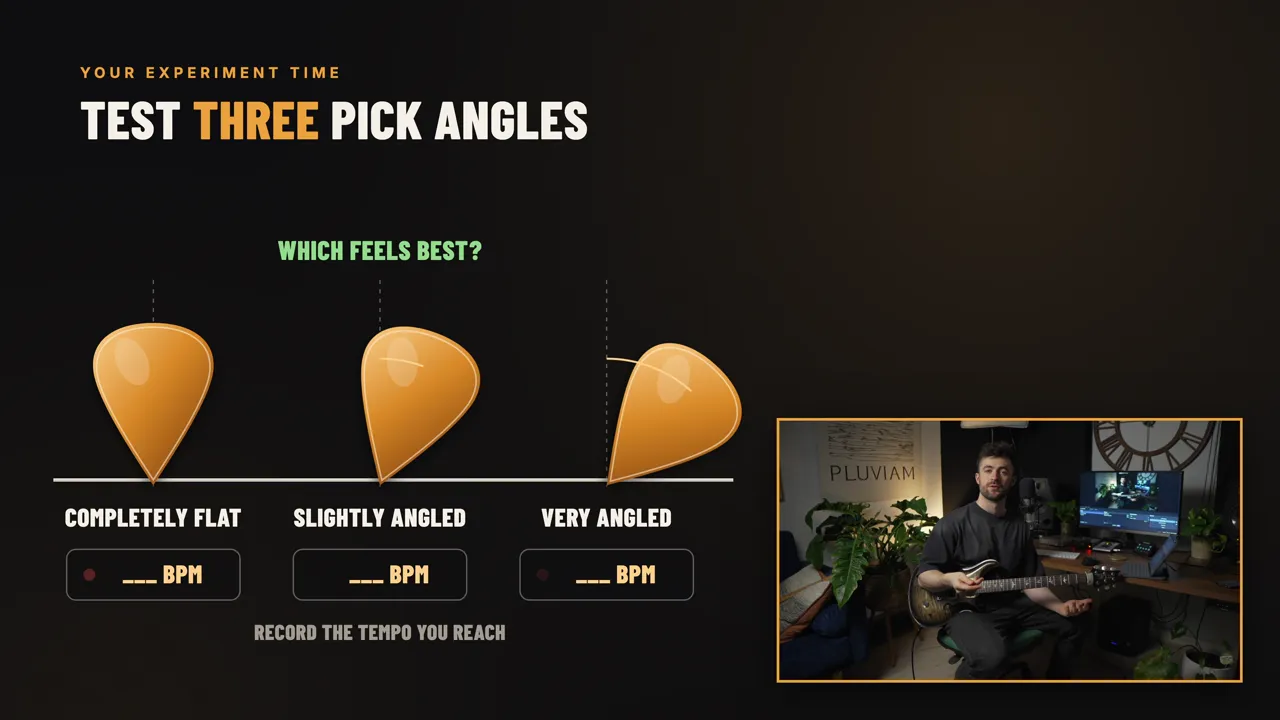
Do that for a week or two and you'll start to find preferences. You might even change other things without meaning to. You might change the pick angle and realise it was never the angle at all, it was your wrist, and the new angle just made your wrist move a bit differently. There are so many gains you won't find unless you're playful about how you operate.
You might not all be fans of AI, but tools like Claude and ChatGPT are actually quite good for this. Type in "I'm stuck, how might I play faster?" and you'll get a load of suggestions. They won't all be relevant, but they're things you can choose to test.
Isn't this a waste of time? ▶ 3:54
It might be. You could spend a week on something and it doesn't improve your playing at all. In the early stages you'll have to sacrifice a bit of efficiency to teach yourself how to teach yourself. And sometimes you'll get lucky and stumble on a lesson that's exactly what you needed at that moment. But you don't want to rely on luck.
The useful thing is that you get better at experimenting the more you experiment. The more ideas you play with, the better you get at spotting what you could change. It snowballs.
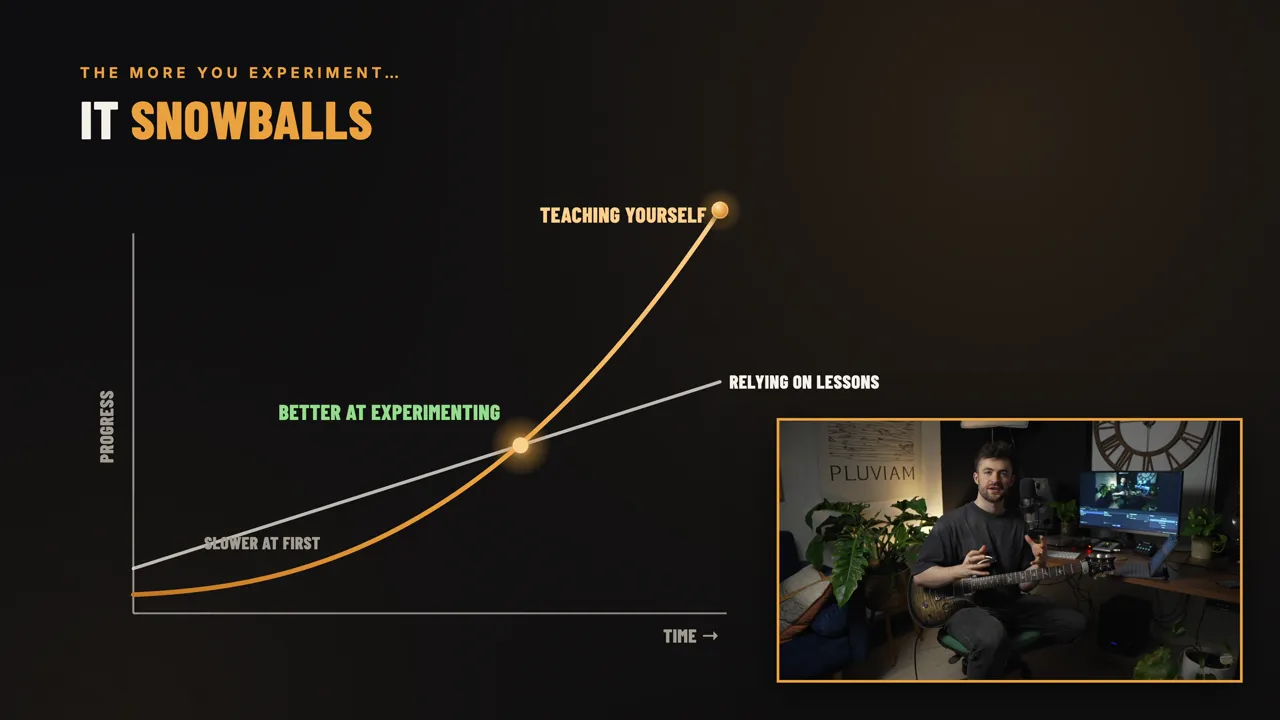
For example, I like writing songs, and I think I've got quite good at playing around with different chords, rhythms and ways of combining them, just by experimenting a lot. But I don't experiment all the time, otherwise all my songs would sound random and completely wacky.
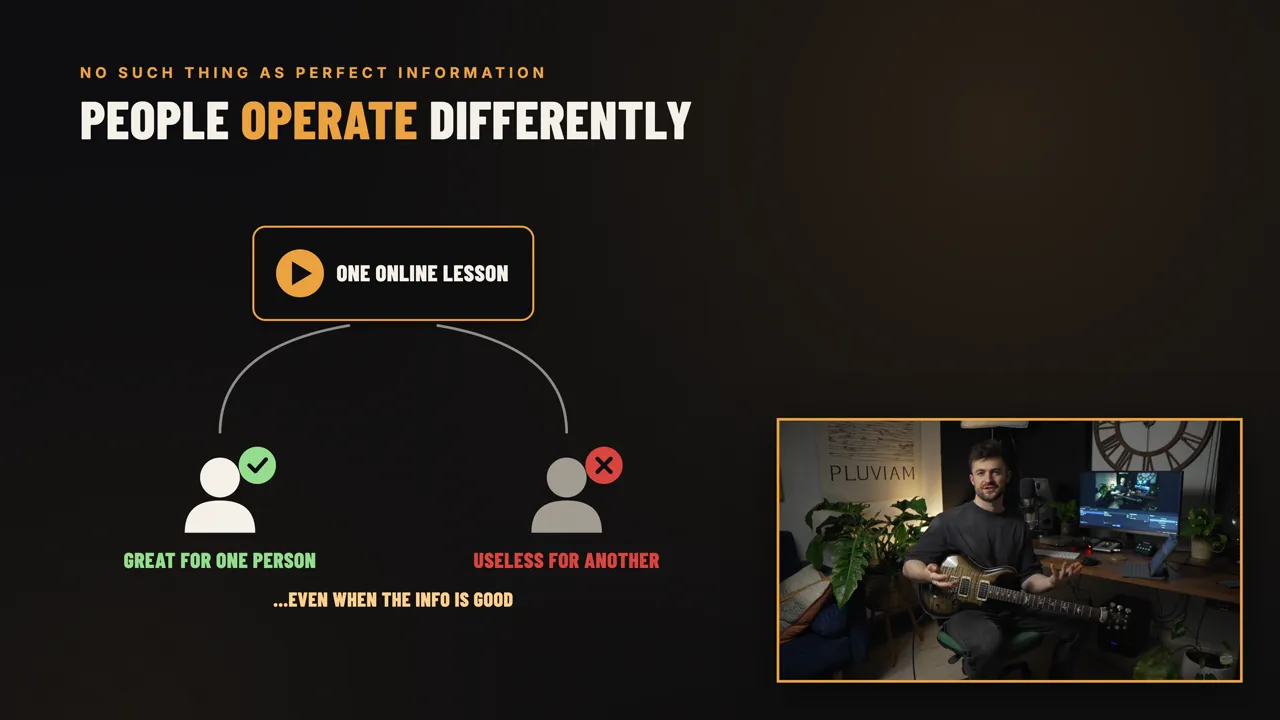
There's also no such thing as perfect information. Different people operate differently. One lesson online might be great for one person and useless for another, even if the information itself is actually good.
Variables to try: picking speed ▶ 5:24
Here's a list to get you thinking about your own playing.
- Pick attack: how hard are you hitting the strings?
- Economy or alternate picking?
- How much of the pick sticks out past your thumb? About a millimetre, or more?
- The angle of the pick.
- Picking from the wrist or the arm? Is the wrist turning side to side or moving up and down?
- String gauge.
- Playing in groups of three, four or five.
- Different scale positions.
- Cutting the left hand out entirely: mute the strings and just pick the pattern with the right hand.
Variables to try: fretting hand accuracy ▶ 6:10
- Your wrist angle: pushed forward or brought right back.
- Your thumb position, both up and down the neck and left to right.
- How curled your fingers are. Right on the fingertips, or slightly on the pads?
- One finger per fret, or just fingers one, two and three for a particular part?
- How relaxed you are, and how hard you're pressing each note.
- Time spent on plain left hand strength and coordination exercises.
- Scales only, or more creative, musical exercises too?
Variables to try: stale improvising and strumming ▶ 6:50
If your improvising feels stale:
- Restrict yourself to one part of the fretboard, or do the opposite and break out of it.
- Vary your pick dynamics so your phrases change in volume.
- Sustain notes for longer, or make your phrases shorter or longer.
- Use more repetition.
- Leave out a string entirely and see how it changes what you play.
- Target chord tones.
- Take an arpeggio and add another note to see how it changes the sound.
If you're strumming a basic open chord song:
- Do your chord changes really quickly, just to challenge yourself.
- Change how far your arm sweeps across the strings to change the tone.
- Try different pick thicknesses.
- Play it to a metronome.
Where teachers and videos still fit ▶ 7:42
There's still room for a teacher or YouTube in all this. What they do is make the feedback loop a lot faster, because they point you in the right direction. In theory you could work out all of music on the guitar through this process with no videos and no prior knowledge. It would just take you a very long time.
So this doesn't mean stop learning or stop trusting teachers. It means take what they teach you and experiment with it. If someone tells you definitively that something works and something doesn't, they're not necessarily wrong, but make sure you trust them before you take it to heart.
Here's your homework. For the next week or two, pick one variable, two at most, and see what changes when you start to play with it.