Pinch harmonics are a rite of passage for every metal player. If you haven't sat in a dark room for hours on end trying to get that squeal, are you even a metal guitarist? Yet plenty of players get one every now and then without being able to say why. Here's how to actually produce them, and how to produce them consistently, one step at a time.
In short: set your guitar up so the harmonic has every chance of coming through, hold the pick so your thumb can't miss the string, learn the two motions separately, then find the spot that works on your guitar. That last step is the important one, and it's different for everyone.
Set up your tone first ▶ 0:51
Before you work on the technique, give yourself as much help as you can. Turn your gain right up. If you're using a guitar VST, turn the input gain up as well, and you can even put a compressor pedal in front.
If your gain is too low, or even just sensibly low, you won't get the feedback you need. Sometimes a hint of the harmonic is all you need to know you're on the right lines, and plenty of overdrive helps you hear that hint.
A few more things help:
- The bridge pickup, ideally a humbucker.
- Fresh strings. Mine weren't fresh when I filmed this, so it can be done on dead strings, but it's harder.
- Slightly boosted mids on your amp or plugin.
Start on the D or G string ▶ 1:38
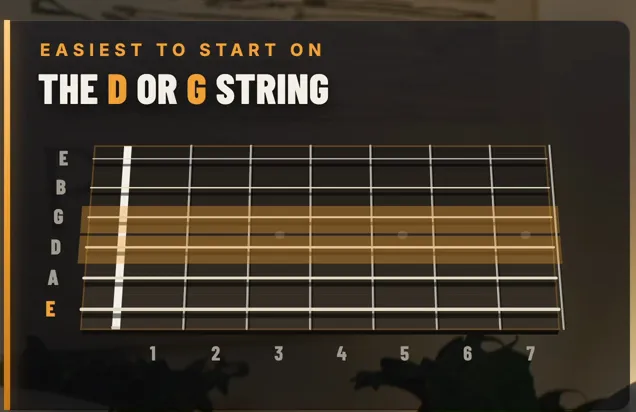
Try the middle two strings to begin with. I think the D and G strings are the easiest ones for pinch harmonics.
Have barely any pick showing ▶ 1:50
This part is the grip. I play with one to two millimetres of pick protruding between my thumb and finger. Any more than that and you'll really struggle. You can go further still and have so little of the pick showing that your thumb brushes the string every time you play. You might even start producing pinch harmonics by accident, simply because of how you're holding the pick.
Beyond that, I don't think pick choice matters much. A slightly pointier pick might help, and picking at a slight angle makes things a little easier.
The wrist motion ▶ 2:27
Think, roughly, of casting a fishing line. As you pick the note, tilt the wrist downwards, rather as if you were about to shake someone's hand. Most of the time when you pick, your hand is turned the other way, so this is the part to notice: for a pinch harmonic, turn the wrist inwards as you pick.
Dig in, but not too much ▶ 2:57
You also need to dig in slightly. If all you're getting is the normal note, you aren't digging in enough. If the note dies and you lose the harmonic, you're digging in too much, so ease off from there until it comes through.
Pick, then touch ▶ 3:13
Here's what's actually happening. The pick passes through the string and plays it as normal, then the thumb just glances the string, which lets a higher-pitched harmonic ring out. That means you can practise the two as separate steps.
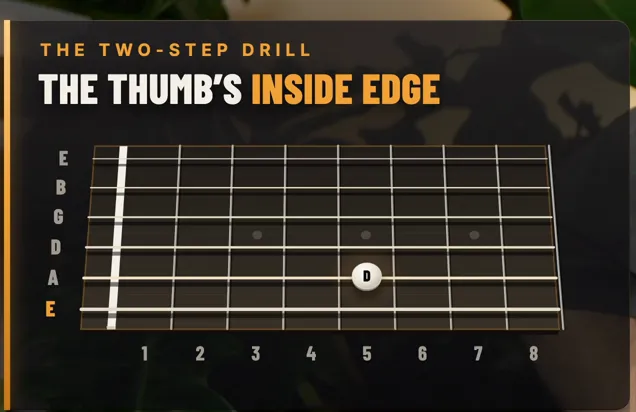
Fret the 5th fret of the A string. Pick it, then touch the string very gently with the inside of your picking-hand thumb. You should hear a hint of a harmonic at the end of the note. Then move your hand along the string and do it again. You'll hear slightly different sounds at different points as the string starts to deaden. Try it on the D string too.
Find your own spot on the string ▶ 4:22
It's important to experiment with where along the string you place the pinch harmonic. It catches more easily in different places on different guitars and for different players, and factors such as scale length make a difference. There's no fixed spot I can give you, so find where on the string the harmonic comes most easily, and use that.
Find the best fret ▶ 4:42
The other thing to experiment with is which fret you're holding down. There's some science, and there are measurements you could apply here, but realistically you aren't going to measure centimetres while you play. Be more intuitive about it. Find a spot where you can just about get a harmonic to ring out, then keep your thumb and pick there and try the same thing on different frets. See where it comes through most easily.

On my guitar, the 9th fret of the D string rang out best. Yours might be different, and that's the point.
Bring the two motions together ▶ 5:38
Once you've found the string, the fret and the part of the string that rings out best, combine the pick and the touch. At first it will still feel like two movements: pick, touch. As you merge them into one, you start to hear that pinch harmonic sound.
A quick note: turn off any noise gate. I forgot about mine while filming, and it was killing my pinch harmonics.
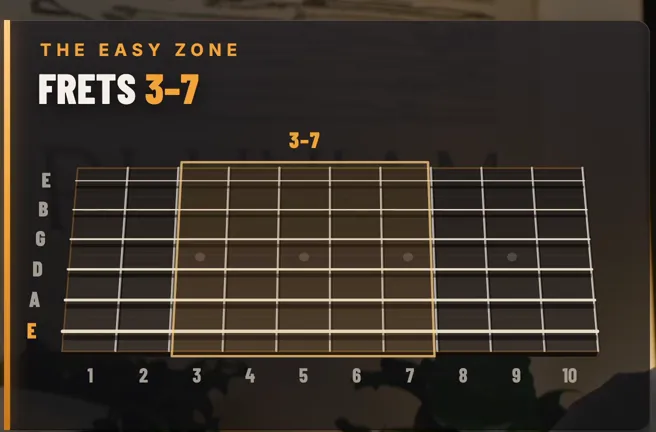
Personally, I find them easiest to catch around the 3rd to 7th fret. I combine the wrist motion with angling the pick slightly outwards as I strike the string, so that the thumb can brush through.
Moving towards the neck ▶ 6:49
If you move your picking hand further along the string towards the neck, you get more pronounced, squealier harmonics. They're harder to catch, so it depends on the sound you want.
Go and experiment
The main point to take away is that pinch harmonics are a matter of feel, and that feel is personal to your hands, your guitar and your setup. Keep changing the angle of your wrist and how far you extend it when you pick, and keep moving along the string and across the frets until you find your spot. Start with the pick-then-touch drill on the D or G string, then bring the motions together.
It's such an intuitive thing, that feeling of the thumb just brushing through the string.
Make it easier: stay with the two separate steps, pick and then touch, on the 5th fret of the A string, until you hear the harmonic at the end of the note every time.
Make it harder: once the harmonic comes reliably on your best fret, move your picking hand towards the neck for the squealier harmonics, and try catching them on frets outside the 3rd to 7th.


